




When Does Welding Automation Make Financial Sense by Production Volume?
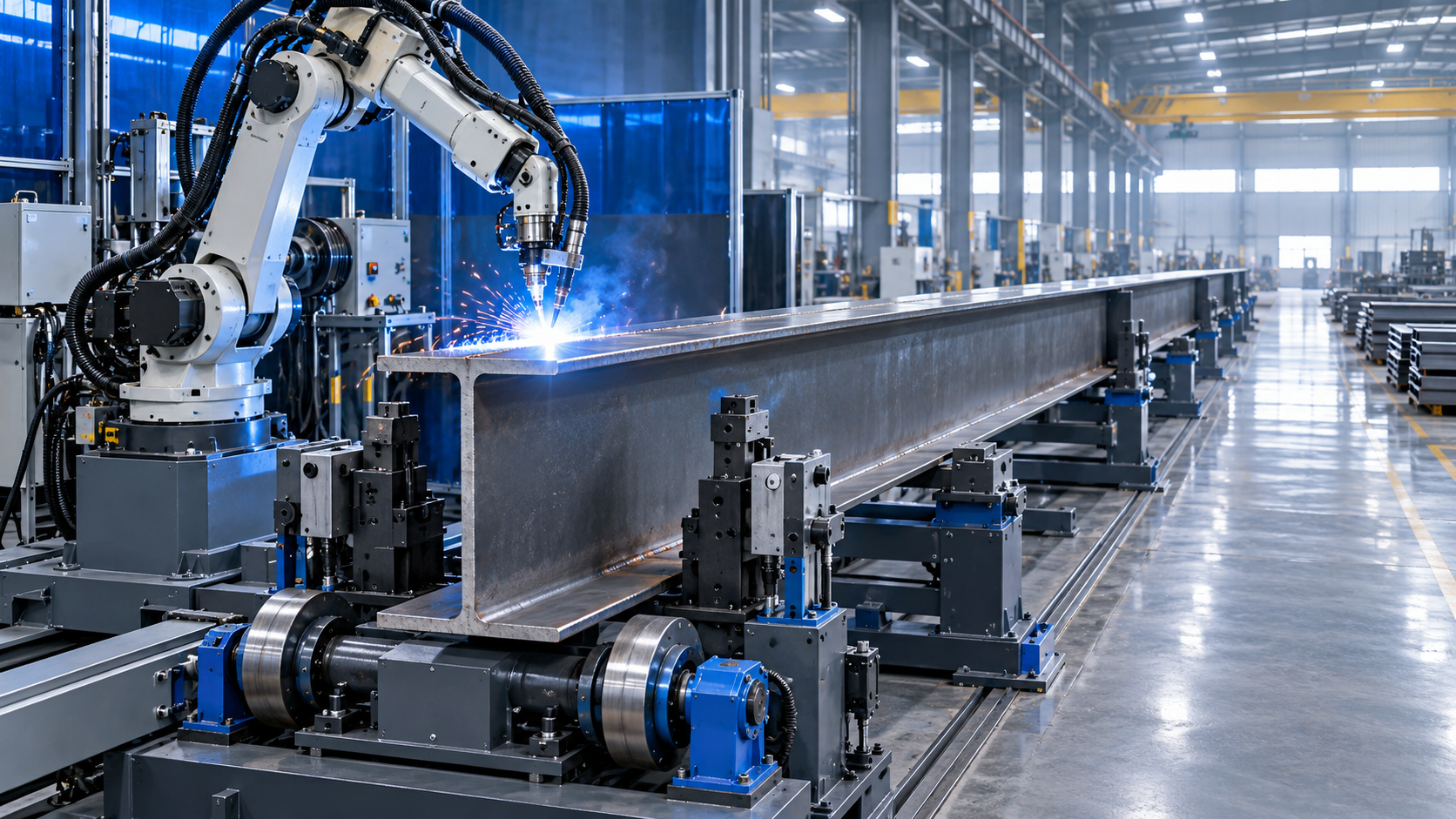
Welding automation makes financial sense when the value of repeatable arc-on time, reduced rework, and more predictable throughput exceeds the annual cost of the cell—not simply when a shop reaches a particular number of parts per month. A fabrication business producing a few hundred nearly identical assemblies can justify automation sooner than a shop producing several thousand highly variable pieces with inconsistent fit-up.
For steel fabrication, the most useful question is not “How many tons do we weld?” but “How many hours of stable, programmable welding work recur on parts that can be positioned reliably?” Volume matters because it spreads engineering, fixturing, programming, and equipment costs across more welds. But repeatability, part family design, shift utilization, and quality requirements determine whether that volume can actually be automated profitably.
What production volume justifies buying a welding robot?
There is no universal output threshold. A robot is justified by the annual volume of repeatable weld content, rather than by the total number of fabricated parts. A shop may have high overall volume but little suitable robotic work if every job requires manual fitting, frequent drawing interpretation, variable joint access, or changing tack locations.
A practical assessment starts with annual manual welding hours for a defined part family. The relevant hours are those spent depositing weld metal and performing directly related repetitive work, not all labor recorded under a welding department. Break the estimate into:
- arc-on time;
- part loading and unloading;
- positioning or rotation time;
- tack-weld and fit-up correction time;
- grinding, spatter removal, and rework caused by inconsistency;
- inspection and repair work associated with weld defects.
If one family of brackets, frames, beams, stiffened plates, or structural modules consumes a substantial and recurring share of these hours, a dedicated or flexible robotic cell may be commercially rational. If the same labor is dispersed among hundreds of one-off items, automation may be technically possible but financially weak.
The important distinction is between volume of parts and volume of repeated weld paths. Fifty large H-beams with identical flange widths, web heights, stiffener layouts, and weld specifications may contain more automatable work than 500 fabricated items that all differ in dimensions and joint details.
The financial model should begin with avoided cost, not robot speed
A welding robot can travel quickly and maintain a stable welding procedure, but cell economics are not determined by travel speed alone. The financial case depends on how much manual work is genuinely displaced and whether the robot creates usable capacity at the bottleneck.
A basic annual comparison can be expressed as:
Annual economic benefit = labor capacity released + reduced rework and consumables loss + contribution from additional output − annualized cell cost − added operating cost.
Annualized cell cost includes more than the robot arm. Depending on the application, it may include a power source, wire feeder, torch package, safety guarding, positioners or roller beds, part handling equipment, fume extraction changes, fixtures, software, installation, programming, staff training, maintenance, and spare consumables. Financing cost and floor-space implications can also matter where factory space is constrained.
The “labor capacity released” line needs careful treatment. Replacing a welder’s task does not automatically create a cash saving. If welders remain employed and their available time cannot be redeployed to revenue-producing work, the benefit is lower. The case is stronger when automation relieves persistent overtime, reduces reliance on difficult-to-fill skilled positions, prevents subcontracting, or allows existing staff to complete work that otherwise delays shipment.
Likewise, an output gain has value only when there is demand, downstream cutting and assembly capacity, and enough material flow to keep the cell productive. A robot sitting idle between short jobs cannot recover its fixed cost through theoretical cycle-time savings.
How repeatability changes the break-even point
Repeatability lowers the cost of every automated part. The same cell becomes more economical when parts arrive with controlled dimensions, predictable joint geometry, and consistent locations for weld starts and stops. This is why production volume cannot be separated from upstream fabrication discipline.
Laser or CNC cutting, controlled drilling, accurate plate preparation, standardized cope details, and repeatable fit-up all improve robotic suitability. They reduce the need for an operator to intervene when a joint is offset, a gap is excessive, or an attachment arrives outside expected tolerance. If these conditions are absent, the robot may spend too much time waiting for correction, and a skilled manual welder may remain faster in practice.
For a recurring fabrication family, the cost of a fixture and program is usually incurred before the first production run. The larger the repeat order, the smaller that initial engineering cost becomes per unit. However, this does not mean that every low-volume item should remain manual. Flexible systems using coordinated positioners, offline programming, vision, touch sensing, or laser seam tracking can reduce changeover effort. They do not eliminate the need for good part preparation, reliable datum strategy, and qualified welding procedures.
Is robotic welding suitable for small-batch fabrication?
Small-batch fabrication can be suitable, but the answer depends on how “small batch” is defined. A batch of ten units may work well if each unit carries long, repeated fillet welds and uses the same fixture, joint design, and program as future orders. A batch of fifty may be unsuitable if every assembly is a new design requiring manual locating and extensive program development.
The most favorable low-volume situation is not necessarily a large lot size. It is a stable family of products with reusable logic: common profiles, repeatable connection details, standard material grades and thickness ranges, and a fixture strategy that accommodates dimensional variants without being rebuilt for every order.
High-mix work becomes more feasible when the shop has already standardized its fabrication process. Modular fixtures, programmable roller supports, parameter-driven programs, and parts identified through a reliable production data system can reduce non-welding time. Yet each added layer of flexibility has a cost. Seam tracking and adaptive programming are valuable where variability is controlled but unavoidable; they are not an economical substitute for poor assembly quality.
A common mistake is to compare manual arc time with robotic arc time while ignoring setup. In short runs, loading, clamping, datum confirmation, program selection, dry-run verification, and first-piece inspection can dominate total cycle time. The correct comparison is total labor and elapsed time per accepted part, including preparation and quality recovery.
Can a welding robot handle variable H-beam sizes?
Yes, but variable H-beam sizes require a cell designed around the range of variation rather than a robot selected only for reach. The practical limits depend on beam length, flange width, web depth, section weight, weld locations, tack condition, access around attachments, and the method used to support and rotate the workpiece.
For longitudinal welds on steel beams, the handling system is often as important as the welding robot. Roller beds, turning rolls, manipulators, or coordinated positioners can present the weld in a favorable orientation and reduce the need for the robot to make difficult out-of-position welds. The ability to rotate the beam can improve deposition stability, visibility for sensing, and access to both sides of a joint.
Variable dimensions introduce several engineering questions:
- Can the rollers or positioners support the full weight and center-of-gravity range safely?
- Can the system locate the web and flanges from consistent reference surfaces?
- Will the torch reach welds near stiffeners, end plates, diaphragms, or other obstructions?
- Are joint positions sufficiently predictable for fixed programming, or is seam finding required?
- Can the fixture and safety envelope accommodate the longest and widest beam without sacrificing access to smaller workpieces?
- Will deformation during welding alter the seam location beyond the sensing system’s effective correction range?
Variable H-beam automation is therefore less about whether a robot can physically move along a beam and more about whether the fabrication process supplies a stable geometric reference. A system may accommodate a stated dimensional range yet still perform poorly if beams arrive bowed, attachments are tacked inconsistently, or joint gaps vary beyond the qualified procedure’s tolerance.
Can a welding robot improve consistency in steel structure welding?
Robotic welding can improve consistency when the joint is presented consistently and the welding procedure has been properly established. It can repeat torch angle, travel speed, wire feed conditions, weaving pattern, start and stop sequences, and programmed interpass behavior more consistently than a process dependent on individual operator technique.
That benefit matters in steel structures because weld quality is not limited to bead appearance. Required performance may depend on weld size, fusion, penetration where specified, profile, discontinuity control, distortion management, and traceability of the applicable welding procedure. Automation can support these controls, but it does not independently guarantee compliance with project specifications or applicable codes.
Incorrect fit-up remains incorrect fit-up when welded by a robot. A robot cannot make an oversized root opening, contaminated surface, inaccessible joint, or unsuitable weld preparation disappear. It may deposit a visually uniform weld over a condition that still requires engineering review or repair. Robust quality planning therefore needs incoming material checks, fit-up verification, fixture control, procedure qualification where required, and inspection methods appropriate to the contract.
For cross-border supply, this distinction is particularly important. Buyers may ask about ISO 9001 systems, CE-related machinery conformity where relevant, welding procedure documentation, welder or welding operator qualifications, traceability, and inspection records. These are separate obligations from purchasing an automated machine. The cell should be evaluated for its ability to integrate with the required documentation and quality-control process, not treated as a substitute for it.
Where automation often fails to make financial sense
The least convincing business cases are often built around highly visible labor savings while overlooking operational constraints. Automation is difficult to justify when the work is dominated by repair, custom fitting, constantly changing designs, very short weld lengths, or parts that require frequent manual manipulation. It is also weak when orders are too intermittent to sustain utilization or when upstream cutting and assembly cannot feed the cell reliably.
Another problem arises when management purchases a robot to solve a welding labor shortage but leaves bottlenecks untouched. If fitters cannot prepare assemblies at the required pace, material is unavailable, drawings change after release, or inspection queues delay completion, the welding cell will not achieve its expected output. The investment may still have strategic value, but its return should not be calculated as though welding alone determines delivery performance.
Automation can also create a concentration risk. A manual welding department may absorb workload changes across several stations and workers. A single large robotic cell can become a critical production point. Preventive maintenance, torch cleaning, spare parts planning, backup programming capability, and trained operators should be included in the investment decision.
How to evaluate the decision before committing capital
A credible evaluation uses representative production data rather than nominal machine capacity. Select a part family that reflects the work expected to occupy the cell, then map the route from cut material to accepted weldment. Record actual weld lengths, joint types, material thicknesses, handling needs, fit-up variation, present labor content, repair history, and order frequency. Separate recurring products from exceptional jobs.
The proposed cell should then be assessed against the complete operating cycle: loading, locating, clamping, welding, rotation, unloading, inspection, and changeover. The key output is not a promotional cycle-time figure. It is the expected number of accepted parts per available shift, with realistic allowances for setup, program confirmation, routine maintenance, and normal production variation.
Three scenarios are useful: a conservative case based on current order patterns; an expected case based on validated recurring work; and a stress case where utilization drops or mix increases. If the economics work only under uninterrupted, ideal utilization, the investment is fragile. If the case remains acceptable with normal variation and the equipment can be reassigned across related product families, the decision is more resilient.
Welding automation is financially justified when a shop has enough recurring, controllable weld work to keep a properly engineered cell productive, while converting released labor and improved quality into measurable business value. Production volume is the visible indicator, but repeatability is the real economic engine. For steel fabricators handling variable H-beams or small batches, the decisive issue is whether part variation has been designed and managed well enough for the robot to work as a production system rather than as an expensive demonstration of capability.
search
Products Navigation
Send Us A Message