




Can an automatic plate rolling machine reduce variation between operators?
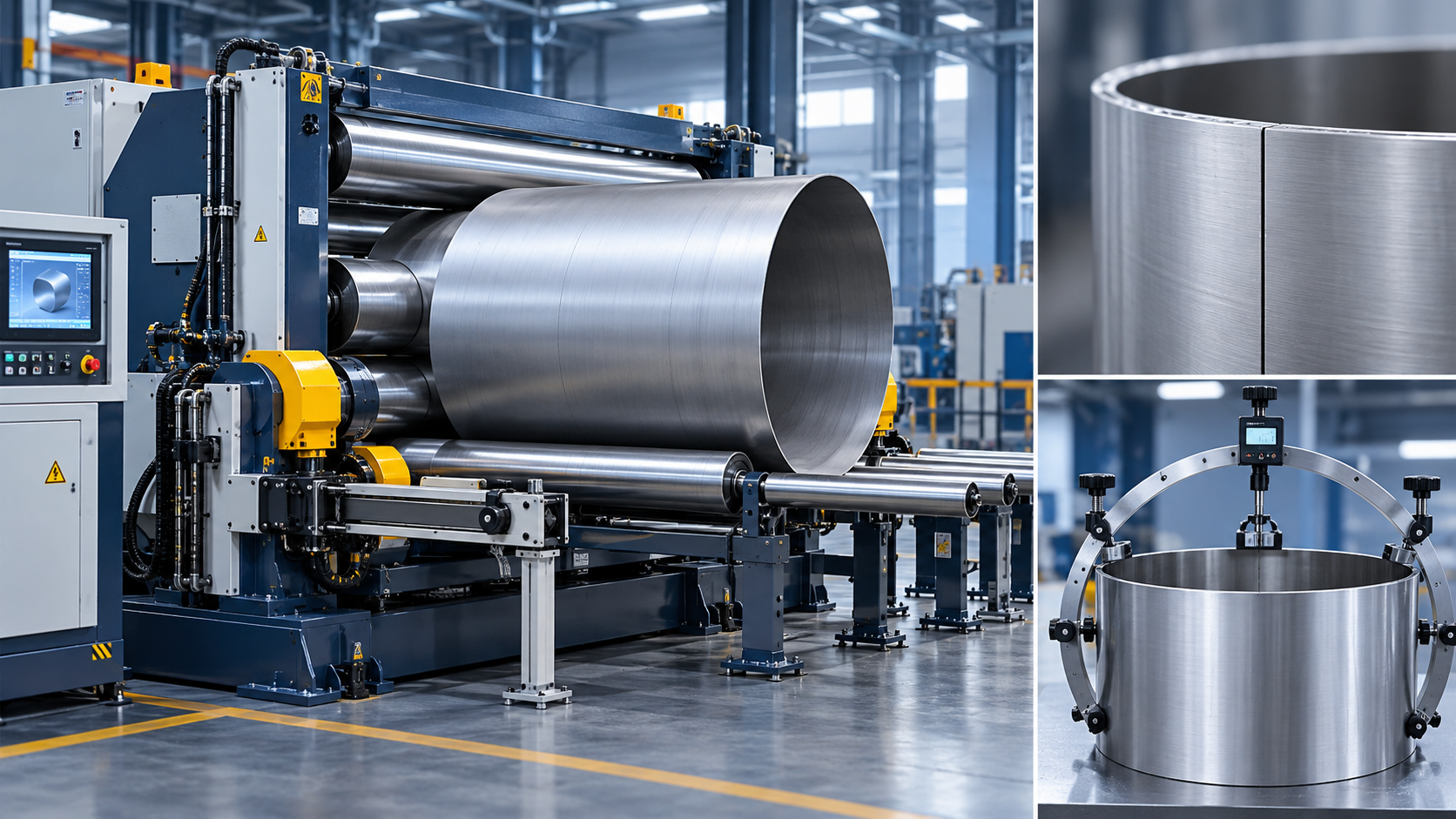
Yes. An automatic plate rolling machine can materially reduce variation between operators, provided that the machine is set up around controlled material data, verified tooling condition, and a defined inspection method. Automation does not remove every source of variation from plate rolling, because plate properties, handling, and part geometry still affect the result. It does, however, replace many judgement-based adjustments with repeatable motion, stored parameters, and measurable correction routines.
The greatest improvement is usually seen in repeated work: shells, cylinders, cones, and curved sections made from the same material grade, thickness, width, and developed length. Where manual rolling relies on an operator's feel for pressure, feed position, and the number of passes, an automatic cycle can apply the same roll positions and sequence each time. That creates a more stable process across shifts and reduces the tendency to compensate differently for the same visible condition.
Where operator variation enters the rolling process
A rolled plate is affected before the final pass is complete. Material is loaded, squared against the rolls, pre-bent at each edge, progressively formed, checked, and sometimes re-rolled. Small differences at any of these points can become visible as an out-of-round shell, a tapered cylinder, an offset seam, or flat ends that require extra fitting work.
On a manually adjusted machine, two experienced operators may choose different roll penetration values after seeing the first curvature. One may make several light passes to approach the target radius; another may use fewer, deeper passes. Either method can produce an acceptable part, but the residual stress pattern and springback can differ. When the component is later fitted, welded, or machined, those differences may appear as seam mismatch, unequal gap, or changing roundness along the length.
Automatic control narrows this decision range by defining a rolling recipe. A recipe can include upper-roll and side-roll positions, pre-bending sequence, rolling direction, pass count, feed speed, and correction passes. Once validated for a defined job, the same sequence is recalled rather than reconstructed from memory. This is especially useful when short production runs return after several weeks or when parts move between work shifts.
Repeatability begins with correct input data
Programmable movement is only as reliable as the information used to create the program. Plate thickness is often treated as a simple nominal value, yet actual thickness, coating, mill tolerance, and local flatness can alter the force needed to reach a radius. A recipe developed on one batch of material should not automatically be assumed suitable for another batch with a different yield behavior, even when the nominal grade and thickness appear identical.
Material direction also deserves attention. Rolled plate may bend differently relative to the rolling direction, particularly where the job has a tight radius or a high width-to-thickness ratio. If a stored program is used with the plate rotated ninety degrees from the original qualification condition, the final diameter can drift. The machine has repeated its programmed motion accurately, but the material response has changed.
For that reason, job data should identify more than part diameter and plate thickness. Useful records include material grade, actual thickness range when available, plate width, rolling direction, inside or outside diameter requirement, edge-prebend requirement, and the measurement basis used for acceptance. A radius measured at the plate center can look correct while the edges are not parallel or the shell is barrel-shaped.
Springback must be treated as a process variable
Springback is the elastic recovery that occurs after bending force is released. It is one reason a plate must often be rolled slightly beyond its final target curvature. Automation makes compensation more consistent because an established over-bend value can be applied repeatedly. It cannot determine the correct compensation from nominal data alone unless the machine includes suitable sensing and the process has been calibrated for the actual material condition.
A common misunderstanding is to regard a stable displayed roll position as proof of a stable finished radius. Roll position describes machine geometry, not necessarily the part after unloading. A sound qualification procedure checks the released part, records the measured diameter or radius, and adjusts the recipe from that result. The correction belongs to the material-and-part combination, rather than becoming an undocumented personal adjustment.
What an automatic machine controls, and what it does not
This distinction matters because repeatability and accuracy are related but different. A poorly calibrated automatic plate rolling machine may repeatedly produce the same incorrect diameter. That is still a reduction in operator-to-operator variation, but it is not an acceptable production result. Machine acceptance should therefore assess both repeatability and conformance to the drawing requirement.
Alignment errors are often mistaken for rolling errors
A cylinder that appears uneven is not always the result of incorrect roll pressure. If the plate enters with one edge leading, the curvature can become asymmetric across the width. The seam may then close at one end and remain open at the other. Increasing roll force to correct the visible gap can worsen the condition because the underlying problem is skew, not insufficient curvature.
Automatic positioning is most effective when it is paired with a defined loading reference. Side guides, end stops, plate squaring practices, and adequate infeed support limit the opportunity for the plate to rotate or sag during engagement. Long, thin plate is particularly sensitive: its own weight can pull the free end downward, producing uneven contact and a misleading visual indication of radius error.
Pre-bending creates a separate control point. Flat end sections are expected to some extent on many rolling configurations, but their length should be consistent with the process requirement. Different pre-bend choices can cause different flat-end lengths even when the central body diameter is correct. A program should therefore preserve both the pre-bend roll position and the plate reference position used before each edge is formed.
Measurement must match the actual acceptance requirement
Diameter tapes, templates, internal radius gauges, seam gap checks, and roundness measurements do not answer exactly the same question. A diameter tape around a shell can confirm circumference-derived diameter, but it may not reveal localized flats, lobing, or a cone condition. A template can show a local radius deviation while missing an overall lengthwise taper. Reliance on only one measurement often causes disputes between a rolling result that looks acceptable and an assembly result that does not fit.
The inspection method should be defined before recipes are released for routine use. For a cylindrical shell, the measurement locations may include both ends and one or more intermediate sections. For a conical part, the required dimensions need to be measured at specified stations along the axis. Where seam welding follows rolling, seam alignment and fit-up gap should be assessed in the same supported condition expected during downstream assembly.
Measurement timing also changes the result. A plate may relax after removal from the rolls, after tack welding, or after being moved by lifting equipment. Recording when a measurement is taken prevents an apparent machine inconsistency from being attributed to the wrong stage. If post-roll shape is the acceptance condition, the part should be measured after it is fully released and supported in a repeatable way.
Automation changes the role of the person at the machine
The task shifts from continuous manual correction toward verification, controlled loading, recipe selection, and exception handling. That shift reduces variability only when access to programs is managed. Uncontrolled edits can turn a stable recipe library into a collection of near-duplicates with unclear validity. Job names, revision status, material conditions, and approval records should make it clear which program is authorized for a particular part.
A short first-piece confirmation is more useful than assuming that an existing file remains correct forever. The first part can reveal material batch differences, wrong plate orientation, a damaged roll surface, or an incorrect tool configuration. Once the result is accepted, the same program can be used with far less dependence on individual judgement. If it is not accepted, the adjustment should be documented in the recipe rather than retained as an informal instruction.
For fabricated assemblies that continue into automated welding, stable rolling geometry also reduces downstream positioning variation. A system such as the Cantilever type welding robot BR-2010A Pro/DG12 uses laser camera positioning and automatic arc tracking to accommodate actual part location during welding. Those capabilities do not correct a poorly formed shell, but consistent rolling reduces avoidable seam-fit changes before the welded assembly reaches the cell.
Mechanical condition remains part of process control
Automation should not be evaluated only through the control interface. Roll surface condition, bearing clearance, hydraulic pressure stability, synchronization between driven elements, and calibration of position feedback all affect whether the programmed command becomes a repeatable physical movement. A worn or contaminated roll can mark the plate and alter traction. Unequal motion between sides can introduce taper. Hydraulic drift can change the effective pressure during a pass even when the displayed program is unchanged.
Routine checks need to be tied to observed symptoms. Repeated diameter variation across otherwise identical plates points toward calibration, pressure stability, or recipe issues. A consistent diameter with differing seam alignment points first toward loading reference, plate squareness, or support. Marks that appear in the same location on successive parts suggest roll-surface contamination or damage rather than material defects. Separating these causes avoids unnecessary program changes.
Safety improvements come from controlled motion, not from removing attention
Plate rolling involves pinch points at the rolls, stored energy in curved plate, moving workpieces, and heavy material that may shift unexpectedly. Automatic cycles can reduce exposure to repeated manual adjustments near the work zone and can make movement timing more predictable. They do not make it acceptable to reach into the roll area during motion, guide a moving plate by hand, or rely on body position to restrain a springing workpiece.
Material support is particularly important when forming large-diameter shells or long plates. The plate should remain controlled as it exits, because an unsupported curved section can rotate, drop, or rebound. Defined lifting points, suitable outfeed support, clear communication during loading, and functioning emergency stops are part of a stable process. A safety interruption that differs from run to run can also create quality variation when it occurs mid-pass.
An automatic plate rolling machine therefore reduces variation most effectively when it is treated as a controlled manufacturing system rather than a machine that simply replaces handwheel adjustments. Validated recipes, matched material records, alignment references, first-piece measurement, maintained mechanical accuracy, and disciplined handling turn repeatable motion into repeatable parts.
search
Products Navigation
Send Us A Message