




What jobs are best suited to a 3 roller plate rolling machine?
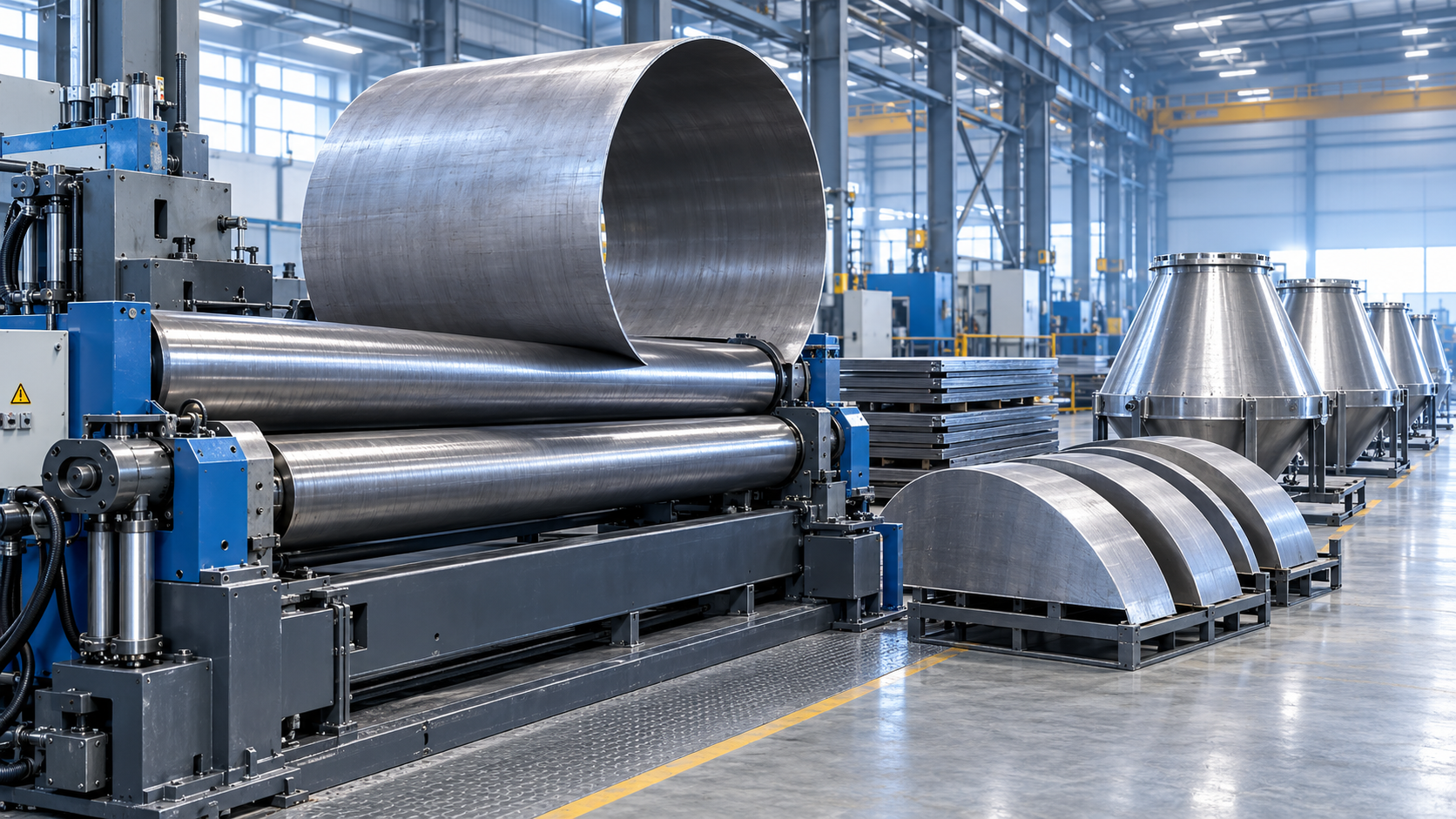
A 3 roller plate rolling machine is best suited to jobs that require sheet or plate metal to be formed into smooth, continuous curves: cylinders, large-radius arcs, conical sections, and shell segments. It is particularly useful where the part must hold a consistent radius over a substantial length, such as a tank body, duct section, pipe shell, hopper cone, or rolled cover.
For an information researcher, the useful starting point is simple: choose this type of machine when the required geometry is fundamentally curved and continuous. If the workpiece needs sharp straight bends, boxed profiles, flanges, or closely spaced angular folds, a press brake is generally the more appropriate tool. Plate rolling and press braking often appear in the same fabrication shop, but they solve different forming problems.
Jobs That Fit a Three-Roll Machine Well
The most common application is rolling a flat plate into a cylindrical shell. This includes vessel shells, water tank sections, furnace casings, filter housings, silos, smoke ducts, pressure-related shell components, and large pipe sections. The plate passes between the rolls while the roll position progressively introduces curvature. Repeated passes bring the two ends together until the required diameter is reached.
This process is valuable when a fabricator needs a round or near-round part without creating multiple visible bend lines. A cylinder made with many press-brake bends may be acceptable for a low-cost guard or enclosure, but it will remain faceted unless the bends are extremely close together. A rolled cylinder has a smoother profile and usually requires less corrective fitting before welding.
Three-roll machines are also well matched to partial cylinders and open arcs. Typical examples include curved machine guards, architectural metal panels, railings, fan housings, conveyor covers, curved roof components, and sections used in large welded assemblies. In these jobs, the part does not need to close into a complete tube, but radius consistency still matters for appearance, fit-up, and assembly.
Conical work is another suitable category, provided the machine and its tooling are configured for the intended geometry. Cones are used in hoppers, transition pieces, dust collection equipment, material handling systems, reducers, and process equipment. Rolling a cone is more demanding than rolling a cylinder because the two sides of the blank must travel at different effective speeds. The operator also needs to manage material movement carefully to avoid twisting, uneven edges, or an inconsistent taper.
Where a Three-Roll Arrangement Makes Sense
A 3 roller Plate Rolling machine is often selected for workshops that need a practical balance between capability, operating simplicity, and investment level. Its three-roll layout is well suited to conventional rolling work in which the operator can make multiple passes and can allow for some trimming or finishing at the plate ends.
The machine is particularly effective for batch fabrication of standard shells and curved parts where the plate size, material grade, thickness range, and target diameters are reasonably predictable. A workshop producing repeated duct sections or tank bodies can establish a repeatable rolling sequence, record roll positions, and reduce setup time over later runs.
For low- to medium-volume work, the ability to handle different diameters with the same basic machine is often more valuable than a highly specialized setup. The operator can adjust the roll position for a new job rather than changing over to dedicated forming equipment. This flexibility is useful in general fabrication, maintenance work, equipment manufacturing, and subcontract sheet-metal processing.
Material form matters. Plate rolling machines are intended for sheet and plate that can tolerate cold forming without unacceptable cracking, surface damage, or excessive springback. Mild steel is a common application material, but stainless steel, aluminum, and other alloys may also be rolled when the machine capacity, roll condition, surface protection, and bending properties are considered. The same nominal thickness does not guarantee the same rolling result across different materials. Higher-strength plate usually needs greater forming force and may spring back more after leaving the rolls.
Cylinders Are Easy to Describe, Harder to Finish Well
The basic principle of rolling is straightforward, but the end result depends on more than the machine’s rated plate thickness. Diameter, plate width, yield strength, rolling direction, edge condition, and the required roundness all affect whether a job is realistic.
A machine may be able to bend a given thickness in a large diameter, yet struggle to achieve a small diameter in the same material. This is why capacity should not be discussed only as “maximum thickness.” The relevant question is: maximum thickness at what plate width, material grade, and finished diameter? A buyer comparing machines should ask for the manufacturer’s rolling capacity in those conditions rather than assuming one published thickness figure covers every job.
Plate width has its own effect. A wide sheet demands even support and accurate roll alignment. If the rolls deflect under load or the plate enters unevenly, the finished shell can become tapered, barrel-shaped, or out of round. These issues are especially important where several shell courses must align for welding or where the rolled part must fit an existing flange, end cap, or support structure.
The plate ends require attention as well. In a basic rolling process, the small flat or less-curved area left at each end may need pre-bending before the final rolling passes. The amount of residual flatness that can be accepted depends on the product. A decorative cover may tolerate it. A shell requiring a tight longitudinal weld seam, close circularity, or accurate mating to another component may not.
Some three-roll designs make pre-bending easier than others, and some fabricators use a press brake for this preparatory operation. Where a component combines straight folds and a broad rolled radius, production may involve both processes. For example, a fabricated enclosure could use a press brake for folded edges and mounting flanges, then use a rolling machine for its curved body. A machine such as a Torsion bar synchronize CNC press brake is relevant on the folding side of that workflow, especially for thin sheet parts requiring repeatable straight bends before or after rolling.
Best-Fit Applications by Part Requirement
Jobs That May Need Another Method
A three-roll machine is not the automatic answer whenever a component is made from sheet metal. Jobs dominated by sharp angles are better handled by a press brake. Electrical cabinets, trays, brackets, channels, door frames, and parts with several short bends need controlled bend locations rather than a continuously changing radius.
Very small diameter work can also be a poor fit. Each machine has a practical minimum rolling diameter determined by roll diameter, roll spacing, material behavior, and machine geometry. Trying to force a plate below that range can lead to poor roundness, high residual flatness at the ends, surface damage, or excessive load on the machine.
Parts with extremely tight tolerances may need supplementary operations. A rolling machine can form a shell efficiently, but accurate final diameter, circularity, seam alignment, and end-face condition may still depend on calibration, trimming, welding sequence, or sizing. For a component that must locate precisely inside another assembly, it is sensible to consider the full manufacturing route rather than viewing rolling as the final operation.
Very thin material creates a different challenge. Thin sheet can be rolled, but it may buckle, telescope, or show handling marks if it is not supported properly. Large thin sheets with broad radii often require careful feeding and exit support. A machine chosen only for heavy plate capacity may not necessarily deliver the control needed for delicate sheet work.
How to Judge Whether a Planned Job Is a Good Match
Before selecting a machine or sending a plate rolling inquiry, define the finished part rather than only the starting plate. A useful job description includes the material type, thickness, plate width, developed blank length, target inside or outside diameter, required radius, cone angle where applicable, and acceptable tolerance. It should also state whether the part will be welded, whether visible surface quality matters, and whether the shell must join to flanges or other formed components.
- Specify the material grade or at least its forming behavior, rather than listing thickness alone.
- State the narrowest finished diameter expected across the job range.
- Separate occasional maximum jobs from the normal production workload.
- Identify whether both ends must be closely pre-bent for welding.
- Consider handling requirements for long, wide, or heavy plates.
- Allow for springback, especially with high-strength materials and large-radius work.
- Assess the required repeatability when parts must be interchangeable.
The distinction between a one-off repair part and a production shell also changes the decision. For occasional work, an operator may accept more trial passes and a small amount of post-forming adjustment. For recurring fabrication, time spent correcting diameters or closing seam gaps quickly becomes a process cost. Repeatable roll positioning, dependable controls, adequate plate support, and a forming method matched to the part family become more important.
The Practical Decision
The jobs best suited to a three-roll plate rolling machine are those built around a continuous curved surface: cylindrical shells, partial arcs, curved covers, large-radius sections, and many conical fabrications. It earns its place where smooth curvature and flexible diameter capability matter more than sharp bend definition.
Its limitations are equally useful in making a decision. Small radii, demanding end geometry, sensitive surfaces, complex folded profiles, and close assembly tolerances may require additional equipment or a different forming route. A fabricator that defines the finished diameter, material condition, plate dimensions, and seam requirements before comparing machines will make a far more reliable choice than one that relies on thickness capacity alone.
search
Products Navigation
Send Us A Message