




What drives edge milling machine price differences between models?
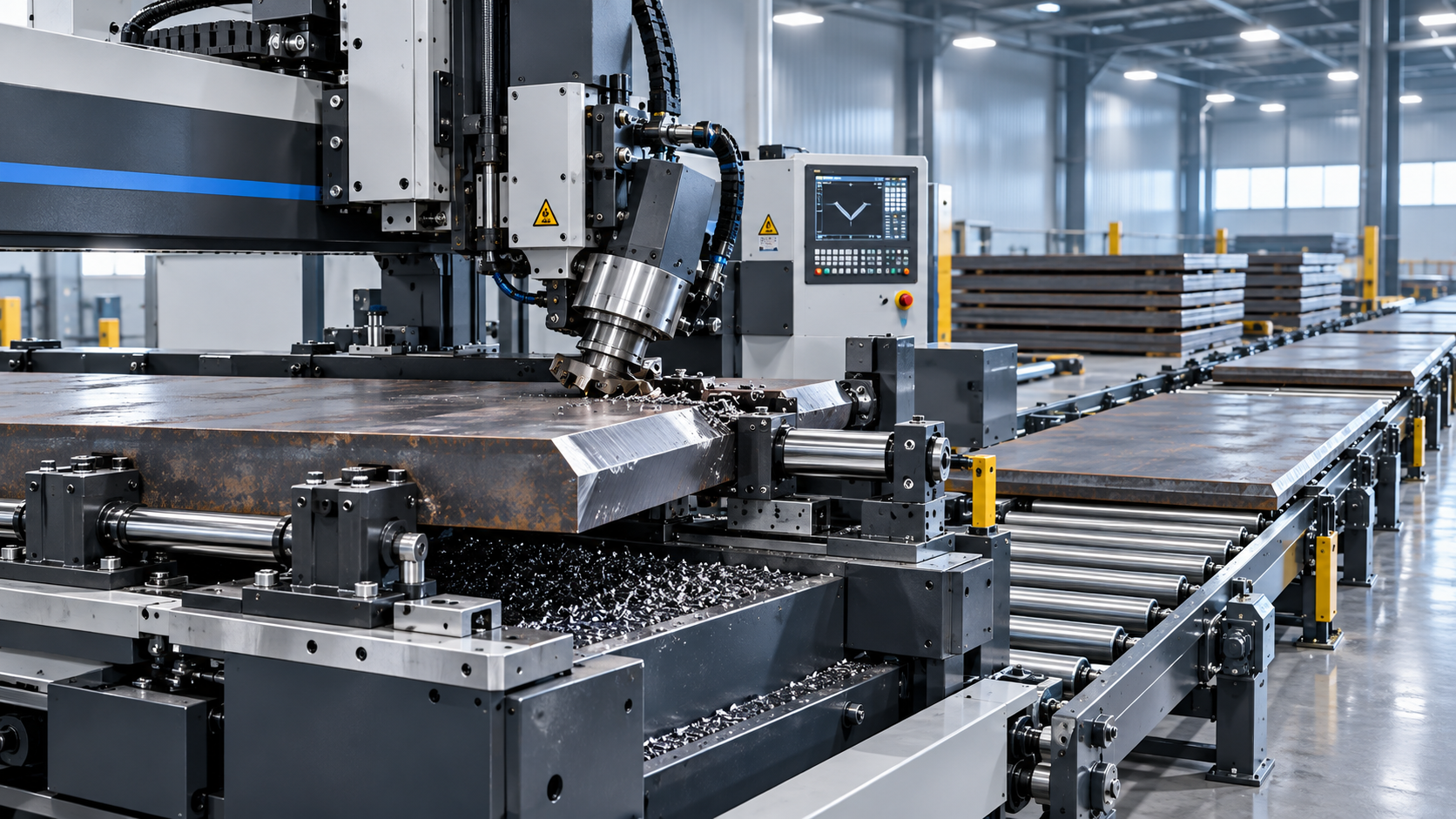
A quotation review can become confusing when two edge milling machines appear to perform the same basic task but carry very different prices. One model may be a compact manual or semi-automatic unit for plate preparation, while another is designed for continuous heavy-duty milling, automatic feeding, bevel control, and integration into a production line. The lower quotation is not necessarily the better purchase, and the higher quotation is not automatically over-specified.
The main reason edge milling machine price differences exist is that machines are priced around the work they must reliably perform: plate size, material grade, bevel geometry, accuracy requirement, production rhythm, and expected service life. Procurement decisions improve when the quotation is separated into its practical cost drivers rather than compared only by total amount.
Start with the actual edge-preparation requirement
Edge milling is often purchased because flame cutting, grinding, or manual beveling cannot provide a sufficiently uniform welding edge. This becomes especially important where long weld seams, thick plates, narrow preparation tolerances, or repeatable groove angles affect downstream fit-up and welding quality.
Before comparing models, define the part rather than the machine category. A supplier needs more than the statement “plate edge milling.” The useful questions are:
- What are the minimum and maximum plate thicknesses?
- What is the typical plate length and width?
- Which materials will be processed: carbon steel, stainless steel, alloy steel, or mixed materials?
- Is the required profile a straight edge, a single bevel, double bevel, radius, or a custom weld-preparation geometry?
- What angle tolerance and surface condition are acceptable after milling?
- How many parts must be processed per shift or per batch?
A machine intended for occasional preparation of moderate plates may use a simpler fixture, a smaller milling head, and manual loading. A model built for wide, thick plates moving through a recurring production schedule needs greater structural rigidity, higher spindle capacity, more robust clamping, and a feeding system that can hold a stable cut along the whole edge. Those differences are major contributors to price.
Machine construction is not a cosmetic difference
The bed, guideway arrangement, carriage, and clamping structure determine whether a machine can maintain a consistent bevel when the workpiece is large or the cutter experiences variable load. A lighter construction can be appropriate for limited-duty work, but it may not be suited to long plates, repeated deep cuts, or materials that create higher cutting resistance.
Procurement teams sometimes compare only the stated maximum plate thickness. That figure alone does not show how comfortably the machine operates at that thickness. Ask whether the capacity is intended for continuous work or only for intermittent operation. It is also useful to confirm the maximum milling width, maximum bevel depth per pass, supported plate length, and any requirement for workpiece support outside the main machine frame.
A heavier frame, reinforced rails, higher-grade bearings, and more stable clamping normally raise the initial purchase cost. However, they can reduce chatter, uneven bevel dimensions, frequent readjustment, and accelerated wear. For components that will later be assembled into pressure-bearing, structural, or precision-welded fabrications, that stability may be more valuable than a low entry price.
Clamping and workpiece handling affect both price and labor
The workpiece must remain secure as the cutter travels. Basic machines may require operators to position and clamp plates manually. More advanced equipment may include hydraulic clamping, multiple clamping zones, automatic pressure adjustment, infeed and outfeed support, or systems designed to reduce plate movement during long milling operations.
These features add cost, but the decision should be tied to handling reality. A workshop processing short, manageable blanks may accept manual setup. A fabrication line working with long, heavy plates can lose significant time when operators repeatedly reposition material or correct movement during cutting. The correct comparison is therefore not only machine price; it is machine price plus handling effort, floor space, lifting requirements, and likely setup interruptions.
Milling head, spindle power, and cutter design create another gap
The milling assembly is where the edge is actually formed, so its design has a direct effect on finish quality, productivity, and consumable cost. Higher-priced machines may use more powerful motors, more rigid spindle systems, adjustable milling heads, or cutter arrangements suited to larger material removal rates. They may also support multiple bevel forms without extensive mechanical changeover.
Power should not be treated as a standalone buying criterion. More motor power is useful only when the machine’s structure, transmission, cutter system, and chip removal arrangement can use it effectively. A high-power motor on a lightly built machine does not automatically improve edge quality. Conversely, a carefully matched milling system can provide stable results at moderate power when the duty cycle and material range are controlled.
Ask suppliers to explain the cutting-tool arrangement in operational terms. Clarify whether inserts are standard replaceable types, whether the cutter head is dedicated to one profile, how angle changes are made, and whether the proposed tooling is suitable for the materials being quoted. Stainless steel and tougher alloys can place different demands on tools than ordinary carbon steel. A low machine quotation can become less attractive if insert replacement, setup time, or special tooling creates a high recurring expense.
Automation changes the investment logic
Automation is one of the clearest reasons two machines with similar nominal capacities can have very different prices. The difference may include automatic plate feeding, programmable travel, motorized adjustment, servo-controlled bevel settings, automatic return, digital position feedback, or interfaces for upstream and downstream equipment.
For low-volume jobs with frequent part changes, a simple setup may be more economical because operators can adjust it quickly without paying for functions that remain unused. In contrast, repetitive production exposes the cost of manual alignment, manual measuring, and repeated handling. A more automated edge milling machine can be justified when it reduces variation between parts and keeps a stable rhythm ahead of welding, assembly, or inspection.
Automation also needs to match the next process. For example, a production cell may use automated welding where stable bevel preparation helps maintain fit-up conditions. In such a layout, the edge milling machine should be evaluated alongside material flow, plate staging, weld-joint preparation, and inspection requirements. A welding robot such as the 6 Axis 1500mm ArmSpan Industrial Welding Robot is intended for repeatable weld path execution, but its consistency cannot fully compensate for poorly controlled edge geometry or inconsistent joint gaps.
Accuracy specifications need context
It is easy to request the “highest accuracy” without identifying which accuracy matters. Edge milling quotations may refer to bevel angle accuracy, dimensional consistency, straightness, surface finish, cutter-position repeatability, or machine travel accuracy. These are related but not interchangeable.
A buyer should connect every tolerance request to the downstream requirement. If plates are manually fitted before welding and the joint design allows adjustment, extremely fine positioning capability may provide little practical return. If the plate edge must mate consistently with another prepared component, or if later automated welding depends on predictable joint geometry, tighter control may be justified.
Ask suppliers how the stated accuracy is achieved and verified. Relevant points include guideway design, carriage drive, encoder or scale feedback, clamping arrangement, head adjustment method, and the condition under which the value applies. A number on a quotation is less useful when it does not state whether it concerns an unloaded position, a short test piece, or a complete production cut.
Capacity claims should be converted into a duty-cycle question
Two models may both be able to machine the same thickness, but one may be engineered for occasional edge preparation and the other for sustained use. The latter generally costs more because it may require stronger drives, larger cooling capacity, more durable transmissions, better chip management, and components selected for longer operating periods.
The practical question is not “Can this machine mill our thickest plate?” It is “Can it mill our normal workload at the required quality without becoming the bottleneck?” Consider the usual plate thickness, the heaviest expected material, average edge length, number of passes, and how often the machine will run during the shift. Buying around the rare maximum condition can lead to unnecessary capital cost, but buying around an average condition while ignoring peak demand can create delays and maintenance pressure.
Material removal rate affects the rest of the workshop
Higher removal rates can shorten milling time, but they also create more chips, heat, noise, and cutter loading. A higher-priced model may include better chip evacuation or provision for extraction and collection. This is not an optional detail in applications where chips can interfere with the guideway, contaminate the work area, or slow material handling.
Review whether the quotation includes chip trays, conveyors, coolant provisions where applicable, guarding, and access for cleaning. These items can be omitted from a base offer and appear later as additions. Their absence may not prevent the machine from operating, but it can make routine production less efficient and increase housekeeping requirements.
Controls, electrics, and safety scope are often hidden inside the quotation
Control systems influence both usability and maintainability. A basic electrical panel may be sufficient for straightforward fixed-angle milling. A more advanced package may include programmable parameters, fault diagnostics, digital displays, interlocks, speed control, and integration capability. The more complex system usually costs more, yet it may reduce setup ambiguity when several operators or recurring products are involved.
Safety equipment must be compared on an equal basis. Guarding around the cutter, emergency-stop locations, interlocked access points, electrical protection, and safe procedures for loading and maintenance all affect the actual scope of supply. If the machine will be installed in a facility with specific electrical, machinery safety, or import requirements, confirm the applicable expectations before finalizing the model. Retrofitting guards, control modifications, or documentation after shipment is usually less efficient than specifying them at the quotation stage.
Compare quotations as delivered systems, not headline figures
A reliable comparison starts by asking each supplier to quote the same processing requirement and to state exclusions clearly. Price differences are often caused by scope rather than by the core machine alone. One offer may include standard tooling, while another lists tooling separately. One may include commissioning support, while another covers only delivery. One may assume the buyer provides lifting, foundations, electrical connection, and chip handling.
Build a comparison sheet around the following commercial and technical points:
- Machine model, plate capacity, bevel range, and supported material conditions
- Manual, hydraulic, servo, or CNC adjustment functions
- Included cutter heads, inserts, spare parts, and recommended consumables
- Clamping method and any infeed, outfeed, or plate-support equipment
- Electrical specification, installed power, control components, and safety devices
- Foundation, installation, training, commissioning, and acceptance conditions
- Warranty scope, documentation, service response arrangement, and spare-parts availability
This approach prevents a misleading comparison between a bare machine and a production-ready package. It also reveals whether a lower-priced machine will need additional fixtures, handling devices, or tooling before it can perform the intended operation.
Choose the cost level that matches the process risk
A lower-cost edge milling machine is often appropriate when plate sizes are limited, production volumes are modest, bevel requirements are uncomplicated, and skilled operators can manage setup without affecting throughput. It can be the sensible choice for repair work, job-shop production, or applications where edge preparation is not a critical bottleneck.
A higher investment becomes easier to justify where thick or long plates are processed repeatedly, bevel consistency affects automated welding or assembly, handling is labor-intensive, and downtime would interrupt a larger fabrication sequence. In those conditions, the relevant measure is not the initial edge milling machine price alone. It is the cost of achieving the required edge quality repeatedly, including labor, cutter usage, rework exposure, handling time, and production interruptions.
The most useful purchase decision comes from matching the machine’s structural capacity, automation level, and support scope to the real workload—not from selecting the lowest quotation or the most elaborate configuration by default.
search
Products Navigation
Send Us A Message