




What drives the installed cost of a rail mounted welding robot?
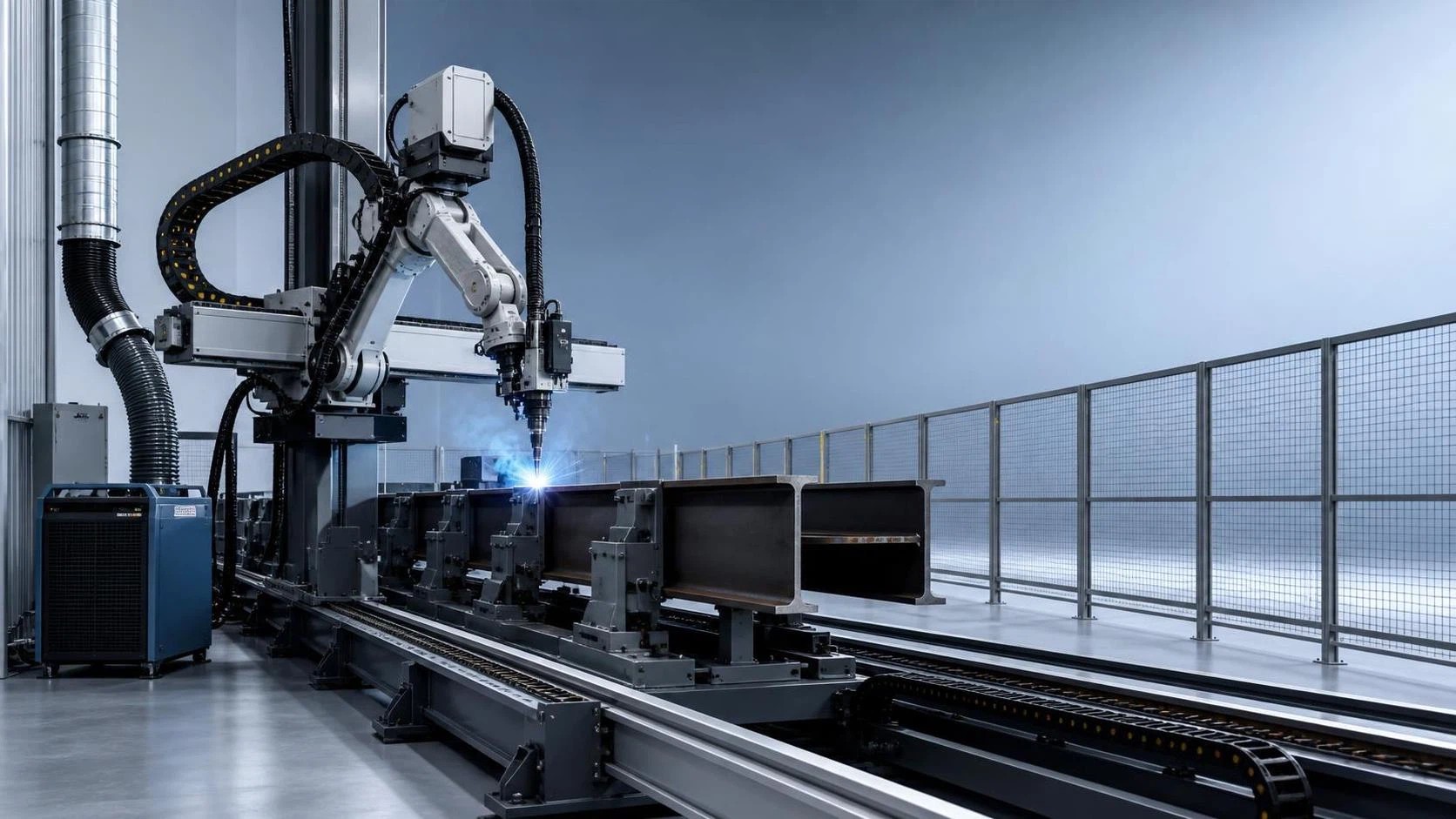
The installed cost of a rail mounted welding robot is rarely defined by the robot arm alone. In large fabrication projects, the robot may represent only one part of a wider automation cell that includes a travel rail, welding package, workpiece handling, guarding, controls, extraction, installation labor, and production validation. A proposal that appears inexpensive at the equipment level can become the more costly option once site work, interfaces, and commissioning are included.
For capital approval, the useful question is not “What is the robot price?” but “What must be purchased, built, modified, and supported before the system can produce acceptable welds at the planned throughput?” That distinction is especially important for long beams, vessels, structural components, pressure-related fabrications, and repetitive assemblies where a rail mounted welding robot is selected to cover a working envelope beyond the reach of a fixed-base robot.
The rail is a production asset, not a simple accessory
Rail length is usually the most visible cost driver after the robot itself, but length alone does not explain the full investment. The installed rail system may include a steel base structure, precision rails, rack-and-pinion or other drive mechanisms, cable carrier systems, end stops, energy chains, leveling arrangements, and position-reference devices. The requirement for straightness, rigidity, and repeatable positioning rises with weld tolerance, robot speed, and workpiece length.
A short rail installed on a prepared concrete floor is a fundamentally different project from a 20- or 30-meter axis installed beside an existing production line. In the latter case, the budget may need to cover floor survey work, grouting, anchor design, reinforced foundations, structural supports, and alignment after installation. If the floor is uneven, cracked, or subject to vibration from nearby presses, cranes, or machining centers, corrective work can be material.
Longer rails also increase secondary costs. More travel requires longer cable management, more protection against dust and spatter, more extensive safety zoning, and additional time for installation and calibration. Where two robots share a rail or work in adjacent zones, collision prevention and coordinated motion add another layer of control engineering.
When comparing quotations, it is worth separating the following items rather than accepting a single “linear track” line:
- usable robot travel versus total rail length;
- rail load capacity and allowable moment load;
- travel speed and positioning repeatability;
- base-frame supply, foundation scope, and installation responsibility;
- cable carrier length, service access, and replacement cost;
- site alignment, leveling, and final acceptance tolerances.
A lower-cost rail can be appropriate for moderate-duty welding, but it may be a false economy where large fixtures, heavy dress packs, high accelerations, or continuous multi-shift operation are planned.
Robot reach, payload, and welding process determine the cell specification
Robot capacity affects both purchase cost and the mechanical requirements of the rail system. A robot carrying only a compact MIG/MAG torch has a different payload requirement from one carrying a tandem torch, laser seam tracker, touch sensing package, wire cutter, torch-cleaning accessories, or a heavy submerged arc welding head. The payload calculation must include the end-of-arm tooling, cable package, and dynamic forces during motion, rather than only the torch weight.
Reach also needs careful interpretation. The quoted maximum reach may not translate into useful reach once the robot is mounted on a rail carriage, positioned around fixtures, and required to maintain correct torch angle. Inadequate access often leads to manual rework, extra fixture rotations, or a future request for a positioner that was excluded from the initial budget.
The welding process itself is a major cost determinant. Standard gas metal arc welding may require a robot, power source, wire feeder, torch package, gas controls, and basic seam-location capability. Higher deposition processes, pulsed systems, tandem arrangements, narrow-gap applications, or submerged arc automation can require more costly power sources, specialized torches, heavier-duty cable systems, and additional process development. Stainless steel and aluminum projects may also require more disciplined contamination control, fume management, and consumable handling than ordinary carbon-steel fabrication.
It is prudent to ask whether the quoted system includes weld procedure support, trial welding on representative material, and demonstration of required weld quality. Automation does not remove the need for qualified welding procedures or appropriate quality controls. If codes, customer specifications, or third-party inspection requirements apply, the cost of procedure qualification, testing, documentation, and production traceability should be budgeted separately unless explicitly included.
Fixtures and material flow frequently decide the real return
Many automation business cases overemphasize arc-on time and understate handling time. A robot can only generate value while parts are accurately presented, clamped, and available. If operators spend long periods finding components, correcting fit-up, manually aligning distorted parts, or waiting for an overhead crane, the rail mounted welding robot will have a low utilization rate regardless of its programmed speed.
Fixtures are therefore not a peripheral purchase. For long structural fabrications, fixture design may involve datum location, pneumatic or hydraulic clamping, anti-distortion support, root-gap control, adjustable stops, and interfaces for turning or repositioning the part. Heavy or variable workpieces can require rotators, headstock-tailstock positioners, manipulators, conveyors, or crane coordination. These components may equal or exceed the cost of the robot in complex projects.
Upstream fabrication quality also affects the automation budget. A rolling operation that produces more consistent cylindrical shells, cones, or curved sections can reduce fit-up variability before robotic welding. For example, a CNC Bending machine with 4 roller may be relevant in metal fabrication environments producing heavy curved components. Its shorter lower-roll span is intended to improve dimensional accuracy, while the four-roll arrangement can reduce the need for auxiliary handling of leading and trailing ends. That does not make rolling equipment part of every robot project, but it illustrates a wider financial point: the welding cell should be evaluated together with the accuracy and repeatability of upstream processes.
A system designed around nominal drawings but fed by inconsistent real parts often accumulates hidden expenses through gap-filling, manual tack welding, sensor upgrades, cycle interruptions, and scrap. Before approval, production data should be reviewed for part variation, fit-up rejects, rework rates, and the percentage of components that currently require manual correction.
Safety and compliance costs should be defined early
Safety is one of the most commonly under-scoped elements in early automation proposals. A rail-mounted system covers a changing operating zone as the robot travels. This can make the safety layout more complex than that of a fixed robot cell. The final system may need perimeter fencing, interlocked access doors, safety-rated scanners or light curtains, emergency-stop circuits, safety PLC functions, zone controls, warning devices, and procedures for setup and maintenance.
The right solution depends on the plant layout, movement of personnel and forklifts, overhead crane routes, workpiece loading method, and local regulatory requirements. The relevant machine safety obligations vary by country and by project role. For cross-border procurement, responsibilities should be contractually defined: who provides the risk assessment, who supplies the safety hardware, who validates the final installation, and who provides the declaration or documentation required in the destination market.
Where equipment is supplied into the European market, CE-related obligations may be relevant, but a component-level statement from an equipment supplier should not be treated as proof that the completed integrated line meets all applicable requirements. The legal status of the finished assembly depends on how the system is integrated and placed into service. This point should be checked with the responsible integrator and, where necessary, a qualified compliance specialist.
Fume extraction deserves the same discipline. Welding fume control may require local extraction hoods, movable extraction arms, enclosed booths, filtered units, ducting, electrical work, and periodic filter replacement. The least expensive layout is not always the best one if it obstructs robot travel, prevents crane loading, or creates an ongoing maintenance burden.
Integration costs are where quotation gaps become visible
A rail mounted welding robot has to communicate with surrounding equipment and production controls. Typical interfaces include welding power sources, positioners, torch cleaners, wire feeding systems, fume extraction, material-handling equipment, barcode or part-identification devices, plant networks, and quality-recording systems. Even a relatively simple cell needs clear logic for start conditions, interlocks, fault handling, recovery after interruption, and safe manual operation.
Integration effort rises sharply when the project includes multiple workpiece families, frequent changeovers, or legacy machinery. A supplier may quote a standard robot package, while the buyer assumes that it includes custom fixtures, offline programming, automatic program selection, remote service capability, or integration with manufacturing execution software. Those assumptions should be converted into a written scope before a purchase order is released.
Important cost questions include:
- Is robot programming included for all part families or only for a sample part?
- Are cycle-time targets based on real handling time and welding parameters, or only simulated robot motion?
- Who is responsible for electrical distribution, compressed air, shielding gas piping, network connections, and extraction ducting?
- Are factory acceptance testing and site acceptance testing defined with measurable criteria?
- What level of operator, maintenance, and programming training is included?
- What happens if workpieces differ from the drawings provided during quotation?
These are not minor contractual details. They determine whether cost overruns appear as change orders during installation or remain under the supplier’s defined deliverables.
Site preparation can alter both capital cost and project timing
Facilities often discover late that the intended location lacks sufficient floor capacity, electrical supply, gas availability, crane clearance, or material-flow space. A preliminary site survey should verify dimensions, floor condition, cable routes, power quality, grounding, compressed-air capacity, gas storage and distribution, ventilation, and access for delivery and installation.
Electrical upgrades can be significant where high-capacity welding power sources are combined with several axes, positioners, extraction equipment, and cooling units. The budget should distinguish between the equipment supplier’s internal wiring and the plant-side work needed to bring suitable power to the cell. Similar boundaries apply to gas piping and extraction systems.
Project timing has a financial effect as well. Civil work, import clearance, assembly, safety validation, programming, weld trials, and operator training may create a period in which capital is committed but production has not yet improved. A realistic cash-flow model should include progress payments, installation milestones, commissioning duration, and a contingency for site-driven delays.
Lifecycle cost is more important than the initial discount
The lowest installed price is not necessarily the lowest cost of ownership. A robust evaluation should cover expected service life, preventive maintenance, spare-parts availability, technical response time, software licensing, torch consumables, wire feeding components, rail lubrication, calibration requirements, and the cost of production interruption.
Rail systems add maintenance points that do not exist on a stationary robot: travel drives, gear racks, pinions, carriage wheels or guides, energy chains, and alignment-related inspections. In welding environments, spatter, dust, heat, and damaged cables can reduce reliability if protection and cleaning routines are inadequate. Buyers should request a recommended maintenance schedule and a list of wear parts with estimated replacement intervals. If the supplier cannot provide this, the long-term operating budget is difficult to defend.
Service capability should be assessed geographically and contractually. Remote support may resolve programming issues, but it cannot replace local intervention for mechanical damage, safety faults, or welding process problems. For imported equipment, lead times for critical spares and the availability of local technical personnel can matter more than a small initial price advantage.
Build the approval model around utilization, not theoretical capacity
Return on investment depends on productive utilization. A credible model should begin with actual annual weld volume, current labor content, overtime exposure, rework levels, consumable use, and bottlenecks. It should then estimate the proportion of this workload that can be automated without excessive manual preparation.
The model should avoid treating every displaced manual welding hour as direct labor savings. In many plants, automation initially redeploys skilled welders to higher-value or less repetitive work rather than reducing headcount. That can still be economically sound if it relieves capacity constraints, reduces subcontracting, improves delivery reliability, or allows the business to accept more work. The financial benefit should simply be described accurately.
Useful sensitivity tests include lower-than-planned utilization, higher fixture cost, a delayed production ramp, additional programming requirements, and a change in welding consumable prices. If the project remains acceptable under conservative assumptions, the investment is more resilient. If the return only works at near-perfect uptime and full three-shift loading, the proposal carries greater execution risk than its headline payback suggests.
A disciplined comparison of rail mounted welding robot proposals should therefore normalize the scope: same usable envelope, same weld process, same fixtures, same safety standard, same site-work allocation, same acceptance criteria, and similar service coverage. Only then does a price comparison become meaningful. The most reliable project is usually not the one with the cheapest robot, but the one with the fewest undefined interfaces between equipment, facility, workpiece quality, and ongoing support.
search
Products Navigation
Send Us A Message