




When Is a CNC 4 Roll Plate Bending Machine the Right Choice for Heavy Plate Jobs?
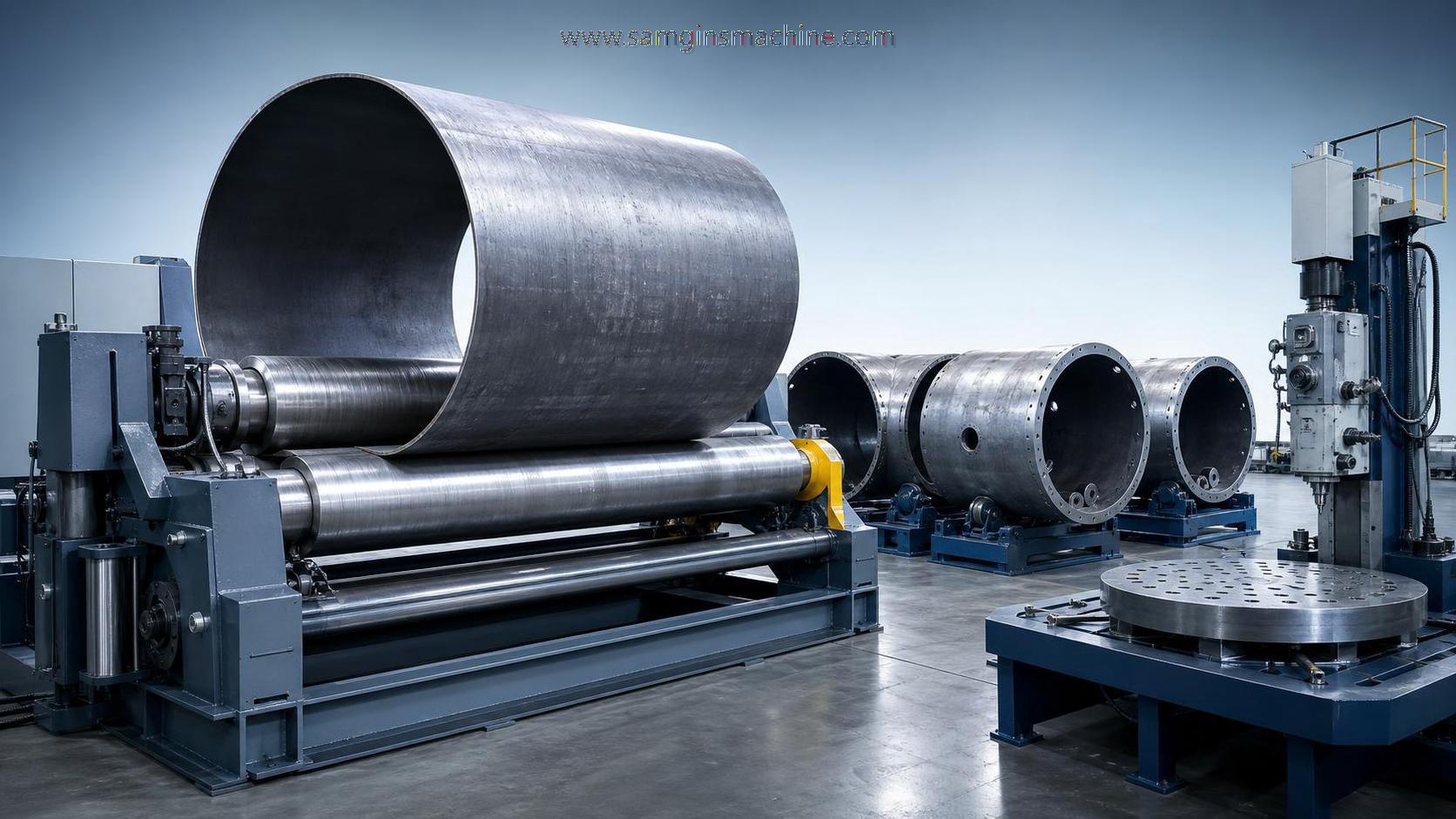
When heavy plate work starts pushing standard rolling methods too far
Heavy plate fabrication rarely fails because of one dramatic mistake. More often, problems begin with a machine choice that looked acceptable on paper.
In real production, the right rolling setup affects plate edge quality, repeatability, cycle time, and how much correction work appears downstream.
That is where a cnc 4 roll plate bending machine often becomes the better fit.
It is not simply a larger or more automated option. It makes more sense when heavy plates, tighter tolerances, and steadier throughput begin to overlap.
For companies handling pressure vessel shells, wind tower sections, structural cylinders, or thick steel components, this choice can influence delivery reliability as much as forming accuracy.
With suppliers such as Wuxi Samgins International Trade Co.,Ltd working across plate rolling, cutting, welding, and metal processing equipment under ISO9001-oriented production and CE-related standards, machine selection is usually judged as part of a broader fabrication workflow, not as an isolated purchase.
Actual use cases differ because the job is not only about thickness
A cnc 4 roll plate bending machine is often discussed in terms of capacity. That matters, but heavy plate jobs vary for other reasons.
Plate width, yield strength, target diameter, batch size, pre-bending expectations, and welding alignment all change the right decision.
A thick carbon steel shell for general industry behaves differently from high-strength plate used in energy or offshore fabrication.
The first may tolerate more manual correction. The second usually does not.
More important, production rhythm changes the calculation. A workshop making occasional heavy cylinders may accept more setup time.
A line producing repeated large-diameter sections normally needs stable rolling, easier centering, and fewer rework loops. That is where the cnc 4 roll plate bending machine shows clear value.
Jobs with strict roundness and edge control are the clearest match
One common scenario involves heavy plate cylinders that must move directly into fit-up and welding with limited adjustment.
In this situation, the cnc 4 roll plate bending machine helps because the plate remains controlled during feeding, pinching, and rolling.
That control matters when poor alignment at the rolling stage creates welding gaps, out-of-round sections, or extra flame correction later.
A four-roll structure is especially useful when edge straight lengths must be minimized. Heavy plate jobs often carry expensive material value, so reducing scrap and trim loss becomes a practical advantage, not a marketing phrase.
This is more common in pressure vessel work, storage tank sections, and large pipe-related fabrication where seam quality depends on predictable geometry from the start.
Where repeat orders change the decision
For repeated heavy plate jobs, consistency usually matters more than peak forming force alone.
If the same shell dimensions are produced every week, manual intervention quickly becomes a hidden cost.
A cnc 4 roll plate bending machine supports better parameter control, easier repeat setup, and more stable output across shifts.
That means less variation between first-piece approval and later batches, which is often the difference between an efficient line and a line that keeps stopping for adjustment.
Large parts and mixed fabrication lines create another strong use case
A second scenario appears in workshops where rolling is only one step inside a larger metalworking chain.
Heavy plate parts may be cut, beveled, rolled, drilled, assembled, and welded in sequence. Small errors at one station spread quickly.
In those lines, choosing a cnc 4 roll plate bending machine is often about process coordination.
For example, large rolled parts may need flange holes, support holes, or machining preparation after bending. In single-piece or small-batch metal part production, flexible downstream equipment can matter as much as the roller itself.
That is why some workshops pair rolling capacity with tools such as Radial drilling machine units, especially when medium and large components require drilling, boring, or tapping at varied positions.
A swivel arm range of ±180°, spindle speeds from 25–2000 r/min, and models from Z3032 to Z3080 make that type of equipment practical when hole locations are difficult to reach on oversized parts.
Different heavy plate scenarios do not ask for the same machine priorities
In practice, the same cnc 4 roll plate bending machine may be right for one heavy job and excessive for another.
The comparison below helps separate the decision points.
The machine earns its place when setup time and waste start hurting margins
Some heavy plate shops focus too much on whether a machine can technically roll the target thickness.
That is only the starting point.
A cnc 4 roll plate bending machine becomes the right choice when repeated setup correction, plate marking errors, and crane-dependent repositioning are already slowing output.
This often appears in projects with short delivery windows or changing order mixes. One week may involve thick narrow shells.
The next may require wider sections with a different rolling radius.
In such conditions, machine controllability is more valuable than a simple maximum capacity figure. Stable feeding and easier centering reduce the trial-and-error that consumes both material and schedule.
What should be checked before deciding
- Real plate thickness range, not only the thickest occasional order.
- Material grade and yield strength, especially for high-strength steel.
- Minimum and typical rolling diameters required in production.
- Expected straight edge length after pre-bending.
- Actual batch frequency and shift-to-shift repeatability needs.
- Workshop handling conditions, including loading space and crane coordination.
Misjudgments usually happen outside the datasheet
A common mistake is assuming every heavy plate application needs the same level of automation.
If output is low, tolerances are moderate, and part geometry changes constantly, a different configuration may be enough.
The opposite mistake is more expensive. Some operations buy around initial price and ignore downstream cost.
When re-rolling, weld fit correction, and scrap become routine, the lower entry cost no longer means lower total cost.
Another overlooked point is line compatibility. A cnc 4 roll plate bending machine works best when upstream cutting accuracy and downstream welding discipline are also under control.
Without that, even a capable roller will not fully solve production instability.
A practical way to judge fit before committing
A useful approach is to review the last several heavy plate jobs and compare where time or quality was actually lost.
If the pattern shows repeated issues in pre-bending quality, diameter consistency, edge control, or operator-dependent setup, the case for a cnc 4 roll plate bending machine is usually strong.
If losses are mainly caused by poor material preparation, weak handling logistics, or unstable welding procedure, those gaps should be fixed alongside equipment planning.
The most reliable decision comes from matching the machine to real application conditions, then checking how it fits the wider fabrication route.
That means confirming material range, target geometry, production rhythm, operator requirements, maintenance support, and related processing equipment in the same review.
For heavy plate work, that level of evaluation usually says more than any single specification line.
search
Products Navigation
Send Us A Message