




When Is a Gantry Plate Drilling Machine Better Than a Conventional Setup?
When Is a Gantry Plate Drilling Machine Better Than a Conventional Setup?
For project managers balancing throughput, accuracy, and fabrication cost, drilling is rarely just a hole-making step. It affects fit-up, welding quality, downstream assembly, and ultimately whether a project stays on schedule. A gantry plate drilling machine becomes the better option when large plates, repeated hole patterns, and high positioning precision are part of the daily workload. In those cases, a conventional setup may still work, but it usually asks for more handling, more operator intervention, and more tolerance risk than many modern fabrication projects can comfortably absorb.
That distinction matters in industries where plate processing is tied to vessel sections, base plates, structural components, flanges, bridge members, or equipment frames. If the plate is heavy, the hole map is dense, or the same pattern repeats across batches, the machine choice starts shaping the whole production flow rather than one operation in isolation.
The real comparison is not machine versus machine
A lot of buyers compare spindle power, axis travel, or table size first. Those are important, but they do not answer the practical question. The better comparison is workflow versus workflow.
A conventional drilling setup often means radial drilling, manual positioning, magnetic drills, or a standard machining arrangement that was not designed around large-format plate work. It can be perfectly adequate for low volume, oversized one-off jobs, repair work, or parts with generous tolerances. The trouble begins when plate dimensions increase and drilling accuracy has to remain stable across multiple parts and shifts.
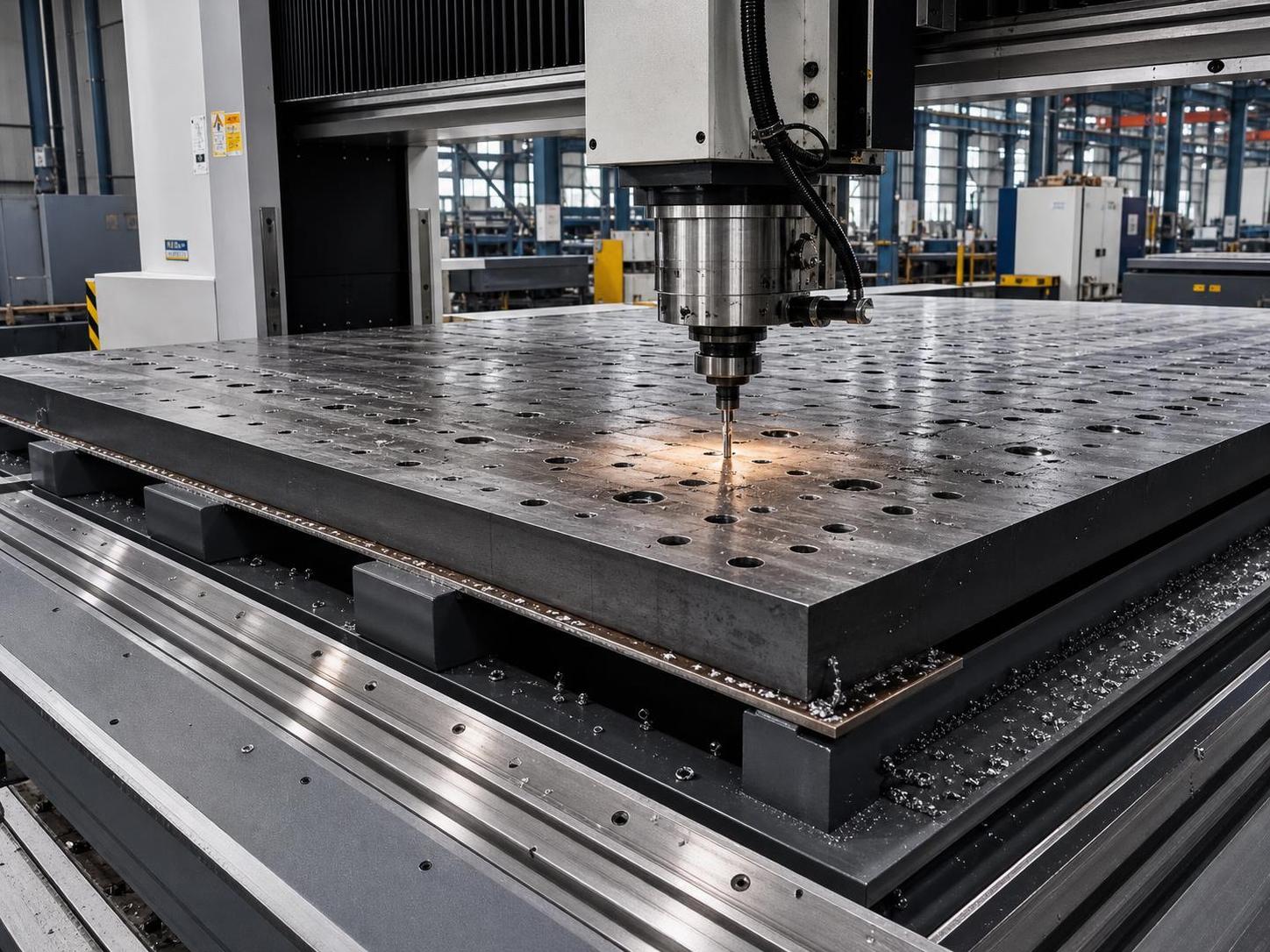
A gantry plate drilling machine changes the equation because it is built around plate geometry. The workpiece stays supported while the machine moves in a controlled coordinate system. That sounds straightforward, but in production terms it means fewer repositioning steps, more predictable hole-to-hole accuracy, and a lower chance that handling introduces error.
Where gantry drilling clearly pulls ahead
One clear trigger is plate size. Large steel, stainless steel, or aluminum plates are awkward to reposition repeatedly on a conventional setup. Every lift, clamp, and re-reference consumes time and creates another opportunity for deviation. On a gantry platform, that burden shifts from operator technique to machine control.
The second trigger is pattern density. If a part has dozens or hundreds of holes, manual marking and repeated setup start becoming the hidden cost center. The nominal drilling time may look acceptable, but total cycle time stretches because layout, alignment, checking, and correction take longer than expected. For project-driven manufacturing, that extra time usually shows up later as schedule pressure in assembly or welding.
The third is positional consistency. In pressure equipment, steel structures, or fabricated assemblies, the issue is often not whether a single hole can be drilled accurately. It is whether every hole on every plate lands where downstream processes expect it. A gantry plate drilling machine is often the better answer when tolerance stack-up can cause fit-up problems, misaligned bolting, or field modification.
It also becomes attractive when traceability and programming matter. CNC-based drilling allows repeatable patterns to be stored and reused. For projects with families of similar parts, that reduces the dependence on tribal shop-floor knowledge and helps standardize output across operators and batches.
When a conventional setup still makes sense
Not every shop needs gantry drilling. If the work mix is dominated by small batches, highly irregular components, occasional maintenance jobs, or plate drilling that is secondary to other machining steps, a conventional setup may remain more economical. The same applies when available floor space is tight or when the hole quality requirement is not especially demanding.
There is also a volume threshold to respect. A machine can be technically better and still not be the right investment if the drilling load is too light or too unpredictable. Project managers usually get the clearest answer by reviewing three months to one year of actual part history: plate sizes, number of holes per part, repeat rate, setup time, rework frequency, and bottlenecks created downstream.
What project managers should watch beyond drilling speed
Faster drilling alone does not justify a machine change. In fabrication, the strongest gains often come from reducing non-cutting time. If operators spend too long aligning plates, confirming datums, moving heavy parts, or correcting pattern offsets, the actual issue may be process stability rather than spindle performance.
There are a few questions worth asking internally:
- How often do hole-position issues delay fit-up or force slotting and correction?
- How many labor hours are tied to marking, clamping, repositioning, and checking?
- Do large plates wait in queue because current drilling capacity cannot match cutting or welding throughput?
- Are repeat projects being treated like one-offs because programming and fixturing are not standardized?
If the answer to several of those is yes, the argument for gantry drilling gets much stronger.
The upstream and downstream effect is usually underestimated
Plate drilling does not stand alone. In many workshops, the same project also requires cutting, beveling, milling, rolling, welding, and final assembly. Once you look at the line as a connected system, equipment selection becomes less about one machine category and more about handoff quality between processes.
Take edge preparation as an example. If plates move from drilling to weld prep, bevel quality and dimensional stability become just as important as hole accuracy. In sectors such as pressure vessels, boilers, shipbuilding, electric power, chemical engineering, and general machinery manufacturing, shops often pair plate drilling with dedicated bevel-processing equipment to reduce manual finishing. In that context, an Edge milling machine can fit naturally into the same production logic, especially where carbon steel, stainless steel, or aluminum plates require straight edges, beveled edges, or U-, V-, and K-type groove preparation before welding.
That matters because project delivery problems rarely come from one dramatic failure. More often they come from small mismatches between processes: a hole pattern that forces rework, an edge that needs hand correction, a plate that moves too many times, or an operator who has to compensate for inconsistent upstream output.
A useful way to judge suitability
If you are deciding whether a gantry plate drilling machine is the better fit, it helps to score the job mix against a few practical conditions rather than broad claims.
If most of your jobs fall into the right-hand column, the conventional route may be costing more than it appears on paper.
Equipment choice should match the wider fabrication plan
This is where supplier experience matters more than catalog breadth. Shops do not buy drilling in isolation; they build workable process chains. Wuxi Samgins International Trade Co., Ltd, established in 2012 in Wuxi and positioned close to Shanghai for convenient logistics, works across a broad range of metal fabrication equipment including CNC cutting machines, milling machines, CNC machine tools and lathes, welding robots, laser cutting machines, H-beam production line equipment, bending machines, shearing machines, plate rolling machines, leveling machines, deburring machines, pipe benders, thread rolling machines, end face milling machines, and other related systems. For buyers handling export projects or multi-machine planning, that kind of range can be useful because machine decisions often need to align with standards, workflow continuity, and delivery coordination rather than a single piece of equipment.
The company states that production and design are organized in line with ISO9001 quality system requirements and EU CE standards. Even so, project managers should still confirm the exact machine configuration, documentation scope, and destination-market requirements for their own application, especially when the project involves customer-specific acceptance criteria.
One common mistake: buying for maximum capacity, not actual bottlenecks
It is easy to focus on the biggest possible plate or the thickest occasional job. But many investments underperform because they were selected for extreme scenarios instead of daily production reality. The better approach is to map the current bottleneck. Is it floor handling? Hole-to-hole repeatability? Programming time? Queue buildup between cutting and drilling? Rework before assembly? Those answers should guide the specification.
The same logic applies to related edge-preparation equipment. For example, when beveling long plates before welding, some shops benefit from CNC or automatic walking designs with automatic clamping, edge detection, feeding, and return movement. In XBJ Series configurations, thickness coverage may range from 6–80 mm on standard models and from 6–400 mm on heavy-duty non-pressure-beam types, with bevel angle adjustment from 0° to 90° and feed speed from 0.13 to 1.0 m/min. Those numbers do not make one process universally better than another, but they show why plate fabrication decisions should be made as a system, not as isolated machine purchases.
So when is it better?
A gantry plate drilling machine is the better choice when your project mix repeatedly combines large-format plates, dense or repeated hole patterns, tight positional requirements, and a need to keep downstream fabrication predictable. It is also the stronger option when manual setup time is quietly eroding throughput or when drilling quality has become a hidden source of fit-up and schedule problems.
If your workload is lighter, less repetitive, or more irregular, a conventional setup may still be the sensible answer. But if you are already seeing delays caused by plate handling, alignment inconsistency, or rework between cutting, drilling, and welding, that is usually the point where conventional methods stop being flexible and start becoming expensive.
Before making a decision, review actual drawings, plate sizes, hole counts, material range, downstream tolerances, and the handoff between drilling and the next process. That exercise tends to reveal very quickly whether the issue is machine capacity, process design, or both.
search
Products Navigation
Send Us A Message