




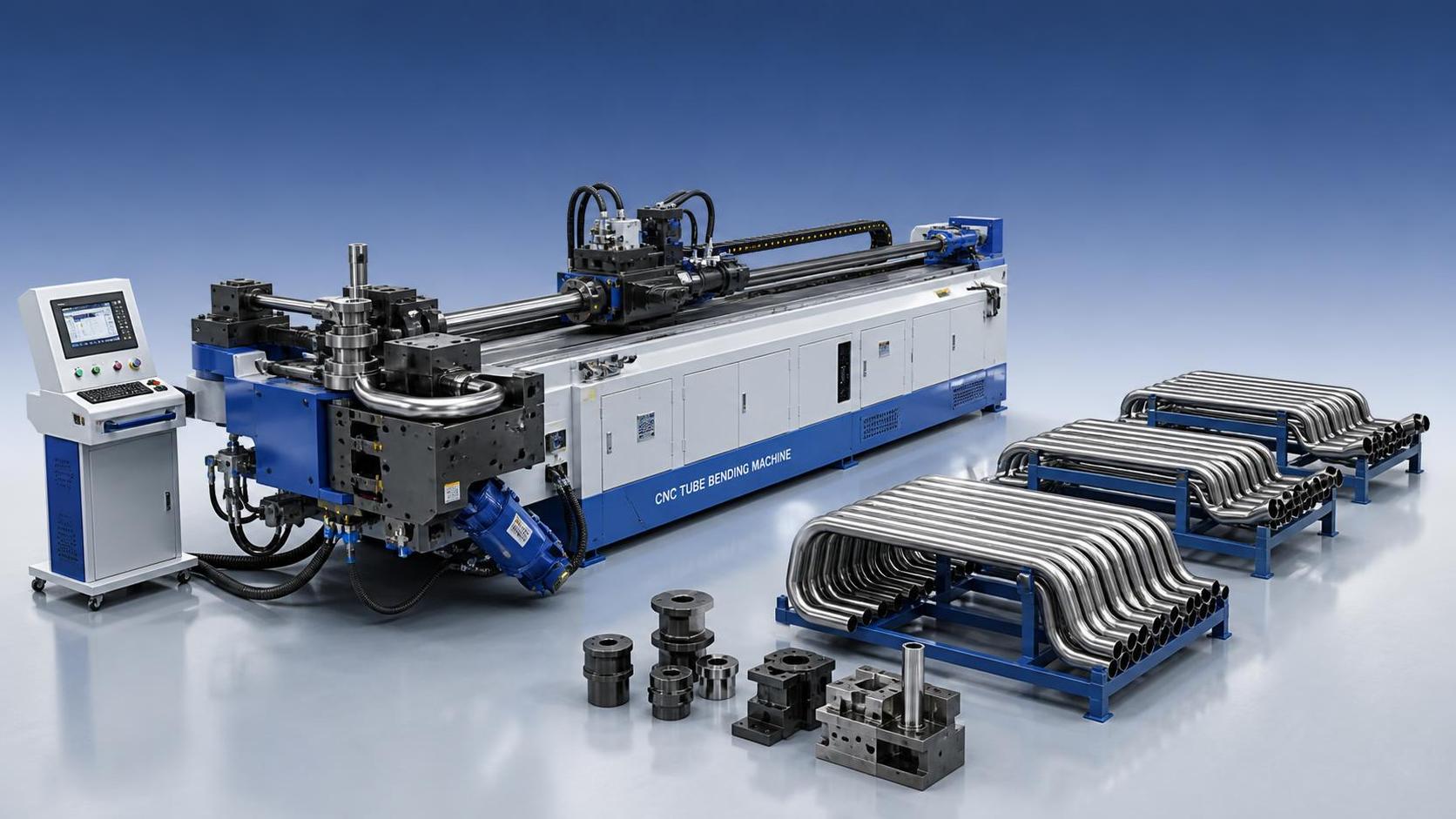
When Is an NC Tube Bending Machine Enough for Medium-Volume Manufacturing?
A common problem in medium-volume production is that bending demand grows faster than the original manual process, but not enough to make every buyer comfortable with a full CNC investment. At that point, many teams start comparing options and asking whether an nc tube bending machine is already sufficient for the job, or whether choosing anything below full CNC will create limits too early.
This question matters because the wrong decision affects more than purchase cost. It can influence setup time, operator workload, repeatability, training, part changeover, and the ability to keep delivery schedules stable when order quantities are neither small prototypes nor fully mass-produced runs. For many buyers, the real task is not finding the most advanced machine, but finding the machine that matches the production pattern without adding unnecessary complexity.
Why this decision becomes difficult in medium-volume production
Medium-volume manufacturing sits in an awkward middle range. If output is very low, a simpler process with more operator involvement may still be acceptable. If output is extremely high, the case for full automation is easier to justify. The confusion appears in the middle, where the production line needs consistency and reasonable speed, but order variation is still high enough that flexibility matters.
In this range, many people assume that anything less than full CNC is a compromise that will eventually slow them down. That is not always true. An nc tube bending machine can be a practical and stable choice when the bending tasks are repetitive enough to benefit from programmed control, but not so complex that they require continuous multi-axis adjustment, advanced geometry compensation, or unattended production logic.
The problem is usually not the label on the machine. The real issue is whether the production requirements are being described accurately. Buyers often say they need “more precision” or “better efficiency,” but those phrases are too broad to support a good equipment decision. The better approach is to break the work into repeatability needs, bend complexity, changeover frequency, material variation, and staffing constraints.
What usually goes wrong when the machine choice is mismatched
When the selected bending solution is below the actual requirement, several operational problems tend to appear. The first is inconsistent output across repeat batches. This often shows up when the same part is run again after a setup change and the bend angle or position drifts enough to create fitting issues downstream.
The second problem is hidden labor cost. A machine may seem affordable at purchase stage, but if the operator has to spend too much time correcting, measuring, re-aligning, or repeating setups, the apparent savings disappear in daily production. Medium-volume work is especially sensitive to this because the same inefficiency repeats often enough to become expensive, yet not always in a way that is visible in a simple quotation comparison.
The third issue is overbuying. Some factories move directly to a more advanced CNC system because they want to avoid future limits, but then discover that the part mix is relatively stable, bend programs are simple, and the team is only using a fraction of the machine’s capability. In that case, they carry higher investment, more involved training demands, and sometimes more maintenance expectations than their actual production mix requires.
When an nc tube bending machine is usually enough
An nc tube bending machine is often enough when production involves repeat orders with a limited number of bend patterns. If you are processing the same or similar tube shapes across regular batches, NC control can provide the consistency and setup support needed without requiring the full feature set of a more complex CNC configuration.
It is also a good fit when the part geometry is moderate rather than highly complex. For example, if the work mainly involves standard bends, predictable lengths, and manageable tooling changes, NC equipment can support reliable output well. In these cases, the production benefit comes from controlled repeatability rather than extreme automation.
Another sign that NC may be enough is when your operator team still plays an active role in setup and inspection. In many medium-volume environments, the process is not meant to run with minimal human involvement. Instead, the goal is to reduce manual inconsistency while keeping the workflow understandable, trainable, and economical. An NC system can be well suited to that balance.
It is also worth considering when product variety exists, but within a defined range. Many factories do not make one part forever, but they also do not change to completely different bend logic every hour. If the variation is structured and predictable, NC equipment may cover the workload effectively.
Signs that you may need more than an nc tube bending machine
NC starts to become limiting when the production task involves frequent geometry changes, tight tolerance demands across complex bend sequences, or a need for more automated axis coordination. If your parts include many different radii, demanding spatial bends, or constant switching between product families, a more advanced system may reduce setup burden and improve repeatability.
You may also need to move beyond NC if labor availability is a growing problem. In some workshops, the issue is not whether the machine can technically make the bend, but whether the process depends too heavily on experienced operators who are difficult to replace. When that risk becomes serious, more automation may be justified even before output volume becomes very high.
Another warning sign is when the bending process causes frequent bottlenecks for later stages such as welding, fit-up, or final assembly. If downstream teams are waiting because tube output is too slow or too variable, the bending station may need a capability review. The right answer could still be NC, but the decision should be based on process flow rather than machine category alone.
A practical way to evaluate the right level of bending equipment
Instead of starting with machine types, start with the actual production questions that affect daily work. This makes the decision more objective and reduces the risk of buying based on assumptions.
- List your repeat parts. Identify which products are produced regularly and which are occasional. If most of the workload comes from repeatable families, NC becomes easier to justify.
- Check bend complexity. Separate standard bends from parts that require advanced control, more demanding sequencing, or high adjustment frequency.
- Measure changeover pressure. Consider how often operators must switch materials, diameters, wall thicknesses, or part programs during a normal production cycle.
- Review tolerance risk. Focus on the point where bending variation starts creating assembly trouble, scrap, or rework in later stages.
- Evaluate labor dependence. Ask whether good output depends mainly on a few experienced operators or whether the process is structured enough for broader team use.
- Compare cost against actual utilization. Advanced capability only makes sense if it will be used often enough to improve throughput, quality control, or staffing efficiency.
This approach usually leads to a clearer answer than general claims about automation. In many cases, it becomes obvious that the production line does not need the highest specification available. It needs equipment that matches the actual rhythm of the work.
Common misunderstanding: more automation always means better value
One of the most common mistakes is treating machine advancement as the same thing as production suitability. In reality, value comes from fit. A machine that exceeds your process needs can still be a poor investment if it adds cost, training burden, and complexity without solving a real production problem.
This is especially relevant in fabrication environments where tube bending is only one part of a larger line. For example, some manufacturers also need beveling, edge preparation, welding preparation, or fitting work for structural components. In that situation, the broader process matters. If tube preparation, welding access, or downstream assembly efficiency is the real constraint, then budget may be better allocated across multiple steps rather than concentrated only on the bending station.
That is why some buyers compare equipment across connected fabrication tasks. A workshop handling container manufacturing, shipbuilding, or special vehicle production may look not only at bending capacity but also at preparation quality for square, rectangular, or round sections. In those cases, a tool such as CNC Square & Pipe Beveling Machine may fit into the wider decision because it processes different tube forms without accessory changes between types and sizes, and supports one-pass bevel formation for several groove shapes. That does not replace bending equipment, but it can affect how a factory balances investment across the full workflow.
How to match equipment choice to the full fabrication process
When evaluating whether NC is enough, it helps to look one step before and one step after bending. This prevents narrow decisions that make one station look efficient while the whole line still struggles.
Before bending, material condition, section consistency, and cut quality all affect repeatability. After bending, the important questions are whether parts fit correctly for welding, whether edge preparation is clean enough for the next process, and whether the resulting geometry slows assembly. If those related tasks are unstable, buyers sometimes blame the bending machine even when the problem begins elsewhere.
For lines that also process carbon steel, stainless steel, or aluminum components and require bevel preparation for later joining, connected equipment planning matters. A machine such as the CNC Square & Pipe Beveling Machine may be relevant where tube and profile preparation has to stay flexible, since it supports adjustable processing speed from 0 to 1500 mm/min, surface finish in the Ra3.2–6.3 range, and bevel angle adjustment commonly from 0 degrees to 90 degrees depending on model. The point is not that every bending buyer needs beveling equipment, but that medium-volume production decisions are often better when viewed as process chains rather than isolated machine purchases.
What a sensible buying decision usually looks like
If your production is based on steady repeat orders, moderate bend complexity, manageable product variation, and operator-assisted workflow, an NC tube bending machine is often enough. It provides a practical level of control without pushing the factory into higher investment than the work pattern can justify.
If your factory is moving toward more complex tube forms, tighter repeatability requirements across varied parts, or stronger pressure to reduce manual setup dependency, then it is time to compare NC against more advanced CNC options carefully. The decision should come from process demand, not marketing language or fear of under-specification.
A reliable equipment choice is usually the one that keeps output stable, training realistic, and process flow balanced. In medium-volume manufacturing, that often means choosing neither the simplest machine nor the most advanced one, but the one that fits the actual job with the least friction.
Frequently Asked Questions
Is an NC tube bending machine only suitable for small factories?
No. Suitability depends more on part complexity, batch repetition, and process flow than on company size alone. A larger factory may still use NC equipment effectively for stable medium-volume product lines.
How do I know if my bending tasks are too complex for NC?
Look at how often parts change, how demanding the bend sequences are, and whether operators need frequent correction to maintain consistency. If those issues are common, a higher level of automation may be worth evaluating.
Does choosing NC mean sacrificing quality?
Not necessarily. For many repeat jobs with controlled specifications, NC can deliver the consistency needed. Quality problems usually come from mismatch between machine capability and process demand, not from the NC category by itself.
Should bending equipment be evaluated together with other fabrication machines?
Yes, especially when bending is closely connected to cutting, beveling, welding, or assembly. Looking at the full process helps avoid spending heavily on one station while another step continues to limit output.
Conclusion
The practical question is not whether NC is universally better or worse than full CNC. It is whether an nc tube bending machine can cover your real medium-volume workload with enough consistency, efficiency, and flexibility to support production without overcomplicating the operation. For many manufacturers, the answer is yes when parts are repetitive, bend requirements are moderate, and the process still benefits from direct operator control. A clear review of part mix, bend complexity, changeover frequency, and downstream impact will usually show whether NC is enough or whether the factory is already asking for more.