




How a Mandrel Tube Bending Machine Prevents Wrinkles in Tight-Radius Bending
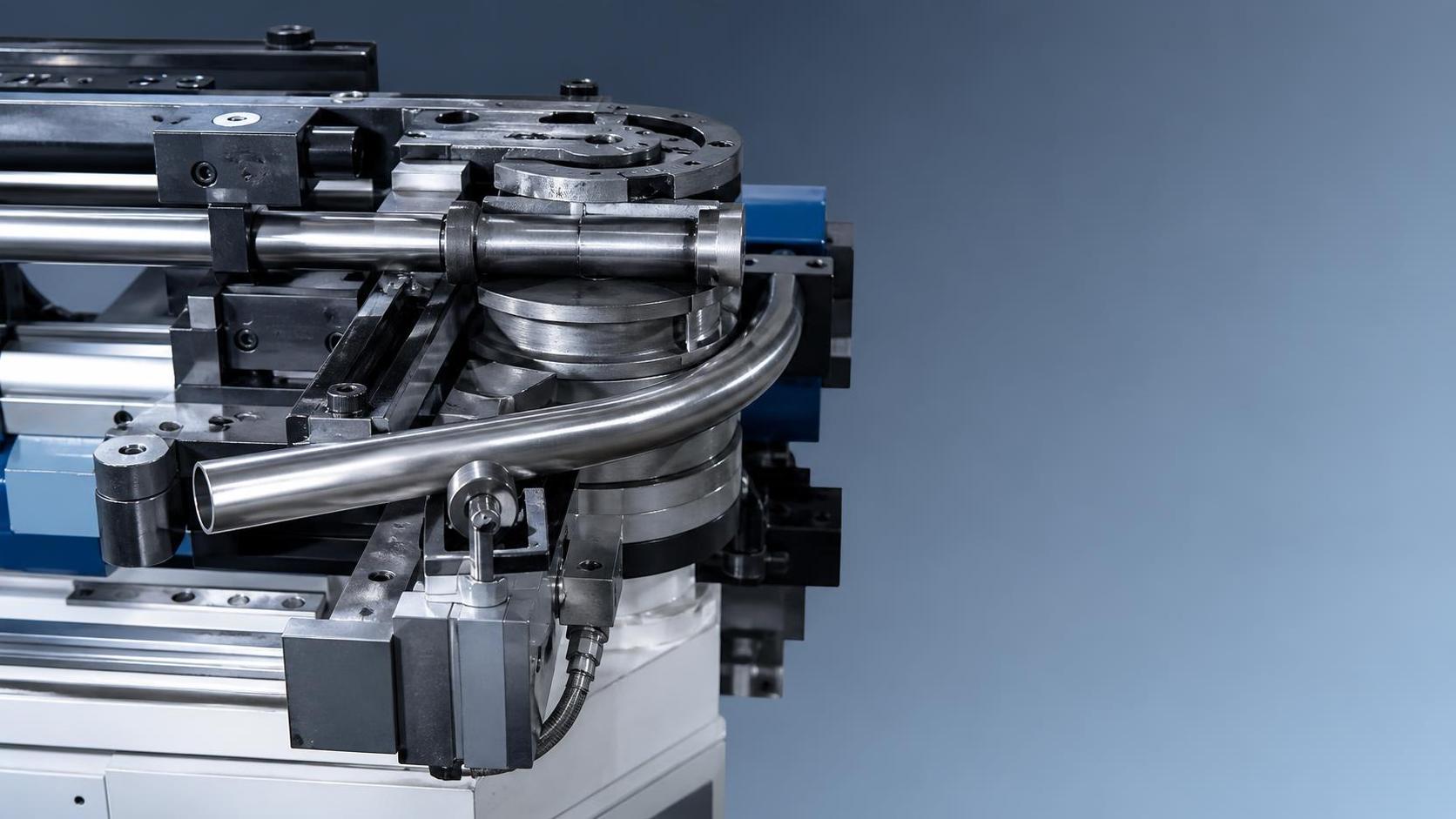
In tight-radius tube fabrication, wrinkling usually starts when the inside wall loses support and compressive forces exceed what the material can hold. A mandrel tube bending machine reduces that failure risk by supporting the tube internally during the bend, stabilizing wall flow, and helping operators keep the bend smooth, round, and dimensionally consistent.
For operators, the real value is practical: fewer rejected parts, less trial-and-error adjustment, and more predictable production on demanding jobs. Understanding how wrinkling forms, how the mandrel works with other tooling, and what setup details matter most makes it much easier to produce clean bends at small radii without sacrificing throughput.
Why Wrinkles Appear First in Tight-Radius Tube Bending
When a tube is bent, the outside wall stretches while the inside wall compresses. In a large-radius bend, the material usually has enough room to deform gradually. In a tight-radius bend, that deformation becomes concentrated in a much smaller zone, which sharply increases instability on the intrados, or inner bend surface.
Wrinkles form when the inner wall cannot stay supported under compression. Instead of flowing smoothly, the metal buckles into small waves or folds. Once those folds begin, the bend surface loses quality quickly, and the part may no longer meet dimensional or functional requirements.
Operators often see this problem in thin-wall tubes, softer materials, and parts with aggressive bend radii. Stainless steel, aluminum, and some mild steel tubing can all wrinkle if the tooling is mismatched, lubrication is poor, or the bending parameters are not balanced for the part geometry.
The key point is that wrinkling is not caused by one variable alone. It usually results from an interaction between tube size, wall thickness, material condition, bend radius, clamp pressure, wiper performance, mandrel position, and machine control. That is why tight-radius work requires a more controlled system than simple free bending.
What a Mandrel Tube Bending Machine Actually Does
A mandrel tube bending machine is designed to control deformation where the tube is most vulnerable. Its defining advantage is the use of an internal mandrel placed near the tangent point of the bend, where wall collapse and wrinkling are most likely to begin.
During bending, the mandrel supports the tube from the inside while the bend die pulls the material around the programmed radius. This internal support helps the inner wall resist buckling and helps the cross-section remain closer to its intended shape instead of flattening or folding.
The machine does not work through the mandrel alone. Good wrinkle control comes from the coordinated action of the bend die, pressure die, clamp die, wiper die, and mandrel. Each component manages a different part of material flow, and poor performance in one area can undermine the entire bending result.
For operators, this means that a mandrel tube bending machine should be viewed as a controlled forming system rather than a single anti-wrinkle device. The machine prevents defects best when tooling selection, setup accuracy, and feed conditions are matched to the specific tube and bend design.
How the Mandrel Prevents Inner-Wall Buckling
The mandrel works by filling the tube internally near the bend zone. This support reduces the amount of unsupported tube length exposed to compressive loading. With less unsupported material available to collapse inward, the inner wall is much more likely to deform smoothly instead of wrinkling.
In practical terms, the mandrel controls how the tube wall flows as it enters and passes through the tangent point. The metal still compresses on the inside, but the compression becomes more stable. Rather than accumulating in loose folds, it is distributed more evenly along the bend arc.
Ball mandrels are especially useful for tighter radii because they can follow the curvature of the bend more effectively than a simple plug style. Their articulated design allows support to continue deeper into the bend zone, which helps maintain wall integrity on more demanding geometries.
Correct mandrel positioning matters just as much as mandrel type. If the mandrel sits too far back, the inner wall is left unsupported where wrinkling starts. If it sits too far forward, friction increases and other defects may appear, including excessive drag, scoring, or instability in the bend start.
Why the Wiper Die Is Often Just as Important
Many operators focus on the mandrel and overlook the wiper die, but wrinkle prevention in tight-radius bending often depends heavily on both. The wiper die sits just behind the tangent point and helps stop the tube material from gathering into folds as the bend begins to form.
Its thin, carefully positioned edge wipes the material and limits the tendency of the inner wall to bunch up. When the wiper is adjusted correctly, it supports the transition into the bend and works with the mandrel to keep the inside surface smooth.
If wrinkles persist even with a mandrel installed, wiper condition and alignment are among the first things to check. A worn edge, incorrect angle, poor contact, or bad insertion depth can allow buckling to begin before the mandrel’s support has fully stabilized the tube wall.
This is why experienced operators troubleshoot the entire tooling package, not just the machine settings. On tight-radius jobs, the best results usually come from fine coordination between wiper geometry, mandrel nose position, pressure die force, and material lubrication.
Which Setup Factors Matter Most to Operators
For day-to-day production, operators usually care less about theory and more about what actually changes results. In most cases, wrinkle control improves fastest when attention is given to five areas: mandrel selection, mandrel position, wiper setup, lubrication, and pressure die behavior.
First, match the mandrel style to the bend severity and tube characteristics. A plug mandrel may be enough for less aggressive work, while a ball mandrel is often better for thin walls or very small radii. Using a simpler mandrel on a demanding bend usually increases wrinkle risk.
Second, adjust the mandrel position carefully. Small changes in insertion depth can produce a large change in bend quality. Operators should record successful settings by part number and material lot whenever possible, because repeatability is one of the biggest advantages of controlled tube bending.
Third, inspect the wiper die edge and fit before production starts. Even a good machine will struggle if the wiper is damaged or misaligned. Fourth, use lubrication appropriate to the material and tooling. Too little lubrication increases friction and drag, while poor lubricant choice can create inconsistent forming behavior.
Fifth, verify pressure die support. Inadequate pressure can let the tube drift or destabilize during bending, while excessive pressure may mark the surface or create unnecessary resistance. Stable support, rather than brute force, is usually what gives the cleanest results.
How to Recognize Whether Wrinkling Comes from Tooling, Material, or Process
Not every wrinkle has the same root cause, and operators save time when they diagnose the pattern correctly. If wrinkles appear immediately at the bend start, the problem often points to wiper position, mandrel location, or early-stage support failure around the tangent area.
If wrinkling develops progressively through the arc, the issue may be related to insufficient internal support, excessive clearance, poor lubrication, or a mandrel design that does not match the actual bend severity. This is common when switching to thinner walls without updating the tooling package.
If the problem appears only on certain material batches, the machine may not be the main cause. Variations in temper, hardness, surface finish, weld seam quality, or wall thickness can change how the tube responds under compression. A setup that works well on one batch may need adjustment on another.
Operators should also watch for related symptoms such as flattening, wall thinning, scoring, or slippage. These clues help identify whether the process is over-constrained, under-supported, or simply out of balance. Effective troubleshooting usually comes from reading the whole bend condition rather than chasing one defect in isolation.
What Machine Capability Means for Consistent Production
Even with good tooling, consistent anti-wrinkle performance depends on machine control and structural stability. Repeatable axis motion, secure clamping, smooth feed behavior, and accurate die alignment all affect whether the same setup produces the same bend across a full production run.
This matters especially in workshops that process multiple part types and need dependable switching between different jobs. A machine that holds position accurately and allows stable parameter control gives operators a much better chance of reproducing successful bend conditions without repeated manual correction.
Across metal fabrication, the same principle appears in other precision equipment as well: rigidity, servo control, and reliable positioning reduce variability and defect rates. For example, in structural steel processing, equipment such as the H beam 3D drilling machine improves repeatability by combining multi-axis control, rigid construction, and accurate feed coordination for demanding production tasks.
That comparison matters because bending quality is not only about forming theory. It is also about whether the machine platform can apply the chosen setup consistently, shift after shift, with minimal drift. In practice, stable mechanics and precise control make defect prevention much more reliable.
When a Mandrel Tube Bending Machine Is the Right Choice
A mandrel tube bending machine becomes especially valuable when the job involves tight centerline radii, thin-wall tubing, cosmetic surface requirements, or strict dimensional tolerances. In these conditions, unsupported bending methods often produce too much wrinkling, flattening, or variation to be acceptable.
It is also the right choice when scrap cost is high or rework disrupts downstream operations such as welding, fitting, or assembly. If bent parts must align accurately with fixtures, connectors, or enclosed flow paths, internal surface quality and bend consistency become more than cosmetic concerns.
For operators, one of the biggest advantages is process confidence. Once the correct setup is established, the machine can produce difficult bends with less guesswork. That reduces setup frustration and makes it easier to maintain quality when production volume increases or part geometry becomes more complex.
In facilities handling a wide range of fabrication tasks, the broader lesson is the same: specialized equipment earns its value when it addresses a defect mechanism directly. That is why manufacturers often pair advanced bending capacity with other dedicated production assets, including systems like the H beam 3D drilling machine, to improve accuracy and throughput across different process stages.
Practical Steps to Reduce Wrinkles Before They Start
Operators can reduce wrinkle risk significantly by building a disciplined setup routine. Start by confirming tube specification, wall thickness, material condition, and seam orientation. Then verify that the bend die radius, mandrel style, and wiper geometry are all appropriate for that exact tube.
Next, check tooling wear before running production parts. A small amount of wear at the wrong contact point can change bend quality enough to create defects. Confirm lubrication coverage, inspect clamping surfaces, and make a short test run before committing valuable material.
During test bending, evaluate more than the appearance of the outside radius. Inspect the inside wall for early wave formation, check ovality, measure springback, and compare the bend shape against the print. Small defects visible in the first trial often become major scrap issues in volume production.
Finally, document the successful setup in enough detail that another operator can repeat it. Good records should include tooling combination, mandrel location, wiper setting, lubrication type, machine parameters, and any material-specific notes. Repeatability comes from controlled knowledge, not memory alone.
Conclusion
A mandrel tube bending machine prevents wrinkles in tight-radius bending by supporting the tube internally where compressive instability is strongest and by working together with the wiper die and surrounding tooling to control material flow. That support is what helps the inner wall stay smooth instead of collapsing into folds.
For operators, the takeaway is clear: wrinkle-free bending depends on more than having a mandrel installed. The best results come from matching the tooling to the job, setting the mandrel and wiper precisely, maintaining lubrication and pressure balance, and using a stable, repeatable machine platform. When those elements are managed well, tight-radius bends become far more predictable, efficient, and production-ready.
search
Products Navigation
Send Us A Message