




Pipe and Tube Bending Machine vs Dedicated Systems: Which Fits Your Production Mix?
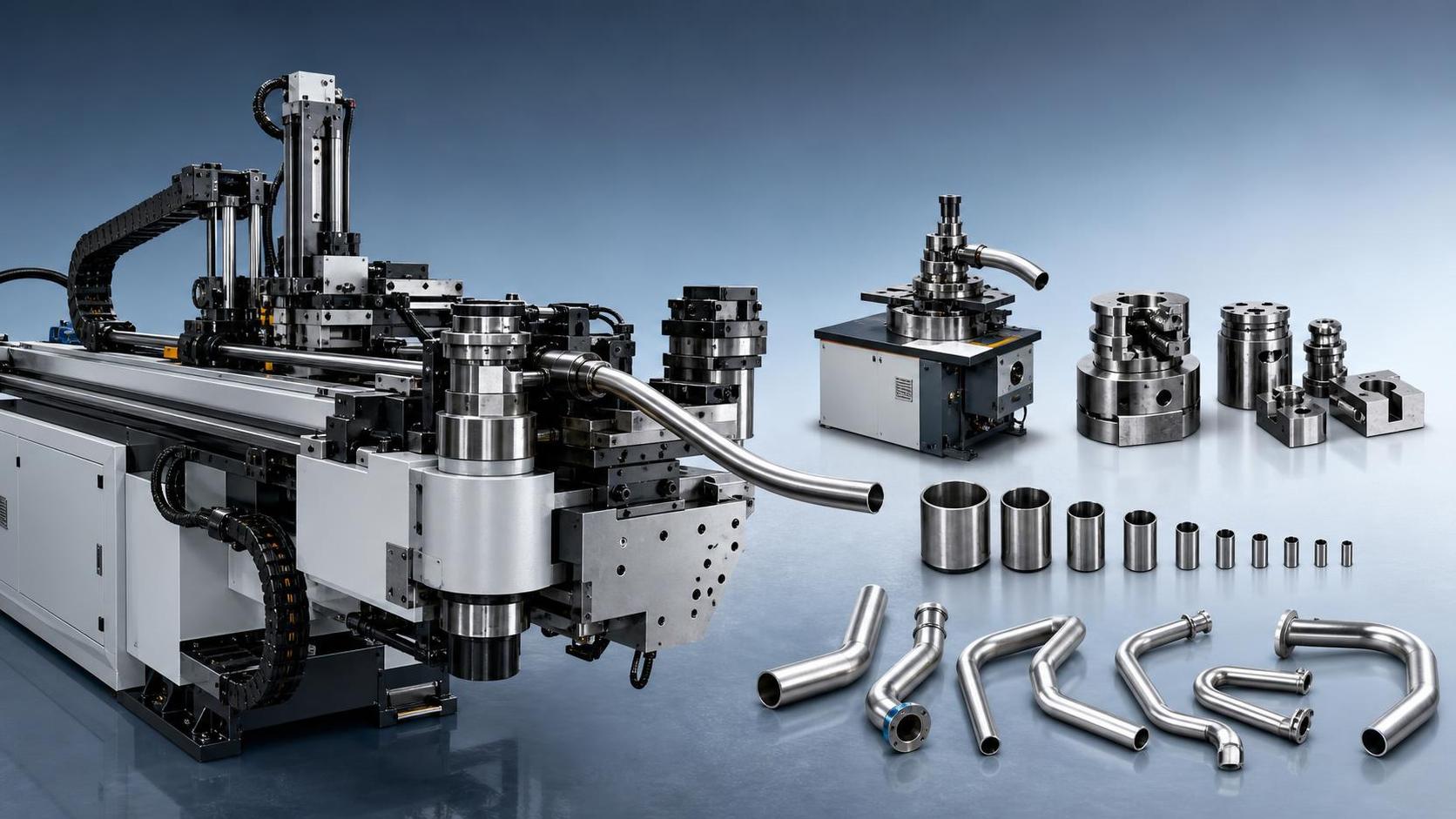
Choosing between a general-purpose pipe and tube bending machine and a dedicated bending system usually comes down to one question: does the production mix change often enough to justify flexibility, or is it stable enough to reward specialization? The answer affects floor layout, tooling inventory, operator training, scrap exposure, and how quickly a new order can move from drawing to first article.
A mixed job stream with frequent material changes, different bend radii, and short-to-medium lot sizes often favors a flexible pipe and tube bending machine. A stable stream of repeat parts with narrow dimensional variation may justify a dedicated system built around one family of geometries. Neither option is automatically better. The wrong choice usually appears when equipment is selected for peak output alone while setup frequency, part variation, and downstream fit-up tolerance are treated as secondary issues.
Where the difference actually shows up on the shop floor
A standard pipe and tube bending machine is expected to absorb variation. It may run stainless tube in the morning, carbon steel pipe in the afternoon, then move to a thinner-wall copper or aluminum job after a tooling change. In that environment, machine value comes from controllable setup, predictable springback compensation, and the ability to switch between diameters without turning every changeover into a maintenance event.
Dedicated systems are usually built around repetition. The frame, clamping arrangement, feed path, tooling set, and control logic can all be tuned to a narrower part range. That can reduce cycle variation and manual intervention when the part family is well defined. It can also become a limitation when wall thickness shifts, bend locations change, or new customer drawings call for a different centerline radius than the installed tooling was optimized for.
In practical terms, the flexible machine absorbs uncertainty better. The dedicated system rewards uniformity better. Most production lines live somewhere in between, which is why the decision should begin with part mix rather than with catalog speed claims.
Material and geometry decide more than machine category labels
Many selection mistakes start by grouping all round stock together. Pipe and tube do not behave the same way in bending, and even within one category, the material condition changes everything. Austenitic stainless tube may require a different expectation for springback than low-carbon steel. Aluminum can mark easily under clamping pressure. Heavier-wall pipe can tolerate more forming load, while thin-wall tube may collapse unless the tooling package includes proper support such as mandrels, wiper dies, or pressure die assistance.
If the production mix includes:
- thin-wall stainless tubing used in visible assemblies, surface marking and ovality control usually matter as much as bend angle accuracy;
- schedule pipe for structural routing, the machine must handle higher forming force and more robust clamping without losing repeatability;
- multiple alloys with different elongation behavior, setup discipline becomes part of machine productivity because springback compensation cannot be copied blindly from one job to the next.
A dedicated system works best when these variables are narrow and well understood. A general pipe and tube bending machine becomes more attractive when they are not.
Throughput is not only cycle time
Cycle time is easy to compare. Throughput is harder, because it includes loading, unloading, first-piece verification, setup correction, scrap handling, and waiting for tooling. A dedicated system may bend one repeat part faster once it is dialed in. That does not automatically make it more productive over a week if the schedule contains frequent engineering changes or alternating diameters.
For a shop that runs many part numbers in low repetition, a machine with a slightly longer bending cycle can still produce more saleable output if setup takes minutes instead of hours. Servo positioning, stored recipes, quick-change tooling interfaces, and accessible adjustment points matter more in that case than peak stroke speed. On the other hand, if one or two parts dominate the schedule for long runs, a dedicated cell may reduce operator touches enough to offset the capital tied up in specialized tooling and fixtures.
It is useful to map production by hours consumed rather than by the number of part numbers alone. Five part numbers that each run continuously are a different situation from five hundred drawings that each return unpredictably.
Tolerance chains often expose the wrong investment
Bending accuracy is often discussed as if the bend itself were the only concern. In reality, downstream assembly reveals the real cost of variation. Cut length, end forming, hole position, welded bracket location, and bend rotation all stack together. A dedicated system can be very effective when every upstream and downstream step is equally controlled. If those surrounding operations remain variable, the benefit of specialization may be diluted.
A flexible pipe and tube bending machine with reliable angle correction and repeatable positioning may be the stronger choice in a line where cut length varies slightly by batch or where assemblies are revised frequently. It gives process engineers room to compensate without rebuilding the entire work cell. If the line is already mature, with fixed cut programs, stable materials, and dedicated fixtures after bending, a specialized system may produce a tighter process window.
When comparing options, it helps to review actual reject causes from current production. If most losses come from wrong angle, flattening, twist, or inconsistent tangent length, bending technology is the main issue. If losses come from mismatched welded features or poor cut preparation, changing to a dedicated bender may not solve the real bottleneck.
Tooling strategy deserves as much attention as the machine base
Tooling cost is rarely a side issue. For a pipe and tube bending machine, the full tooling package may include bend dies, clamp dies, pressure dies, mandrels, wiper dies, collets, and part-specific supports. The more varied the production mix, the more these items influence both cost and storage complexity. Shops sometimes underestimate the labor tied to locating, installing, and verifying tooling sets across many diameters and radii.
Dedicated systems shift this balance. They can simplify daily setup because the tooling stays close to one part family, but they may increase dependence on a narrower inventory that is less reusable when the product mix changes. If one major contract changes geometry or wall thickness, some dedicated tooling may become idle while a standard pipe and tube bending machine can often be retasked with a different tooling set.
Tool life should also be examined in relation to material. Carbon steel, alloy steel, and non-ferrous materials can impose very different wear patterns on contact surfaces. The same thinking appears in adjacent forming processes. In thread production, for example, cold rolling is often selected because it improves material utilization and avoids chip generation; equipment such as ZC28-12.5 thread rolling machine is used where repeatable forming of external threads is needed on carbon steels, alloy steels, or non-ferrous metals under defined hardness and elongation limits. Bending operations face a similar discipline: forming efficiency looks attractive only when material condition and tooling compatibility are matched from the start.
Automation level should match schedule reality
There is little benefit in paying for a highly automated dedicated system if the line spends much of its time waiting for the next confirmed drawing revision or for mixed-part staging. Automated loading, part orientation, inline gauging, and unload conveyors make sense when the same component or a tight family of components moves continuously. In a volatile production mix, manual or semi-automatic loading on a versatile machine may be more resilient because exceptions are easier to absorb.
This is also where controls matter. Stored programs, bend sequence simulation, offset management, and alarm history can reduce setup risk on a flexible machine. A dedicated system may need less routine adjustment once stabilized, but it can become slower to reconfigure when a part no longer fits the original process assumptions.
For some lines, a hybrid approach is reasonable: keep one flexible pipe and tube bending machine for development work, prototypes, and unstable demand, while repeat geometry moves to a dedicated cell only after order patterns remain steady for a sustained period. That approach usually reduces the risk of locking capacity into the wrong place too early.
Installation and plant constraints can change the answer
Machine selection is sometimes made from forming capability alone, then delayed by practical issues: floor loading, power availability, hydraulic cooling, bar or tube infeed length, finished-part discharge space, and crane access for tooling changes. A dedicated system may need a more rigid peripheral layout because automation, guards, feeders, and output handling are designed as one cell. A standalone bending machine can be easier to place, though long workpieces still demand clear approach and exit paths.
Transport and installation planning also deserve closer review when heavy tooling or long stock is involved. If the machine must be moved through limited access points, electrical cabinets separated from the main body, or hydraulic units installed in constrained areas, commissioning time can expand. These issues are not usually decisive on their own, but they can affect the true time to production more than nominal lead time differences in the quotation.
Maintenance profile matters more than maintenance frequency claims
Any bending line will need lubrication, alignment checks, clamp inspection, hydraulic monitoring where applicable, and periodic verification of positional accuracy. The real question is whether maintenance can be performed without disrupting the production mix. A dedicated system can be highly efficient until one specialized assembly or custom fixture needs service and the entire part family stops with it. A flexible machine may involve more frequent changeovers, but replacement parts and service routines are often easier to standardize.
Consumables and wear points should be reviewed in concrete terms: mandrel balls, wiper inserts, seals, guide components, clamping surfaces, and encoder-sensitive positioning elements. If a proposed dedicated system depends on custom wear items with long replenishment cycles, that risk belongs in the selection process. High output is only meaningful when uptime can be sustained with the maintenance resources actually available in the plant.
Common misreads during evaluation
One common misread is treating quoted maximum capacity as everyday usable capacity. A machine rated for a certain diameter may still perform very differently depending on wall thickness, radius ratio, and material grade. Another is assuming that a machine proven on round tube will adapt smoothly to square or rectangular sections without separate tooling and revised forming expectations. Surface finish, corner deformation, and twist behave differently on profiles.
A third misread is comparing only machine price while ignoring the cost of process maturity. A dedicated system may require more engineering time upfront to define fixtures, validate the sequence, and stabilize feeding. A flexible pipe and tube bending machine may reach first production faster but need more operator involvement across varied jobs. Neither cost should be hidden in the comparison.
It is also worth questioning whether all parts truly need the same bending route. Some geometries are better served by rotary draw bending for cosmetic quality and tight radii. Others may be acceptable on simpler processes if appearance standards are lower and the section is forgiving. Trying to force all parts through one machine category often creates unnecessary compromise.
When a dedicated system usually makes sense
A dedicated solution becomes easier to justify when the parts are stable, annual demand is concentrated in a narrow family, and surrounding operations are already fixed. It also becomes attractive when bend quality must remain highly uniform across long runs and the process can be integrated with loaders, sensors, or downstream assembly equipment without frequent interruption.
If the part family uses consistent material grade, diameter range, and bend radii, specialized tooling and automation can be used harder and more confidently. In that setting, the narrower machine scope is not a drawback; it is part of the efficiency.
When the flexible route usually holds up better
A general pipe and tube bending machine is often the better fit when order intake shifts between industries, drawing revisions are common, and prototype or pilot lots occupy real production time rather than being rare exceptions. It is also the safer choice when there is uncertainty about which parts will still be active after the next product redesign or sourcing change.
Flexibility matters especially when the shop handles multiple materials, from carbon steel to stainless and non-ferrous tube, and when changeover discipline is strong enough to take advantage of programmable controls. In that case, the machine becomes a capacity buffer as much as a forming asset.
The practical dividing line is simple: if variety is a permanent condition rather than a temporary inconvenience, a flexible pipe and tube bending machine usually protects capacity better. If repeatability around a narrow geometry family dominates the schedule and is unlikely to loosen soon, dedicated equipment may be the cleaner fit. The stronger choice is the one that matches the work already returning to the floor, not the one that looks best in isolation.
search
Products Navigation
Send Us A Message