




When a cantilever welding robot suits large workpiece welding
When a Cantilever Welding Robot Suits Large Workpiece Welding
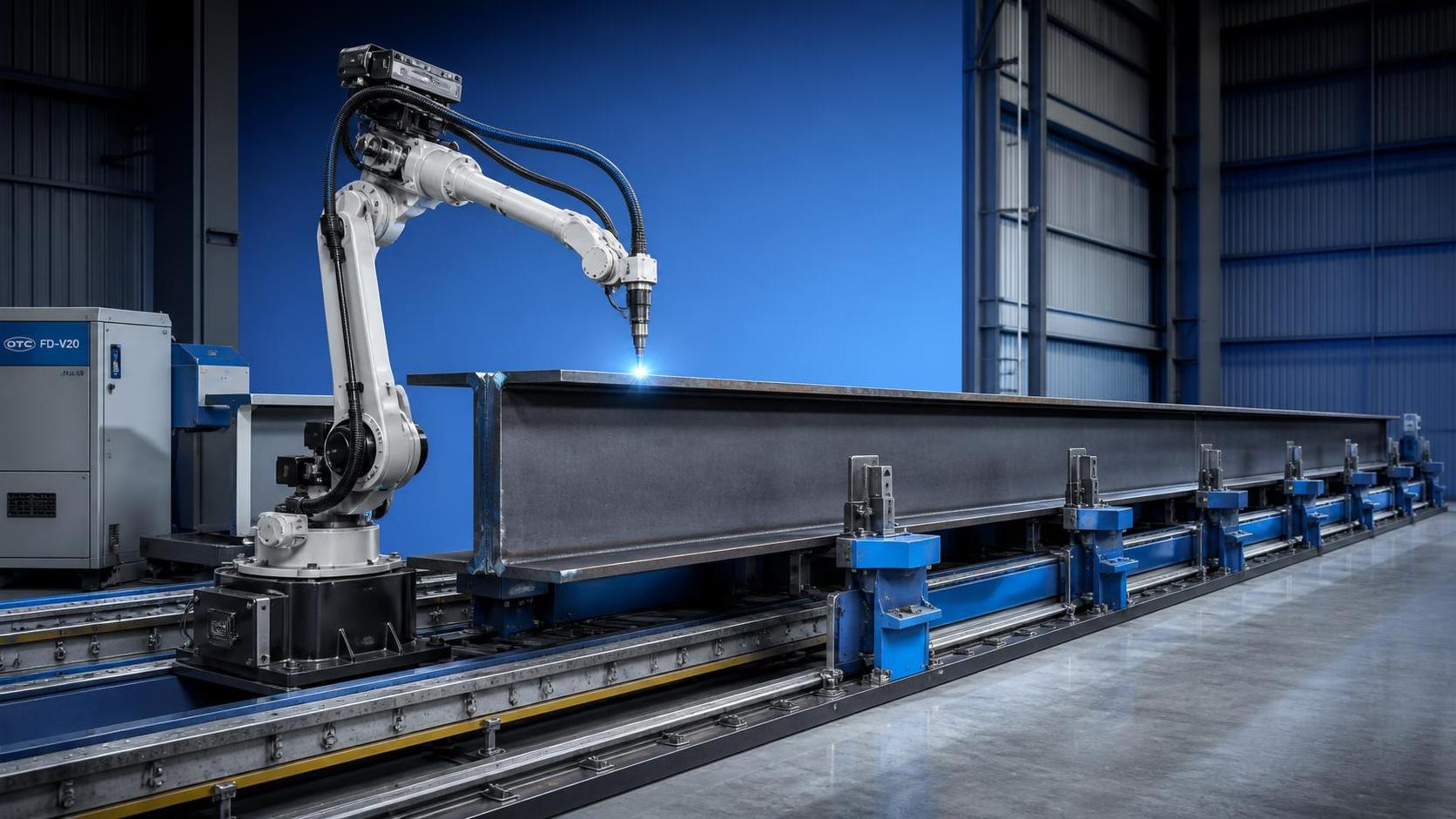
For oversized fabricated structures, the central question is rarely whether welding can be automated. It is whether automation can reach the welds without creating a material-handling problem bigger than the welding problem itself. A cantilever welding robot is often a strong answer for long beams, gantry frames, bridge sections, heavy machinery bases, structural modules, and similar assemblies that are awkward to rotate or repeatedly move between stations.
Unlike a conventional robot cell built around a fixed pedestal and compact safety enclosure, a cantilever arrangement places the robot on a travelling beam or extended horizontal structure. The robot can move along the length of the workpiece while maintaining a controlled welding path. This changes the production logic: instead of bringing every large part to the robot in several positions, the robot travels to the part.
That does not mean a cantilever welding robot is automatically the best choice for every large component. It works particularly well when the product family has repeatable geometry, weld access is reasonably open, and the cost of manual repositioning has become a persistent bottleneck. Technical evaluation should begin with the actual fabrication flow, not with the robot specification sheet.
The Real Trigger: Workpieces That Are Large but Still Repeatable
The best candidates are not simply the heaviest parts. They are parts that combine large dimensions with recurring weld patterns. A 12-metre frame with consistent longitudinal fillet welds may be easier to automate than a smaller assembly with highly variable brackets, frequent design changes, and inaccessible corners.
Fabricators usually begin considering a cantilever welding robot when one or more of these conditions appear on the shop floor:
- Operators spend substantial time turning, lifting, clamping, or re-aligning large weldments.
- Long straight welds must be repeated across a series of beams, columns, box sections, or fabricated frames.
- Manual weld quality changes noticeably between shifts or between experienced and less experienced welders.
- The required welds are physically demanding, such as long horizontal fillets, overhead positions, or repetitive welds along deep structural members.
- A rotary positioner would be impractical because of part weight, workpiece length, unbalanced geometry, or limited available floor space.
In structural steel and heavy equipment fabrication, moving the part is often more expensive in lost time than it first appears. Crane use, fixture adjustments, waiting for clearance, and safety checks all interrupt arc-on time. A travelling cantilever system does not eliminate handling completely, but it can reduce the number of times a large workpiece must be repositioned before welding is complete.
The strongest fit is usually a product with a stable length range and predictable joint locations. For example, fabricated H-beam components, long machine beds, heavy-duty support frames, ship section subassemblies, and modular bridge members can often justify a rail-based robot arrangement when their welding sequence is repeated often enough.
Why Reach Matters More Than Robot Payload
A common evaluation mistake is to focus first on robot payload. Payload matters when the torch package, wire feeder, seam-tracking equipment, and any special tooling create a meaningful load. But for large workpiece welding, reach geometry is usually the more decisive issue.
The cantilever must cover the usable work zone without forcing the robot into poor wrist angles near the start or end of the beam. It also needs enough vertical clearance to reach the top surface, web, flange, and side joints as required. A layout that looks acceptable in a simple plan view can fail in practice when clamps, tack welds, stiffeners, lifting lugs, or temporary supports obstruct the torch approach.
Before specifying rail length or arm reach, it is worth mapping the weld envelope rather than only the part envelope. The weld envelope includes the space needed for torch angle, cable movement, arc start and stop, collision avoidance, cleaning access, and safe operator access for loading. This is particularly important on box structures and frames with internal corners. A robot may physically reach the joint but still be unable to maintain the required work angle throughout the seam.
For long assemblies, the travel axis must also maintain suitable stiffness and alignment. Small deviations in the rail or supporting structure can become visible over a long weld path, especially when the application requires consistent bead placement close to an edge. The robot itself may have good repeatability, but the entire mechanical system determines the real path accuracy at the torch.
Joint Accessibility Decides More Projects Than Expected
A cantilever welding robot is most comfortable with joints that can be approached from one or two predictable directions. Long fillet welds, lap joints, butt joints on prepared plates, and repetitive stiffener welds are generally more manageable than welds hidden behind dense reinforcement.
The difficult cases are not always obvious during quotation. Consider a large frame with cross-members installed before welding. If the torch must pass through narrow openings, turn sharply around gussets, or weld behind brackets, access may be restricted even though the main structure is open. The right response is not necessarily to abandon automation. Sometimes the assembly sequence can be changed so the robot completes accessible seams before secondary components are fitted.
This is where experienced fabricators gain the most from early engineering discussion. Automation may require changing fixture design, tack-weld locations, component orientation, or the order in which subassemblies are built. If those changes are acceptable, the robot can simplify production. If the existing process cannot change, a more flexible manual or semi-automatic arrangement may remain the sensible choice.
Do Not Treat Gap Variation as a Programming Issue Alone
Large fabricated parts naturally introduce variation from cutting, fit-up, thermal movement, and fixture wear. A programmed path is not a cure for inconsistent joint preparation. If joint gaps or part location vary outside a manageable range, the robot can produce inconsistent welds quickly and repeatedly.
Touch sensing, laser seam tracking, or arc-based tracking may be appropriate depending on the process and joint type, but these should be selected for a known production issue, not added as a vague insurance policy. Seam tracking can help the system follow a joint; it does not correct poor bevel preparation, severe distortion, contaminated surfaces, or unsuitable fit-up. The practical starting point is still fixture discipline and a realistic tolerance review.
Production Volume: Enough Repetition, Not Necessarily Mass Production
A cantilever welding robot does not require automotive-scale volume. Heavy fabrication is often low to medium volume, with a range of related workpieces. What matters is whether there is enough recurring welding content to recover the time spent on programming, fixture preparation, and changeover.
A workshop producing one-off architectural structures with continuous design changes may struggle to keep the robot productively loaded. By contrast, a manufacturer building several variants of a recurring frame family may obtain good utilization if the parts share datum points, joint types, and loading methods. The robot program can then be adapted rather than rebuilt from the beginning for each variation.
Evaluators should compare total cycle time rather than weld speed alone. The useful calculation includes part loading, clamping, tack welding, calibration, scanning or sensing where used, robot travel, welding, cleaning, inspection, unloading, and any rework. An automated system that creates a long queue at loading is not fully solving the bottleneck. In some shops, two workstations served by one travelling gantry or cantilever arrangement make more sense than a single isolated cell, provided safety zoning and scheduling are properly designed.
Floor Layout and Safety Are Part of the Machine Specification
A cantilever system can be space-efficient because it follows the workpiece length, but it still needs a carefully protected operating area. The travelling robot, arc radiation, fume, wire feed path, and crane activity all need to be considered together. A long rail installed beside an active production aisle may look convenient until material deliveries and overhead lifting repeatedly interrupt the robot cycle.
There must be clear separation between robot movement and operator tasks. Interlocked guarding, safety scanners, fenced areas, access gates, and safe loading zones depend on the layout and local requirements. The solution should be reviewed as a complete production cell, including welding power source, extraction, electrical routing, gas supply, and workpiece transfer. Treating safety hardware as an afterthought often leads to expensive revisions after installation.
Fume extraction also deserves early attention. A robot can increase arc-on consistency, which may raise the average welding activity in a given area. Local extraction design should account for the workpiece shape and the robot travel range. On deep beams or enclosed frame sections, fumes do not always behave as they do at a bench welding station.
Upstream Preparation Can Make or Break Robotic Welding
Robotic welding is downstream of cutting, drilling, bending, machining, and fit-up. When those operations are unstable, the welding cell inherits the variation. This is why a fabrication line should be assessed as a connected process rather than a group of standalone machines.
For assemblies that incorporate bent tube or pipe sections, repeatable bend geometry helps downstream fixtures locate the component correctly. An NC hydraulic pipe bending machine can be relevant where a practical, programmable bending solution is needed before robotic assembly. Features such as PLC-based programming, servo-controlled rotation, stored bend records, and slow mandrel retraction are useful because they support repeatability and bend appearance. The actual suitability still depends on pipe material, diameter, wall thickness, bend radius, and the tolerance required by the welded assembly.
The same principle applies to plate cutting and edge preparation. If bevel angles vary or cut edges require excessive cleanup, robot cycle time will be consumed by problems that should have been solved earlier. Technical teams should identify which dimensional features are critical to robotic location and include them in routine incoming or in-process checks.
Integration Questions Worth Asking Before Approval
The supplier discussion should go beyond robot brand and travel length. A well-scoped project normally addresses the welding process, workpiece range, fixture concept, quality requirements, maintenance access, operator training, and acceptance criteria. Welding procedure requirements, consumable selection, and inspection methods should be aligned before programming begins, particularly for structures subject to project-specific codes or customer specifications.
It is also sensible to ask how the system will behave when production is less than ideal. How are minor part variations handled? How long does a product changeover take? Can an operator safely intervene after a wire-feed fault? Which consumables are locally available? Is remote troubleshooting possible, and what site support is expected during commissioning? These questions tend to reveal whether the proposed solution is designed for daily operation or only for a demonstration layout.
Wuxi Samgins International Trade Co., Ltd., established in 2012 in Wuxi, Jiangsu Province, supplies welding automation alongside CNC cutting equipment, machine tools, H-beam production equipment, and sheet-metal processing machinery. Its exposure to equipment requirements across overseas markets, including Southeast Asia, Europe, the Americas, and Oceania, is relevant when a project involves coordinating several fabrication processes rather than purchasing a robot in isolation. Production and design requirements should nevertheless be confirmed against the applicable project documentation, including any ISO 9001 or CE-related expectations for the delivered equipment.
A Practical Decision Rule
A cantilever welding robot is usually a good fit when the workpiece is too long, heavy, or awkward to reposition efficiently; the welds recur across a stable product family; and the joints can be reached with reliable torch angles. It becomes less attractive when every assembly is unique, fit-up is uncontrolled, welds are heavily obstructed, or the factory cannot allocate a protected linear workspace.
The most useful next step is to review actual drawings, weld maps, part weights, current handling steps, and a representative production schedule. A few hours spent examining those details can prevent a system from being oversized, underutilized, or forced into joints that should remain manual. For large workpiece welding, the right automation choice is usually the one that reduces handling and variation without making the fabrication process more rigid than the product mix allows.
search
Products Navigation
Send Us A Message