




Where Welding Robots Deliver the Greatest Value in Steel Structure Fabrication
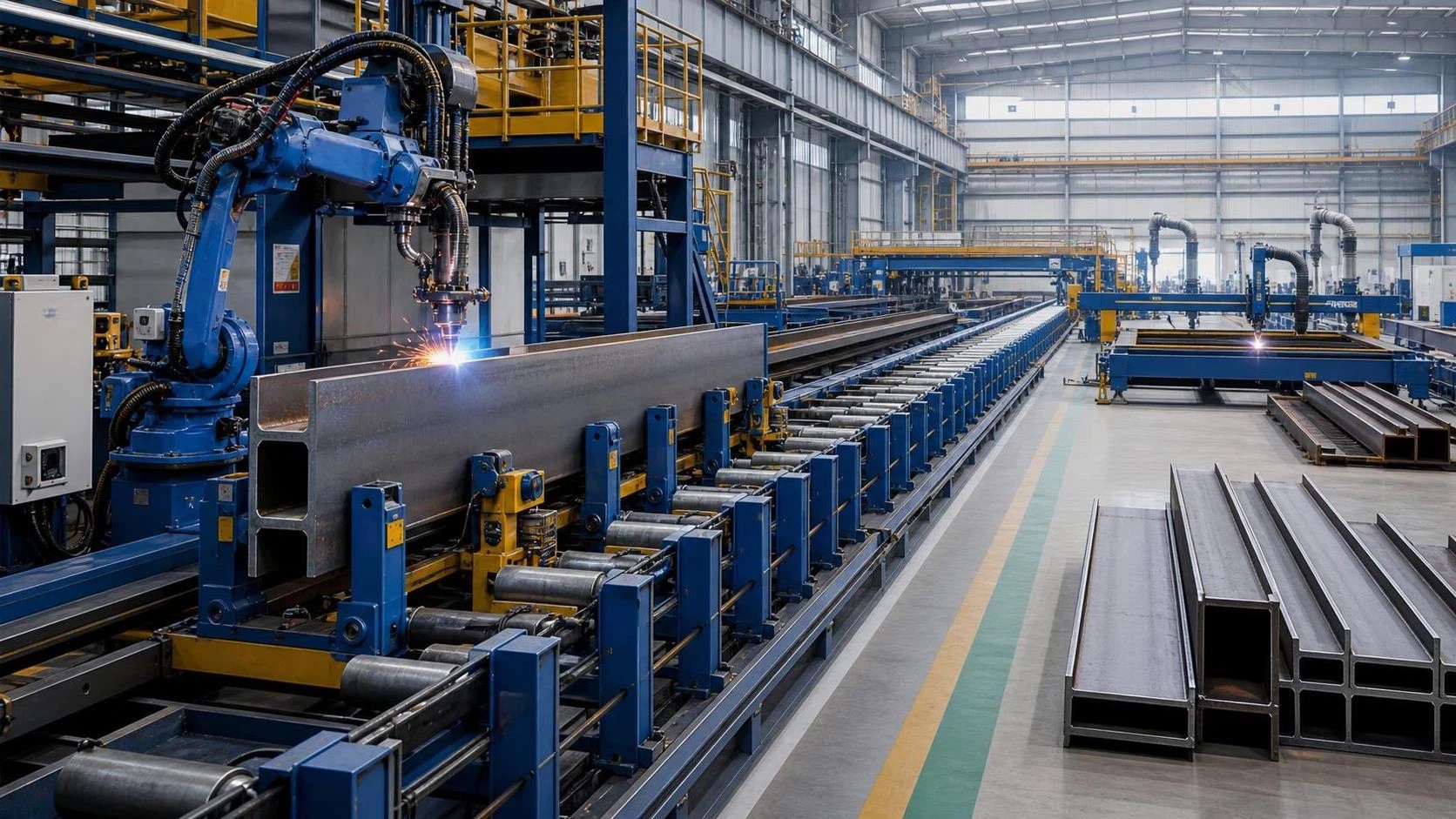
Where Welding Robots Deliver the Greatest Value in Steel Structure Fabrication
For steel structure fabricators, a welding robot for steel structures delivers the greatest value where repeatability, throughput, and weld consistency directly affect project margins.
From H-beams and columns to trusses and heavy assemblies, automated welding helps manufacturers reduce labor bottlenecks, improve quality control, and scale production with confidence.
The key management question is not whether automation is modern, but whether a specific welding operation has enough volume, repetition, and downstream impact to justify investment.
Robots create the strongest returns when manual welding creates schedule risk, inconsistent quality, excessive rework, or dependence on a small number of highly skilled operators.
They are less compelling for highly variable, low-volume custom work where fixture changes, programming effort, and material handling consume more time than welding itself.
Start With the Highest-Value Decision: Which Work Is Repetitive Enough?
Decision-makers should begin by mapping actual production routes rather than selecting equipment based solely on weld speed or advertised robot payload capacity.
The best candidates have recurring joint geometries, stable part dimensions, predictable material grades, and production batches large enough to absorb setup and programming time.
Steel structures often combine repetitive components with bespoke assemblies, making selective automation more practical than attempting to automate every welding activity immediately.
For example, repeated beam-to-plate connections, column stiffeners, flange seams, and bracket assemblies usually offer a clearer automation case than one-off architectural features.
A useful screening method compares annual weld length, part repetition, current labor hours, rework rate, delivery penalties, and the number of times fixtures change.
When the same family of parts appears across several projects, a welding cell can generate value even if no individual order seems exceptionally large.
Managers should also identify work that repeatedly waits for certified welders, because bottleneck relief can be financially more important than raw arc-on-time improvement.
A robot does not eliminate the need for skilled people; it shifts skilled labor toward setup, supervision, quality review, complex joints, and exception handling.
H-Beams and Built-Up Sections Often Produce the Fastest Returns
H-beam and built-up beam fabrication is among the strongest applications for a welding robot for steel structures because dimensions, seams, and workflows are often standardized.
Longitudinal flange-to-web welding can require extensive manual arc time, especially where producers must process repeated members for industrial buildings, warehouses, bridges, and platforms.
Automated beam lines maintain travel speed, torch angle, wire feed, and weld position more consistently than manual operations performed across long production shifts.
That consistency matters because uneven weld profiles and intermittent defects may trigger inspection failures, corrective work, delayed coating, and disruption to the next process.
For high-volume beam work, integrated handling is as important as the robot itself. Infeed, positioning, clamping, turning, and outfeed determine practical throughput.
Fabricators should evaluate the complete line cycle, including fit-up, tack welding, loading, welding, cooling, inspection, and transfer to straightening or finishing stations.
A robot that welds quickly but waits for manually positioned beams cannot provide the productivity gains reflected in its nominal welding specifications.
Where beam sizes vary substantially, adjustable fixtures, programmed recipes, and reliable datum references become essential to preserve utilization across product families.
Columns, Stiffeners, and Base Plates Benefit From Repeatable Positioning
Structural columns commonly include repetitive base plates, cap plates, diaphragms, stiffeners, and connection details that can create substantial manual welding workloads.
These operations are especially suitable when fabricators produce standard building frames, transmission structures, equipment supports, pipe racks, or modular industrial units.
Robotic welding improves process discipline by applying the same programmed sequence to comparable joints, reducing variation between operators and between shifts.
For management teams, this supports more predictable quality records, easier training, and fewer cases where production output depends on individual welding preferences.
Base plate welding can be valuable when the fabrication shop receives repeat orders with consistent column profiles and plate configurations.
However, poor fit-up will still undermine results. Robots require components to arrive within agreed dimensional tolerances and fixtures to hold parts securely during welding.
Before automating, manufacturers should measure gap variation, plate distortion, hole location accuracy, and the reliability of upstream cutting and assembly processes.
Automation investments deliver stronger outcomes when they correct a defined workflow rather than attempt to compensate for uncontrolled part preparation.
Truss and Lattice Production Can Improve Capacity, With Important Limits
Trusses, lattice girders, and tubular framework can be attractive robot applications when chords, braces, angles, and node details repeat across multiple modules.
These products frequently involve many short welds, creating hidden labor losses from repositioning, measuring, tacking, and moving around complex assemblies.
A robotic cell can reduce nonproductive motion when fixtures present joints consistently and positioners rotate or tilt assemblies into accessible welding orientations.
The commercial value is often strongest for standardized roof trusses, solar support structures, modular racks, tower segments, and recurring equipment frames.
Yet truss fabrication requires careful feasibility work because minor dimensional variation can move joints outside the programmed torch path.
Seam-tracking systems, touch sensing, laser sensing, and adaptive programming can help, but they add cost and should address a verified production need.
For highly customized trusses, a flexible robot may still support tack welding or subassembly work while final welding remains manual.
This hybrid approach can improve throughput without forcing a facility to automate assemblies that change too frequently for efficient programming.
Heavy Assemblies Gain From Better Ergonomics and More Stable Quality
Heavy steel assemblies often create an automation case even at moderate volumes because manual welding may involve difficult positions, heat exposure, lifting, and safety risks.
Examples include crane components, machine bases, large frames, structural modules, offshore subassemblies, and heavy equipment supports with repeated connection details.
In these environments, robot value extends beyond labor substitution. It can reduce operator fatigue and improve weld consistency on joints that are physically demanding.
Positioners, manipulators, and synchronized axes are frequently necessary so the robot can access welds while maintaining favorable welding positions.
The investment should therefore be evaluated as a cell, including handling equipment, guarding, fixtures, fume extraction, safety controls, and inspection capability.
Managers should resist comparing a complete robotic cell only with the purchase price of a manual welding power source.
The appropriate comparison includes labor availability, overtime, injury exposure, quality losses, project delay costs, floor-space requirements, and expected production growth.
When heavy assemblies require repeatable multi-pass welds, programmed parameters can also support more consistent heat input and documented welding procedures.
Robotic Welding Delivers More Value When Upstream Cutting Is Controlled
Welding automation begins before the arc starts. Inconsistent cut edges, poor hole placement, inaccurate bevels, and distorted plates create fit-up problems that reduce robot utilization.
For this reason, steel fabricators should assess cutting, nesting, material identification, edge preparation, and part marking as part of the automation decision.
Reliable CNC cutting can improve joint repeatability by producing parts that locate correctly in welding fixtures and require less manual correction.
For medium-thickness and thin conductive sheet components, a Table type cnc plasma cutting machine can support automated preparation of carbon steel, stainless steel, and non-ferrous materials.
Its practical relevance is not simply cutting speed; it is the ability to supply consistent parts to downstream assembly and robotic welding operations.
Features such as CAD/CAM nesting, responsive torch-height control, breakpoint recovery, and dust extraction can help maintain stable material flow in a busy shop.
Fabricators should verify that cutting accuracy, kerf characteristics, heat effects, and edge condition are suitable for the joint type and applicable welding procedure.
Where cutting quality varies, improving part preparation may provide a better first investment than installing a robot into an unstable fabrication process.
Quality Gains Must Be Measured Beyond Visual Weld Appearance
A welding robot for steel structures can improve consistency, but quality outcomes depend on validated parameters, suitable consumables, correct joint preparation, and disciplined inspection.
Management teams should define quality targets before purchase, including weld profile consistency, penetration requirements, defect rates, repair hours, and inspection acceptance results.
Visual inspection remains important, but it should be supported by the appropriate non-destructive testing methods for the project specification and weld category.
Robotic programs can improve traceability by standardizing travel speed, current, voltage, wire feed, sequence, and other defined welding variables.
That traceability is particularly valuable for fabricators serving customers with strict documentation requirements, including infrastructure, energy, industrial, and export projects.
However, a robot cannot independently solve qualification requirements. Welding procedure specifications, operator qualifications, material control, and inspection plans still require management oversight.
Suppliers should demonstrate representative weld samples using the customer’s actual material thicknesses, joint designs, and expected production conditions whenever possible.
A factory trial with simplified sample parts can be useful, but it is not enough to predict performance on real assemblies with gaps, tolerances, and handling constraints.
Calculate Return on Investment With a Full Production Model
Robot return on investment should be based on total production economics rather than a simplistic calculation of welder wages divided by machine cost.
Start with the current baseline: labor hours per assembly, welding time, setup time, rework, consumable use, overtime, delays, and average weekly output.
Then model the future state realistically, including programming, fixture preparation, preventive maintenance, operator training, loading, unloading, and planned downtime.
The most credible business case identifies where capacity will be used after automation, whether through faster delivery, higher output, improved margins, or reduced subcontracting.
Labor savings alone may not justify every project, particularly where headcount cannot be reduced. Capacity recovery and schedule reliability can be stronger benefits.
For example, a fabricator may retain its welders but redirect them from repetitive beam work to high-margin custom assemblies that previously caused delivery bottlenecks.
It is also important to include the cost of quality failures. Repairs can consume floor space, delay blasting and painting, and affect shipment commitments.
A well-designed automated cell often creates financial value by reducing variability across several stages, not by maximizing welding speed in isolation.
Choose the Right Automation Level for the Product Mix
Not every steel fabricator needs a fully integrated automated line. The appropriate solution depends on part volume, product diversity, floor layout, and available technical support.
A basic robot cell may suit repeatable brackets, plates, and subassemblies, while beam production may require dedicated conveying, clamping, turning, and welding systems.
Flexible robotic systems can serve mixed production environments, but flexibility usually requires more sophisticated fixtures, sensing, programming, and operator capability.
Dedicated systems generally achieve higher throughput for stable products, yet they can become underutilized when market demand changes or project specifications shift.
Decision-makers should therefore distinguish between current order volume and sustainable demand over the expected life of the equipment.
They should also ask whether the machine can accommodate likely part sizes, weld types, future products, and local electrical or safety requirements.
Equipment suppliers with mechanical fabrication experience can provide greater value when they assess the entire material flow rather than only the robot model.
For international projects, buyers should confirm applicable quality systems, CE expectations, installation support, commissioning scope, spare-parts availability, and remote service arrangements.
Implementation Risks Are Manageable When Addressed Early
The most common automation failures are usually operational rather than technological: unstable fit-up, insufficient fixturing, weak training, unrealistic cycle assumptions, and poor material flow.
Successful implementation begins with a representative pilot family of parts, clear ownership, measurable targets, and a documented process for handling exceptions.
Production, quality, maintenance, engineering, and safety teams should all participate before the system is ordered, not only after installation begins.
Operators need practical training in loading, program selection, consumable checks, fault recovery, fixture verification, and escalation when actual parts differ from programmed assumptions.
Maintenance planning should cover torch cleaning, wire feeding, cable condition, sensor checks, calibration, backups, and availability of critical spare parts.
Management should expect an optimization period after commissioning. Initial programs often require adjustment once the cell encounters normal production variation.
That learning period should be included in launch planning, customer commitments, and financial forecasts rather than treated as an unexpected performance failure.
With disciplined preparation, the robot becomes a repeatable production asset rather than an isolated demonstration of automation capability.
Conclusion: Focus Automation Where It Changes the Economics of Fabrication
The greatest value from robotic welding comes from repeatable steel structure work where labor constraints, quality variation, and delivery pressure directly reduce profitability.
H-beams, built-up sections, columns, stiffeners, recurring trusses, and heavy assemblies are often the most promising starting points because their work is measurable and repeatable.
A welding robot for steel structures should be selected through a production-system evaluation that includes cutting accuracy, fit-up, fixtures, handling, quality requirements, and future demand.
For business leaders, the right decision is rarely “robot or no robot.” It is identifying the specific fabrication bottleneck where automation will create dependable operational and financial value.
search
Products Navigation
Send Us A Message