




Automating Pipe Fabrication Welds for Consistent Root Passes and Higher Throughput
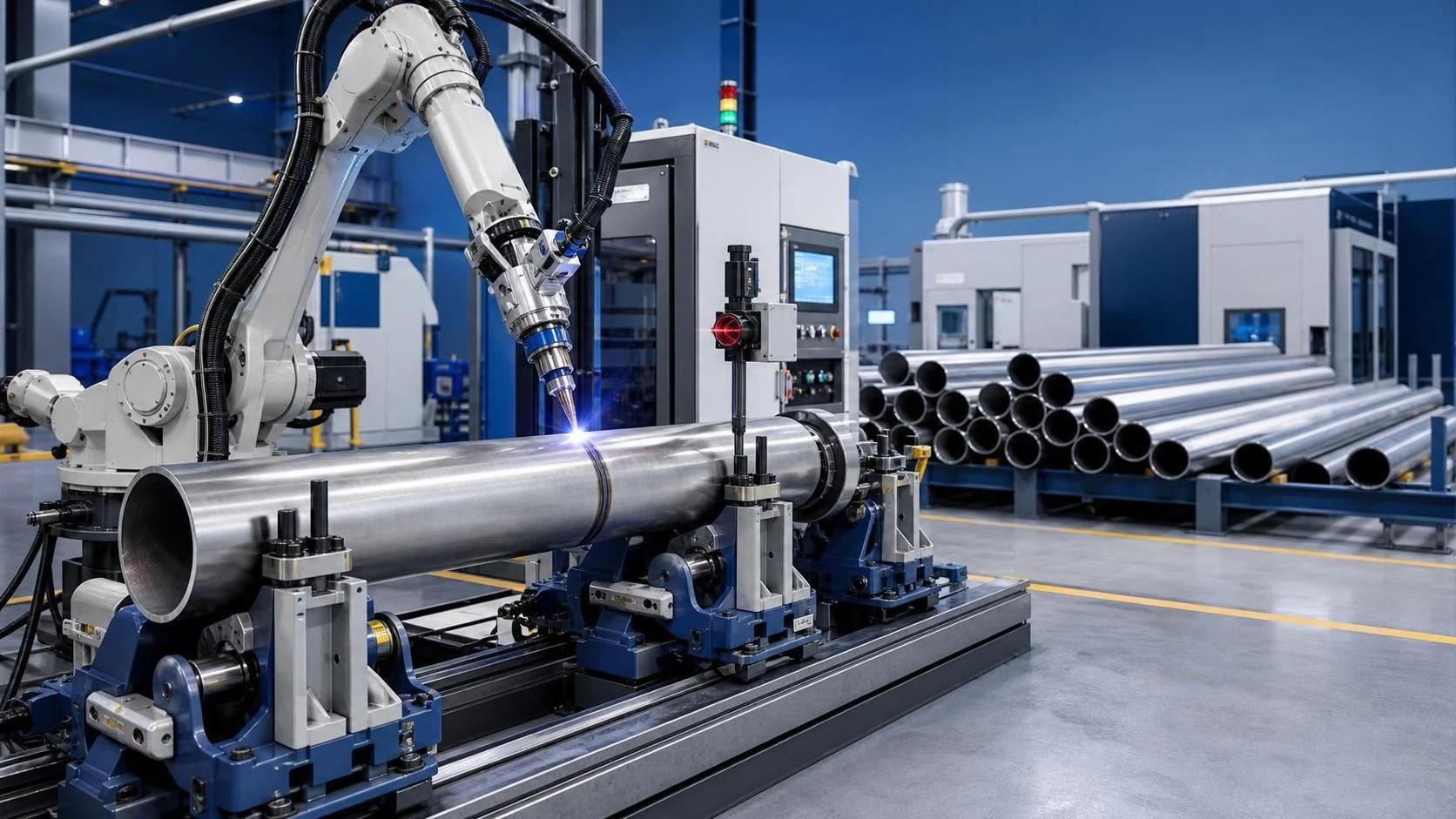
Why the root pass remains the decision point
Pipe fabrication projects rarely fall behind because a shop cannot deposit weld metal quickly. They fall behind because the first pass is inconsistent, fit-up problems surface too late, inspection queues grow, and rework consumes the capacity that was supposed to support the next spool or module. For project managers working against fixed delivery dates, the root pass is therefore more than a welding detail. It is an early indicator of whether production can remain predictable.
A welding robot for pipe fabrication can help address that problem, particularly where joint geometry, material grades, and production volumes are sufficiently repeatable. Its value is not simply that it replaces manual arc time. The more meaningful benefit is the ability to control a critical process window: joint preparation, torch position, travel speed, wire feed, shielding gas coverage, heat input, and pass sequence can be managed with far less variation than a workflow that depends entirely on individual operator technique.
That does not mean every pipe shop should automate every weld. The strongest business case usually appears in projects with recurring diameters, common bevel preparations, high joint counts, demanding traceability requirements, or a sustained backlog. Before selecting equipment, project leaders need to understand where root-pass variation originates and whether automation can remove the actual constraint rather than merely make one station look faster.
The problem is often upstream of welding
When a root pass shows lack of penetration, excessive penetration, internal undercut, incomplete fusion, or unstable bead profile, the welding cell is an obvious place to investigate. But the robot is frequently inheriting a problem created earlier in the process. Inconsistent cut length, poor end squareness, variable bevel angle, contamination, ovality, excessive root gap, and weak tack-weld discipline can all make an otherwise capable automated program unreliable.
This distinction matters during project planning. A robot can repeat a programmed motion accurately; it cannot make badly prepared joints become consistent simply through repetition. If incoming pipe dimensions vary beyond the fixture’s tolerance, the system may spend more time seeking, correcting, or rejecting joints than producing them. The result is disappointing utilization, even though the welding equipment itself is functioning as specified.
For this reason, an automation assessment should follow the material path from cutting through fit-up, rather than start with the welding cell alone. The practical questions include:
- How consistent are pipe outside diameter, wall thickness, and end preparation across suppliers and heat lots?
- Can the shop maintain root gap and hi-lo within the limits assumed by the qualified welding procedure?
- Are tack weld locations and tack quality compatible with the planned automated weld path?
- Is the workpiece rigidly located, rotated, and supported throughout the full welding cycle?
- Can part identification, weld procedure selection, and inspection records follow the spool without manual reconstruction?
If these answers are unclear, the first investment may need to be improved preparation, fixturing, measuring, or internal logistics. Automation is most effective when it is applied to a stable process, then used to make that process repeatable at higher output.
What a robotic root-pass cell actually changes
In a manual operation, an experienced welder continuously compensates for changing gap, bevel condition, position, and heat behavior. That flexibility is valuable for one-off repairs and highly variable assemblies. It also means that results can differ between shifts, operators, and fatigue levels. In a controlled robotic cell, the process is organized around a defined joint family and a repeatable recipe.
Depending on the application, that recipe may combine pipe rotation, robotic torch motion, seam finding, touch sensing, arc-voltage control, vision-based alignment, or other adaptive functions. The exact configuration matters less than the operating principle: the equipment should detect or constrain relevant variation before it becomes a defect, while keeping the torch and weld parameters within the limits established by the welding procedure specification.
For root passes, the most important controls are commonly torch-to-joint position, travel speed, root opening, and heat input. A small change in any of these may affect penetration and internal profile. Automated control can improve consistency, but project teams should avoid treating “robotic” as a guarantee of weld acceptance. Qualification still depends on the material, joint design, process, position, consumables, shielding gas, and applicable code requirements.
For pressure piping, structural pipe assemblies, or customer-controlled fabrication work, the system should be evaluated against the applicable welding procedure qualification and inspection plan. Requirements may derive from contract specifications, customer standards, or codes such as ASME, API, AWS, EN, or ISO standards, depending on the project and jurisdiction. The applicable requirements must be confirmed for each job; a machine supplier’s general capability statement is not a substitute for procedure qualification or customer approval.
Throughput is a system measure, not a robot speed figure
It is easy to compare equipment using advertised welding speed or cycle time. That is rarely enough for a project manager. The useful measure is completed, accepted joints per shift, including loading, alignment, tack preparation, program selection, welding, cooling where relevant, unloading, inspection, and repair. A cell that welds quickly but waits for material, fixtures, or an inspector will not materially improve project throughput.
Consider two common production patterns. In the first, a shop produces hundreds of similar elbows, reducers, and straight-pipe spool joints for a repeat industrial package. Repeatability is high, and fixtures can be designed around a limited range of diameters. Here, the cell can operate with short changeovers and a clear queue of prepared work. In the second, a shop produces custom assemblies with frequent diameter changes, branch connections, restricted access, and inconsistent incoming material. A robot may still be useful, but the expected gain will be lower unless the job mix is segmented and the cell is reserved for suitable weld families.
A realistic capacity model should include planned availability, changeover time, expected intervention rate, inspection hold points, and likely rework. It should also distinguish between arc-on time and labor time. A robotic station may reduce direct welding labor per joint while increasing the importance of a skilled technician who can manage fixtures, parameters, programs, maintenance, and fault recovery. The labor profile changes; it does not disappear.
Select the cell around the joint family
The phrase “pipe welding robot” covers a wide range of equipment. Some systems are designed for circumferential welds on rotators, some for fixed-pipe work, some for branch connections, and some for integrated fit-up and welding lines. The right choice depends on the joint family that creates the greatest schedule pressure.
Start with a production map, not a generic machine specification. List the pipe diameter range, wall thickness range, material groups, joint configurations, annual or project volume, required weld positions, access constraints, and inspection acceptance criteria. Then identify the small number of joint types that account for the largest share of repetitive work. In many fabrication environments, automating those families first produces more useful capacity than attempting to create a universal cell for every exception.
Fixture design deserves the same attention as the robot. A highly capable manipulator cannot compensate indefinitely for workpieces that shift, sag, or are loaded inconsistently. Supports need to protect alignment without obstructing torch access. Rotators must match the workpiece weight and center-of-gravity range. Clamping must be repeatable but should not distort thinner-wall pipe. Where multiple spool geometries are expected, quick-change tooling may be justified, but only after its cost and setup discipline are included in the business case.
Material preparation also affects the economics of the entire cell. Shops fabricating associated brackets, supports, or thin sheet components may need bending equipment that maintains repeatable geometry before those parts reach fit-up. For example, Electro-hydraulic synchronize cnc press brakes can be relevant in a broader fabrication workflow where accurately formed thin-sheet components with side walls or changing profiles must be prepared consistently. This is not part of the pipe root-pass process itself, but it illustrates a wider point: weld-cell performance is influenced by the dimensional stability of the components that arrive at assembly.
Quality control should move closer to the process
Automation creates an opportunity to collect more useful production evidence, but only when the data is connected to decisions. Recording current, voltage, travel speed, wire feed, program number, operator login, and weld completion time can support traceability. On its own, however, a large data log does not prove weld quality. The project team must decide which parameters are meaningful, how they relate to the approved procedure, who reviews deviations, and what response is required when a limit is exceeded.
A practical quality plan usually combines prevention, verification, and feedback. Prevention includes controlled preparation, consumable management, correct program selection, and fixture checks. Verification may include visual examination, dimensional checks, internal profile confirmation where feasible, and non-destructive testing according to the project specification. Feedback means that defect trends are reviewed by cause: is the issue linked to a material batch, a program, a fixture position, a consumable lot, a shift pattern, or a specific joint type?
This is where robotic welding can provide a significant management advantage. Manual defects often lead to broad conclusions such as “operator inconsistency.” A controlled cell can narrow the investigation. If a defect pattern is associated with a repeatable parameter change or a particular handling condition, corrective action can be more targeted. The same transparency can reveal inconvenient facts, including that the root cause lies outside welding.
Common assumptions that weaken the investment case
The first assumption is that automation is justified mainly by headcount reduction. In pipe fabrication, the more defensible case is often schedule reliability, reduced repair load, stable quality, and the ability to allocate experienced welders to complex work that does not suit the cell. A labor-only calculation can understate the value of fewer delays and lower reinspection demand, while also ignoring the cost of programming, technical support, and maintenance.
The second assumption is that one robot can cover all pipe work. A broad operating envelope may look attractive, but flexibility can bring longer changeovers, more complicated fixtures, and less stable cycle times. A narrower cell dedicated to a high-volume joint family may produce a better operational result than an ambitious “all-purpose” installation.
The third assumption is that the robot supplier owns the outcome after commissioning. The supplier should be evaluated for application knowledge, commissioning support, training, documentation, spare-parts availability, and the ability to support the selected process. Yet the fabrication company remains responsible for maintaining prepared work, trained personnel, qualified procedures, inspection discipline, and clear ownership of the cell’s daily performance.
Finally, teams sometimes assume that full automation must be the first step. Semi-automatic orbital equipment, mechanized welding heads, positioners, automated seam tracking, or digital parameter capture can sometimes solve the immediate bottleneck with less integration risk. The correct level of automation is the one that improves accepted output without creating a fragile process that the shop cannot sustain.
How to structure a lower-risk implementation
A phased introduction is often more reliable than a large, single launch. Select one repeatable joint family with a visible quality or capacity problem. Establish its baseline: completed joints per shift, repair rate, inspection turnaround, direct labor, setup time, and schedule impact. Confirm the fit-up standard and weld procedure before the equipment arrives. Then run production trials using representative materials and realistic operator handoffs, rather than ideal demonstration pieces.
Acceptance criteria should be agreed in advance. They may include repeatability of fit-up, target cycle time, weld quality results, changeover duration, traceability records, operator intervention rate, and maintainability. Targets should be based on the shop’s actual production history and contract needs, not on a best-case demonstration. Any financial calculation should include fixtures, safety integration, utilities, training, qualification work, programming, planned maintenance, spare parts, and the temporary productivity loss that can occur during ramp-up.
For project managers, the central question is not whether automated welding is more advanced than manual welding. It is whether the process can convert recurring pipe work into a controlled production flow with fewer root-pass surprises. Where joint preparation is stable, volumes are sufficient, and quality records matter, a welding robot for pipe fabrication can become a practical scheduling tool as much as a welding tool. Where those conditions are absent, improving the upstream process may deliver the more immediate and durable result.
search
Products Navigation
Send Us A Message