




Which Tube Bender Spare Parts Are Usually Needed After Two Years?
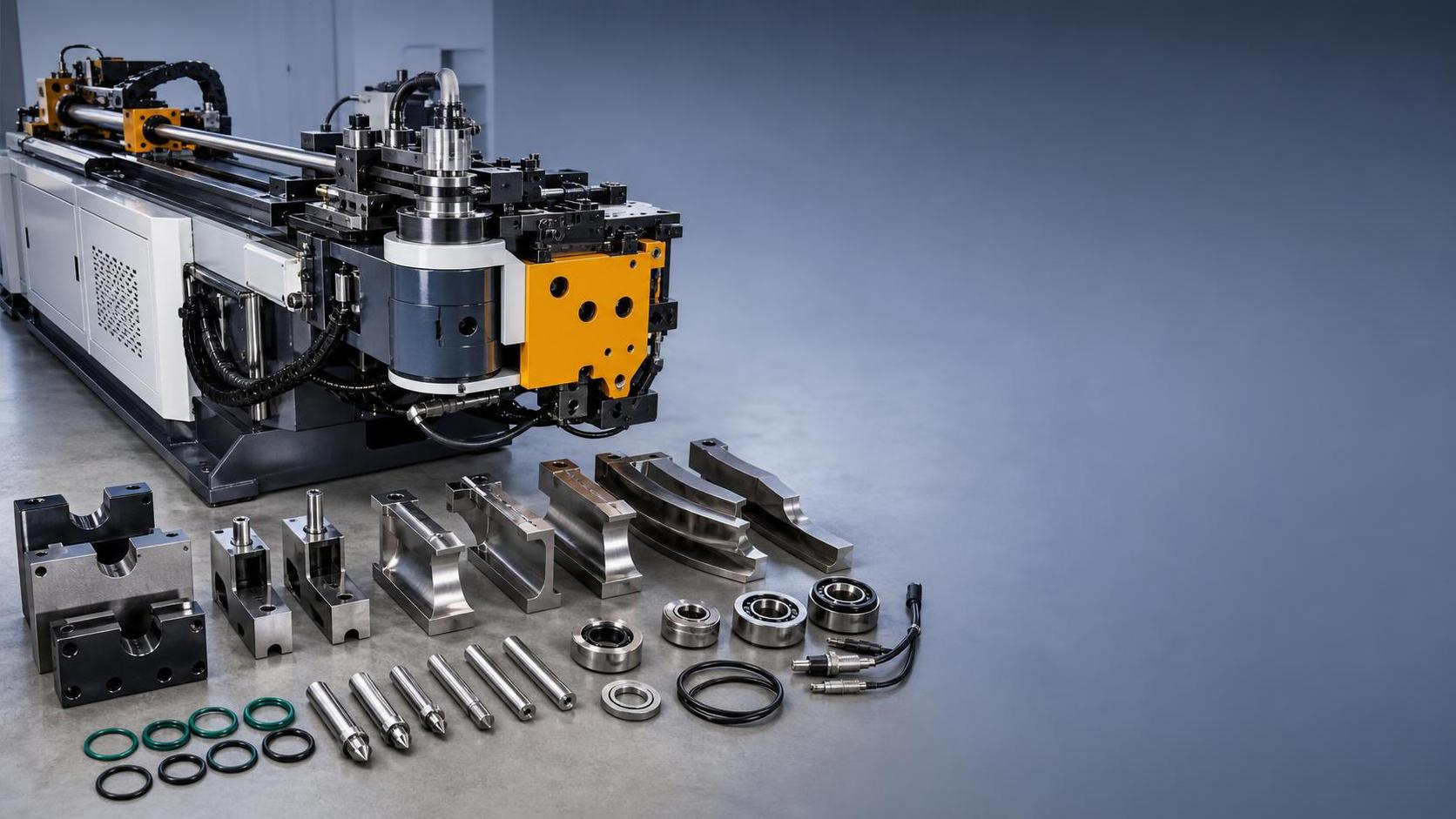
It usually starts with a small change that is easy to ignore. A tube bender that has been running reliably for months begins leaving slightly inconsistent angles. The operator notices a little more marking on the tube surface, or the machine needs more adjustment between jobs than it used to. Nothing looks dramatic, so production continues. Then one day the bend quality drops enough to slow the line, and the maintenance team is suddenly trying to answer a very practical question: What spare parts are most commonly needed for a tube bender after two years?
This is a common point in the life of bending equipment. After about two years of regular use, wear starts showing up not only in the obvious tooling but also in seals, slides, electrical switching parts, and hydraulic components. If these parts are not identified early, the machine may still run, but it often runs with lower repeatability, higher scrap risk, and more unplanned stops. In a fabrication shop, that usually costs more than the parts themselves.
The difficulty is that many people focus only on the die set. That is understandable because dies are visible and directly tied to the bend. But when a machine begins to drift, the real cause can sit elsewhere. Sometimes a pressure die is worn. Sometimes the clamp die no longer holds as evenly as before. In other cases, the issue is a leaking seal, a tired guide component, or a hydraulic valve that no longer responds as smoothly as it should. A useful maintenance approach is not to guess from one symptom alone, but to connect the symptom to the wear pattern.
Where wear usually appears first
For most tube benders in regular service, the first category to inspect is the tooling that directly contacts the tube. Clamp dies, pressure dies, bend dies, wiper dies, and mandrel-related parts take repeated mechanical load. Over time, edges lose sharpness, working surfaces become polished or uneven, and clearances change. Even slight wear can show up as tube slippage, flattening, wrinkling, or more visible tooling marks.
Clamp dies are often among the first parts to attract attention because they determine how securely the tube is held during rotation and feed. If the holding force becomes inconsistent due to wear on the contact face, the operator may compensate by increasing pressure. That can create a new problem: surface damage on the tube. In practice, when both slip and marking appear together, checking clamp die condition makes sense before changing process settings too aggressively.
Pressure dies are another frequent replacement item after extended use. They guide the tube during bending and help control deformation. Once their contact surfaces wear unevenly, the tube may no longer move through the bend with the same resistance from one cycle to the next. Shops often describe this as the machine becoming “touchy,” meaning a setup that worked before now needs frequent correction.
Bend dies do not always need replacement as quickly as some other parts, but they should not be ignored. If a bend die groove shows wear, especially with mixed material batches or high-volume production, the impact can be subtle at first: angle variation, slight ovality, or inconsistent springback behavior. Wiper dies, especially in tighter-radius work, also deserve attention because edge condition matters a great deal. A worn wiper edge can lead to wrinkles that operators sometimes mistake for a material issue.
Parts that fail quietly rather than visibly
Not all commonly needed spare parts are large or easy to see. Seals, O-rings, guide bushings, wear pads, bearings, rollers, and limit switches often create problems gradually. A machine may continue operating while these parts deteriorate, which is why they are frequently discovered only after bend quality has already been affected.
Hydraulic seals are a good example. After around two years, especially in shops with heavy cycles, temperature changes, or contamination risk, seals can harden, wear, or begin leaking internally. External leakage is easy to notice. Internal leakage is less obvious, but it can cause reduced holding force, delayed movement, pressure instability, or drift in positioning. If the machine seems slower to clamp or release, or if pressure no longer feels consistent during repeated cycles, seal wear is worth checking.
Guide components matter for the same reason. Slides, linear guide blocks, wear strips, and bushings help maintain alignment between moving parts. As these wear, the machine may not lose function completely, but it loses smoothness and positional confidence. The result is often vibration, uneven force transfer, or a slight side movement that eventually appears in the bend result.
Electrical wear parts also belong on the list. Proximity sensors, limit switches, connectors, cables near moving axes, and sometimes foot switch components can all suffer from fatigue or contamination. These do not always fail in a clean on-off way. Intermittent signals are common, and they are frustrating because they can mimic programming problems. If a machine occasionally misses a position confirmation or stops unpredictably at the same stage of the cycle, basic electrical spare parts should be inspected before assuming a control system fault.
Symptoms that point to specific spare parts
When people ask, What spare parts are most commonly needed for a tube bender after two years?, they usually want a parts list. A list is useful, but symptoms are more useful because they tell you where to start.
If the tube slips during bending, inspect the clamp die face, clamping mechanism, hydraulic pressure stability, and related seals. If the bend angle varies between otherwise identical tubes, check bend die wear, pressure die condition, machine alignment, and any looseness in guide assemblies. If wrinkles increase on the inside radius, look closely at the wiper die edge, mandrel setup, and pressure die support. If flattening becomes more noticeable, inspect support tooling and verify that worn guide or pressure components are not allowing unstable tube movement.
Unusual noise is another clue. A scraping or chattering sound near moving assemblies often points to wear pads, guide rails, or bearings rather than the die itself. A delayed response in hydraulic motion can indicate valve wear, seal problems, or contamination in the hydraulic circuit. Repeated overtravel alarms or inconsistent home positions are often tied to sensors, stops, or small mechanical locator parts that have worn or shifted.
Tube surface marking should not automatically be blamed on material hardness. In many cases, the cause is worn tooling contact surfaces, debris trapped in a die groove, or operators increasing clamp pressure to make up for lost grip. Replacing the wrong part can waste time, so it helps to inspect the machine in the same sequence every time rather than reacting only to the most visible symptom.
A practical way to decide what to stock
Not every spare part needs to be kept on the shelf, but some do. A sensible spare strategy after two years is to divide items into three groups: high-wear tooling, high-interruption service parts, and lower-frequency structural parts.
High-wear tooling includes clamp dies, pressure dies, wiper dies, mandrel noses, collets, and sometimes bend dies depending on usage. These are closely linked to product quality and should be evaluated based on the materials being bent, bend radius, lubrication condition, and production volume. If your machine runs a narrow range of tube sizes repeatedly, these tooling items are often the most logical parts to prepare in advance.
High-interruption service parts include seals, O-rings, hydraulic hoses where applicable, solenoid-related service items, proximity switches, limit switches, rollers, wear pads, springs, and consumable guide elements. These parts may not be expensive compared with main tooling, but when one fails unexpectedly, the machine can stop altogether. Their value lies in avoiding a long wait for a simple replacement.
Lower-frequency structural parts include major shafts, core machine frames, and larger assemblies that generally do not require routine replacement unless there is damage, poor lubrication, or prolonged operation with unresolved wear elsewhere. These are not usually the first concern at the two-year point, but they can become a concern if smaller wear items have been ignored for too long.
Why some machines seem to need parts earlier than others
Two years is not a fixed rule. A machine in light, clean, well-lubricated service may need little more than seals and a few guidance parts. Another machine of the same model may need several tooling replacements sooner if it bends abrasive material, runs long shifts, changes sizes often, or operates with marginal maintenance habits.
One common mistake is assuming that spare needs depend mainly on age. In reality, cycle count, material type, lubrication quality, setup discipline, and operator habits usually matter more. A machine that frequently runs with incorrect clamp pressure, poor lubrication, or contaminated tooling will wear faster in very predictable places. That is why maintenance records, even simple ones, matter. They help separate normal wear from wear caused by process issues.
Another mistake is replacing only the obviously damaged part. In bending equipment, paired wear is common. A worn pressure die may have been wearing against a guide component that is also no longer true. A leaking seal may have been caused by contamination or a scored rod surface. If the related cause is left in place, the new part may not last as expected.
A useful inspection routine before ordering
Before placing a spare parts order, it helps to inspect the machine with the next production run in mind. Start with the parts that touch the tube. Clean the tooling thoroughly and inspect for scoring, uneven contact polishing, edge breakdown, groove wear, and any buildup that could change contact pressure. Compare left and right wear if applicable rather than looking only at the most damaged spot.
Then move to movement accuracy. Check whether slides travel smoothly, whether guide blocks or bushings show looseness, and whether there is backlash or side play where there should be none. If your machine uses hydraulic clamping and feed support, observe pressure behavior through a complete cycle rather than at idle. A cylinder that appears fine when stationary may behave differently under repeated motion.
After that, inspect the simpler electrical items. Confirm sensor mounting, cable condition, switch response, and connector tightness in areas exposed to movement, coolant mist, dust, or vibration. A surprising number of “major” faults turn out to come from minor switching or signal issues.
Only after those checks does it make sense to decide whether the machine needs immediate replacement parts, a preventive order for the next shutdown, or just closer observation. This approach is more reliable than ordering every part that seems remotely related to the symptom.
When replacement is better than adjustment
Operators and maintenance teams often try to recover performance through pressure changes, offset adjustments, or slower cycle settings. That can be reasonable for short-term control, but it is not always the right long-term decision. If a die surface is worn, increasing clamp pressure may hold the tube for a while but can worsen tube marking. If guide wear is causing instability, software compensation will not restore mechanical support. If seal wear is causing hydraulic inconsistency, repeated tuning may simply hide a part that should already have been replaced.
A good rule is this: if the machine requires more frequent adjustment than before to produce the same bend, a physical wear point is probably involved. At that stage, replacement is usually more productive than continuing to compensate around the problem.
Getting the right parts without creating new problems
Ordering spare parts for a tube bender is not only about naming the machine model. Tooling geometry, tube size range, bend radius, material application, and machine configuration all affect compatibility. This is especially important for clamp dies, pressure dies, mandrels, and wiper dies. Even when a part looks similar, small dimensional differences can change bend quality or shorten service life.
For that reason, it helps to prepare part drawings, serial information, tooling dimensions, photos of wear areas, and a short description of the symptom before contacting a supplier. Companies involved in mechanical equipment supply and fabrication machinery can usually support this process more effectively when the problem is described in functional terms rather than only as “the machine is not bending well.” The clearer the inspection record, the easier it is to match the part to the actual issue.
After two years of use, the most commonly needed spares are usually not mysterious: clamp dies, pressure dies, wiper dies, mandrel components, seals, guide parts, rollers, bearings, sensors, and some hydraulic service items. The harder part is deciding which of these are actually responsible for the quality change you are seeing. If you approach the machine symptom by symptom, and if you treat tooling wear and support-component wear as connected rather than separate, the answer becomes much easier to reach.
In other words, the most practical response to the question What spare parts are most commonly needed for a tube bender after two years? is not just a shelf list. It is a habit of inspecting the right areas before the next quality issue turns into downtime.
search
Products Navigation
Send Us A Message