




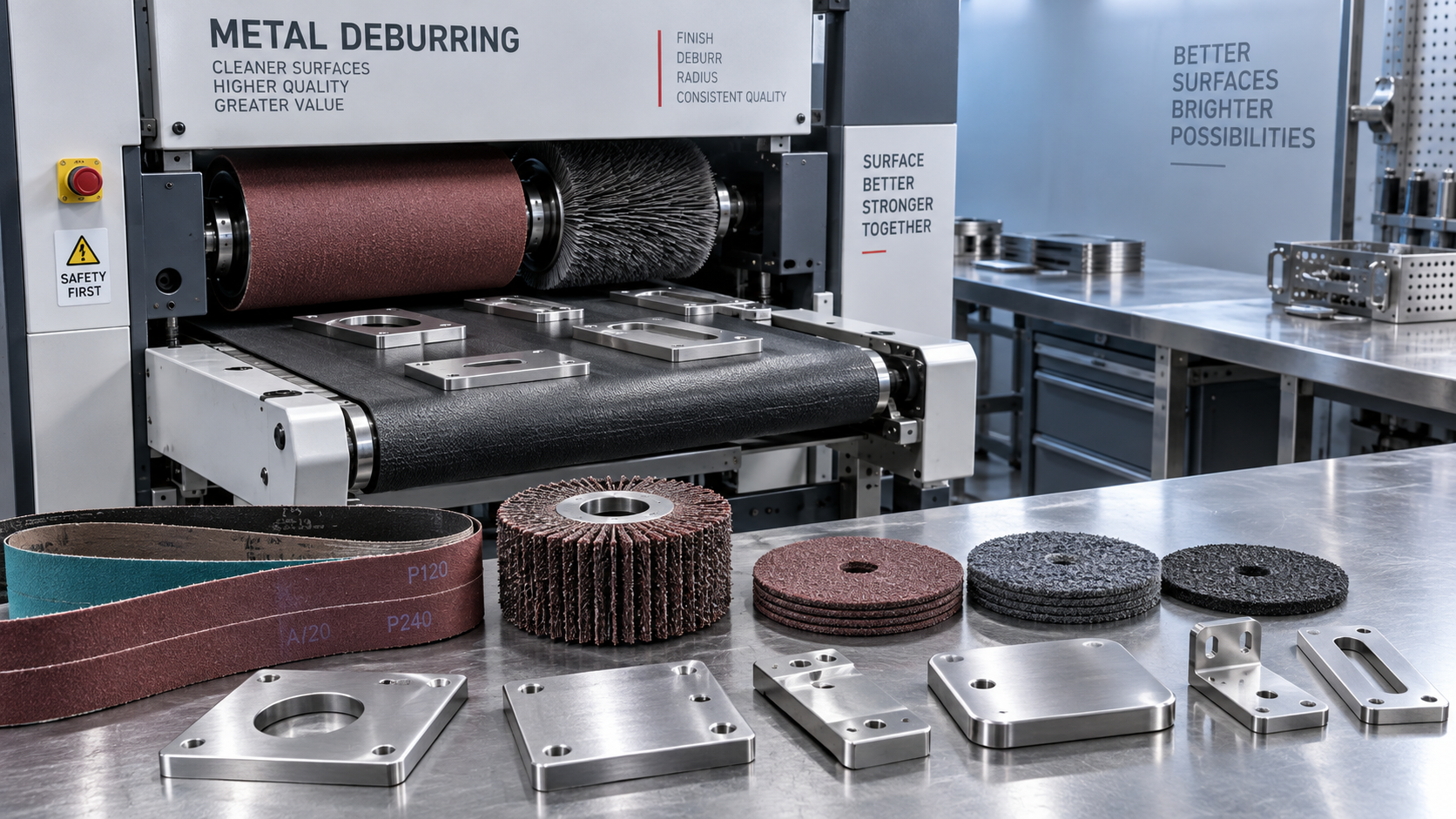
Estimating abrasive costs for sheet metal deburring equipment
A competitive machine price can hide a costly consumables bill. Business buyers should compare abrasive cost per accepted part, supported by trials using representative production materials.
Belts, brushes, and discs wear differently as material, burr severity, finish requirements, and operating settings change. Supplier price lists therefore provide only a starting point.
A reliable budget combines replacement prices, usable abrasive life, production throughput, and replacement downtime. It also accounts for rejects, repeat passes, and your actual product mix.
This article explains how to calculate consumption, compare supplier estimates, and validate assumptions before purchase, helping you assess the long-term value of sheet metal deburring equipment.
Start with cost per accepted part, not abrasive purchase price
The most useful purchasing metric is abrasive expenditure divided by accepted production output. This connects consumable spending directly to saleable work rather than theoretical machine capacity.
A cheaper belt can become more expensive if it wears quickly, requires slower processing, or produces inconsistent edges that force operators to repeat the deburring cycle.
Conversely, a higher-priced abrasive may reduce total costs when it maintains the required finish longer or supports greater throughput without increasing scrap or downstream quality problems.
Define an accepted part before requesting quotations. Specify acceptable burr removal, edge condition, surface appearance, dimensional restrictions, and any requirements affecting coating, assembly, or safe handling.
Keep abrasive cost separate from total conversion cost. Labor, electricity, extraction, maintenance, and depreciation belong in the broader business case, even when consumables dominate the comparison.
For mixed production, calculate costs by part family before developing a weighted average. A single blended figure can conceal expensive jobs and distort future operating budgets.
Which consumables should the estimate include?
Request a complete consumables schedule for the proposed configuration. Depending on the machine, this may include abrasive belts, finishing brushes, abrasive discs, or other replaceable media.
Identify each installed abrasive position and its replacement unit. A quotation for one disc or brush segment is insufficient when normal replacement requires a complete set.
Record dimensions, grit, abrasive type, backing, attachment method, and approved alternatives. These details determine whether quotations describe interchangeable products or consumables with different performance and availability.
Use the actual delivered replacement price, including applicable freight and duties. Treat recoverable taxes consistently with your accounting policy rather than automatically including them as costs.
Ask whether worn components can be replaced individually or must be changed together. Uneven wear can make complete-set replacement materially more expensive than component prices suggest.
Confirm minimum order quantities, lead times, and local availability. These factors mainly affect working capital and supply risk, but they can also increase delivered purchasing costs.
Calculate hourly consumption, then convert it into production cost
For each abrasive type, divide its replacement cost by its usable contact hours. Add the resulting hourly figures for all abrasive stations operating during the process.
Usable contact hours mean time spent processing material under the defined conditions. They should not include idle shifts, loading delays, or periods when abrasive stations remain disengaged.
If the supplier reports life in parts or processed area, retain that measurement initially. Convert units only when your production data supports a defensible relationship.
The following hypothetical example illustrates the calculation. Its prices and service lives are budgeting assumptions, not market benchmarks or performance claims for any particular machine.
If production yields 240 accepted parts per abrasive contact hour, the abrasive cost is $10 divided by 240, or approximately $0.042 per accepted part produced.
At 1,800 annual contact hours, estimated abrasive consumption costs $18,000. This assumes the stated wear rates remain representative throughout the operating year and production mix.
Actual purchase spending may differ because replacements occur in whole units and inventory carries between periods. Separate annual consumption expense from cash needed for stock purchases.
Calculate accepted throughput using total abrasive contact time, including repeat passes and rejected pieces. Otherwise, the denominator exaggerates productive output and understates the cost of saleable parts.
Adjust the estimate for your materials and production mix
Material type alone does not establish abrasive life. Alloy, thickness, cutting method, burr geometry, surface contamination, and the required final condition all influence the result together.
Light burr removal from consistent laser-cut parts differs from processing heavy slag or achieving a specified edge radius. Each application needs its own validated consumption assumptions.
Surface finishing can also change the economics. Appearance requirements may force replacement before an abrasive loses its ability to remove burrs, shortening commercially usable service life.
Pressure, feed speed, grit selection, and station engagement affect both removal and wear. Supplier estimates should therefore state operating settings alongside the achieved quality and throughput.
Part geometry matters because contact patterns are uneven. Narrow components, dense perforations, or repeated loading in one track can create localized wear before the entire abrasive expires.
Create separate estimates for your major job families, then weight their per-part costs by forecast accepted quantities. Update those weights when the order mix changes.
If part sizes vary substantially, also track abrasive cost per processed square meter. Retain per-part figures for quotations, while using area measurements to diagnose consumption differences.
Make supplier trials demonstrate usable abrasive life
Send representative production parts, including difficult but routine examples. A trial using unusually clean samples may demonstrate finish quality while providing little evidence about operating costs.
Provide measurable acceptance criteria and inspect results consistently. For edge-radius requirements, agree the measurement method and sampling locations before comparing results across machines or abrasive systems.
Record abrasive specifications, starting condition, settings, contact time, processed quantity, accepted output, repeat passes, and reasons for rejection. Photograph relevant wear patterns and quality changes.
Define the replacement endpoint in advance. It should reflect failure to meet agreed production requirements, unacceptable throughput loss, or manufacturer wear limits applicable to the consumable.
A short demonstration cannot prove full service life. Ask whether the estimate comes from completed wear trials, comparable customer records, or extrapolation from a brief test.
When extrapolation is unavoidable, request a range and its assumptions. Use a conservative planning case until production measurements establish how reliably the estimate transfers to your work.
Check results near the end of abrasive life as well as when consumables are new. Some systems need setting adjustments that change throughput, finish, or operating effort.
Compare quotations under the same production conditions
Require each supplier to price the same material mix, quality target, and annual accepted output. Differences in test conditions can overwhelm apparent differences in consumable prices.
Compare configuration details as well as totals. Extra abrasive stations may improve edge coverage or reduce passes, but their consumption must appear in the operating estimate.
For illustration, one machine consuming $10 per contact hour at 240 accepted parts costs approximately $0.042 per part. Another consuming $12 at 330 parts costs $0.036.
At 500,000 accepted parts annually, that difference represents approximately $2,652 in abrasive expense. Whether it justifies a higher purchase price depends on the complete ownership calculation.
Measure changeover time and frequency separately. Translate replacement downtime into lost production only when machine capacity constrains output; otherwise, focus on the labor actually consumed.
Also investigate alternative abrasive supply. Standard dimensions can improve purchasing flexibility, although substitutions still need validation for fit, operating limits, finish quality, and usable service life.
Request written assumptions with the quotation. An unsupported annual consumables allowance is less useful than a transparent calculation that your team can update as production changes.
Test budget sensitivity before approving the investment
Build a base case using validated assumptions, then test shorter abrasive life, higher replacement prices, and lower accepted throughput. These scenarios reveal which uncertainties threaten the budget.
In the example, shortening all abrasive lives by 25 percent raises hourly consumption cost from $10 to approximately $13.33, increasing annual expense to about $24,000.
If accepted throughput also falls from 240 to 200 parts per contact hour, abrasive cost rises to approximately $0.067 per part under those combined adverse assumptions.
This scenario is not a forecast. It shows why apparently modest changes in wear and output can materially alter the commercial value of a machine quotation.
Set inventory levels from replacement frequency, delivery time, and service variability. Keep sufficient critical consumables available, while distinguishing safety stock investment from the cost of consumption.
After installation, track actual replacement events against production records. Review cost by job family regularly and investigate deviations before changing the budget or blaming abrasive quality.
Include downstream requirements without overprocessing parts
Deburring targets should support the next manufacturing step. Excessive finishing adds abrasive expense, while inadequate burr removal can create handling problems, poor seating, or downstream rework.
For parts moving into bending, agree edge and surface requirements with the fabrication team. Validate them on representative workpieces rather than specifying the most aggressive finish automatically.
Wuxi Samgins International Trade Co.,Ltd supplies sheet metal deburring equipment alongside bending and cutting machinery, making connected process requirements a practical subject for your equipment enquiry.
Its Torsion bar synchronize CNC press brake uses hydraulic transmission and torsion-shaft synchronization; its welded steel frame and wedge compensation support the bending process described by the supplier.
When evaluating a combined workflow, confirm bending requirements separately from abrasive performance. The downstream machine provides process context, while deburring trials establish the actual consumables budget.
Approve a defensible budget, then verify it in production
A credible abrasive estimate identifies every replacement unit, uses delivered prices, defines usable life, and divides consumption by accepted output under clearly stated processing and quality conditions.
Before approval, obtain a consumables schedule, representative trial results, documented assumptions, and a sensitivity calculation. Together, these provide a stronger purchasing basis than machine price alone.
Choose equipment that delivers the required result at an acceptable total operating cost. Lower abrasive expenditure has value only when quality, throughput, and supply reliability remain satisfactory.
Finally, replace initial assumptions with measured production data. That turns an estimated consumables allowance into a working cost model for purchasing, pricing, and future equipment decisions.