




Understanding 7 Axis Railway Type Welding Robot Systems: Design, Working Principles, and Key Benefits
What Is A 7 Axis Railway Type Welding Robot?
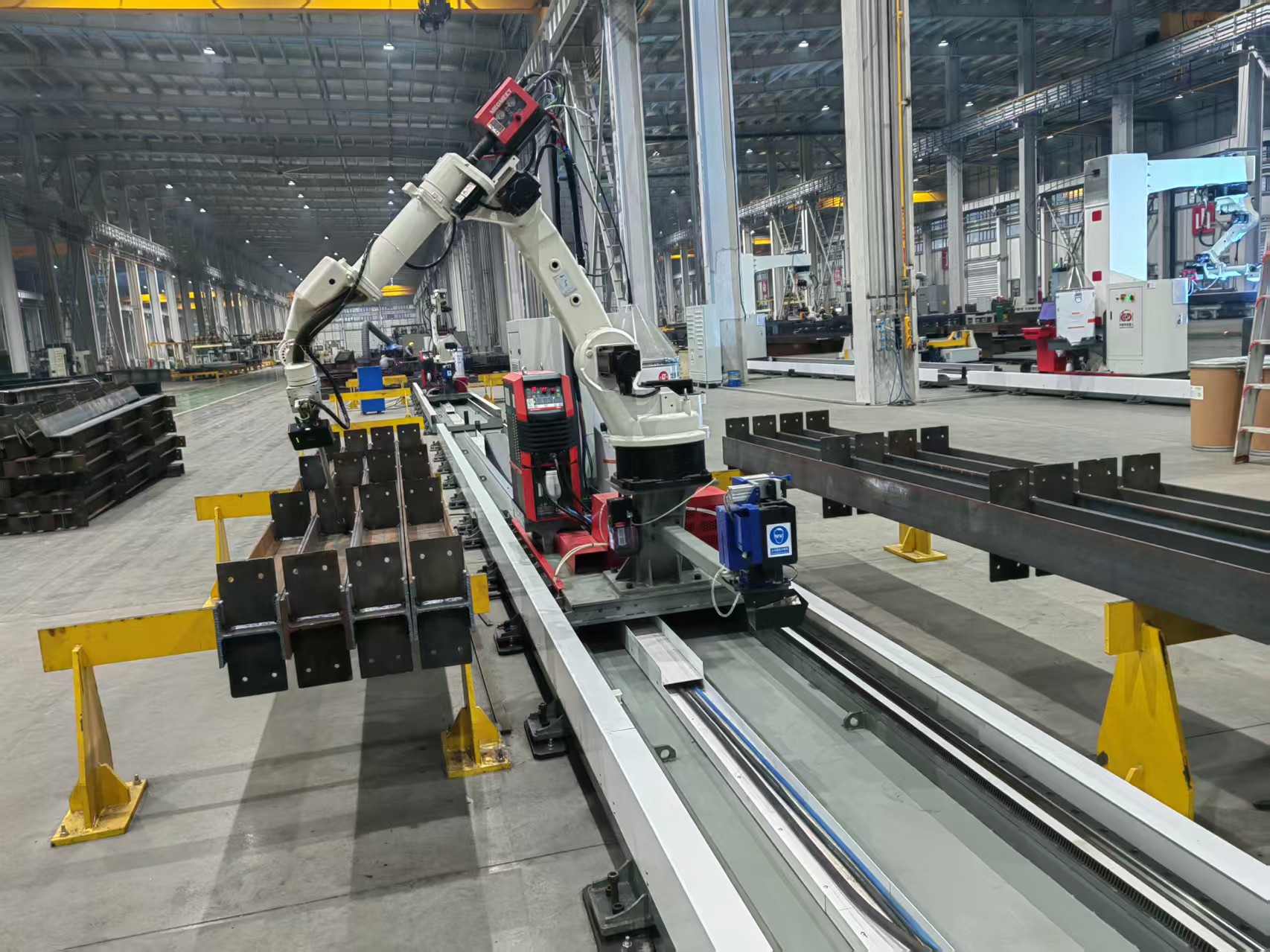
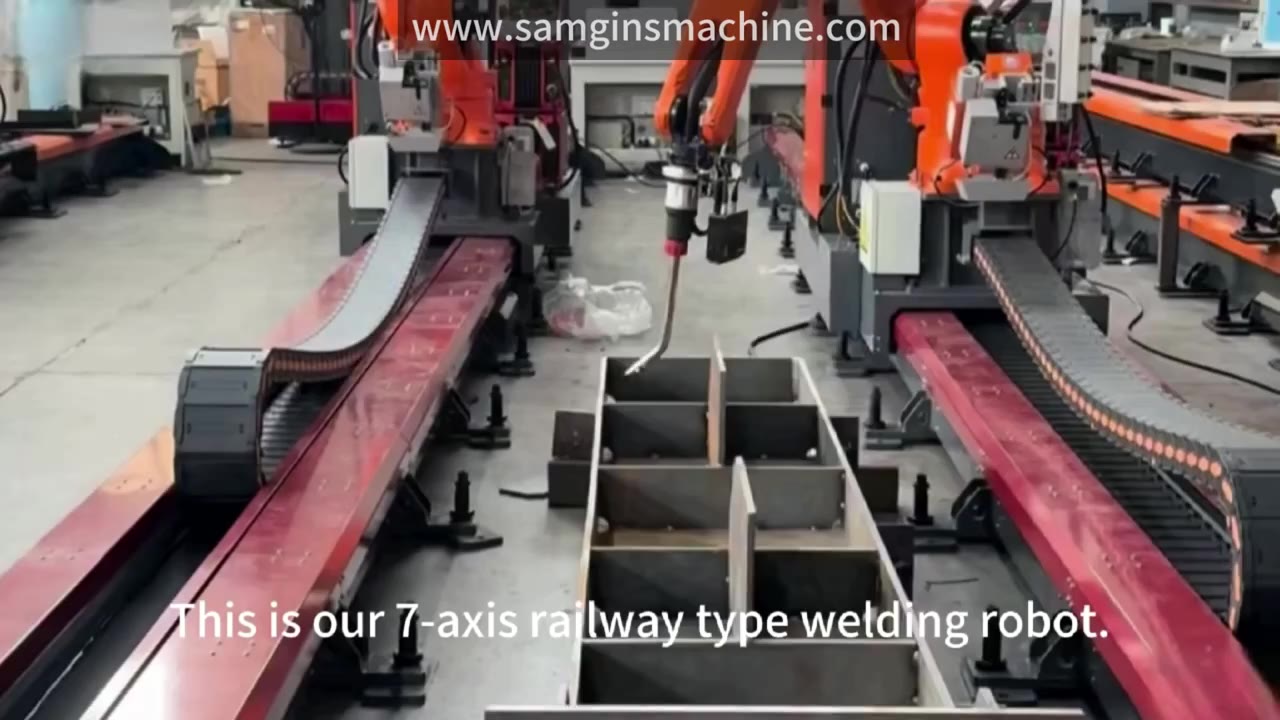
A 7 axis railway type welding robot is an automated welding system in which a six-axis articulated robot is installed on a linear railway, creating a seventh programmable axis. The robot controls torch position and orientation, while the rail moves the complete robot assembly along a defined production length. This arrangement expands the usable working envelope beyond the reach of a stationary robot and is particularly relevant for long workpieces, repeated weld stations, and large fabricated assemblies.
The physical system normally includes the robot arm, railway and carriage, servo drive, controller, welding power source, torch package, wire feeder, safety guarding, and workholding. Depending on the process, it may also include seam tracking, touch sensing, laser profiling, fume extraction, positioners, rotators, or coordinated external axes. A properly engineered cell treats these components as one motion and welding process rather than as separate machines.
The term does not describe one universal robot size or welding process. A 7 axis railway type welding robot can be configured for MIG/MAG, TIG, plasma, or other suitable arc-welding applications, subject to material, joint design, deposition requirements, and project specifications. In fabrication practice, its value comes from controlled access to weld seams over distance, repeatable torch angles, and the ability to automate a sequence that would otherwise require repeated manual repositioning.
Design Architecture And Working Principles
The first six axes provide articulated motion: base rotation, shoulder, elbow, wrist pitch, wrist yaw, and wrist rotation. Together, they allow the welding torch to approach a joint at controlled angles and maintain a programmed travel path. The seventh axis is the railway travel axis. It moves the robot longitudinally, extending coverage along vessels, beams, pipe sections, frames, panel lines, or multiple fixtures placed in sequence.
During programming, the controller synchronizes the rail carriage with the robot arm and the welding power source. The programmed path defines coordinates, torch orientation, travel speed, wire-feed settings, voltage or current parameters, weaving behavior where required, start and stop conditions, and safety positions. For repetitive products, the same validated program can be reused with controlled adjustments for part dimensions, joint location, or production batches.
Accuracy depends on more than robot repeatability. Rail straightness, carriage rigidity, installation alignment, fixture stability, cable routing, and calibration all affect the actual torch position at the joint. Long rails also require attention to expansion, mechanical anchoring, and protected cable management. When parts have normal fit-up variation, sensing methods can establish a reference point or compensate for seam position before welding begins.
Main Configurations And Application Categories
A single-robot rail cell is commonly selected for linear seams, long structural members, and products that can remain fixed in a stable fixture. The rail lets one robot cover a long workstation without creating multiple isolated cells. This configuration can suit longitudinal seams on fabricated components, stiffener welding, box sections, steel frames, and recurring assemblies where part presentation is predictable.
A coordinated system pairs the rail-mounted robot with a welding positioner, turning rolls, or a welding manipulator. External equipment presents the seam in a favorable welding position while the robot controls the torch. This can improve access around cylindrical equipment, pipe spools, tanks, pressure-related fabrication, and large welded structures. The appropriate configuration depends on the part center of gravity, allowable rotation, joint sequence, and production takt time.
Dual-robot or multi-station layouts are used when throughput, weld length, or part complexity justifies greater automation. One robot may work while another prepares, welds a separate zone, or serves an adjacent fixture. Such layouts require disciplined collision avoidance, interlocked safety zones, balanced power capacity, and process planning. Adding robots is not automatically productive unless material handling, tack-welding quality, and inspection capacity can support the faster weld cycle.
Why Fabricators Use Railway Mounted Welding Automation
Traditional manual welding remains flexible, but long repetitive seams can involve inconsistent travel speed, operator fatigue, frequent ladder or fixture repositioning, and variable torch angle. A 7 axis railway type welding robot can maintain programmed motion and welding parameters over the accessible length of the rail. This helps fabricators standardize repeatable operations while assigning skilled welders to setup, fit-up control, complex repair, inspection, and tasks where human judgment is especially valuable.
The seventh axis is useful where a fixed-base robot would require workpiece movement between segments. Reducing these transfers can lower non-welding time and avoid losing the part reference between operations. It can also make a production line more adaptable: stations can be arranged along the rail according to the actual flow of fabrication, provided guarding, operator access, and loading routes are designed from the beginning.
For customers needing an integrated fabrication solution, Wuxi Samgins can combine customized 7/9-axis welding robots with related equipment such as welding rotators, positioners, long seam welding machines, H-beam production equipment, and cutting machinery. This broader equipment scope is relevant when robotic welding is only one stage in a larger factory workflow. Integration should be evaluated around the complete part route, not only the robot purchase price.
Who Should Consider This System And Where It Fits
Typical users include steel structure manufacturers, tank and vessel fabricators, pipeline and pipe-spool workshops, heavy-equipment producers, transportation-equipment suppliers, and sheet-metal factories with recurring welded assemblies. The strongest business case usually appears where parts have sufficient volume, weld length, repeatability, and process stability. A low-volume, highly variable job shop may still benefit, but it should assess programming effort and fixture changeover before selecting a dedicated cell.
The system is particularly appropriate for seams that extend beyond a conventional robot cell, or for several fixtures placed along one track. Examples include longitudinal welds on fabricated shells, structural beam subassemblies, frame members, stiffened plates, large skids, and modular steel products. The rail can also support efficient reach across successive work zones, although it does not eliminate the need for practical access, part clamping, root-gap control, and safe loading methods.
Wuxi Samgins has supplied equipment to international customers including URALSTANKOIMPORT, MD Calbah Industries Pty Ltd, Ersay International Transport, BatysMunaiGazZhabdyktary LLP, Estructuras Metalicas Girders Chile Limitada, and Lincoln Electric-MENA. These named customer relationships indicate experience serving varied export markets, but each buyer should validate the proposed cell against its own drawings, materials, local regulations, welding procedures, and acceptance requirements.
Selection Criteria, Standards, And Quality Control
Start selection with the workpiece, not the robot. Define the maximum part length, mass, geometry, joint types, material thickness, weld positions, access constraints, expected annual volume, and permissible changeover time. Then define rail length, robot reach and payload, torch package, welding process, fixture concept, and whether a positioner or rotator is necessary. The proposed travel range must include practical approach and retreat positions, not merely the nominal seam length.
Buyers should request a clear scope for design, manufacturing, factory acceptance, installation, commissioning, operator training, spare parts, and remote or on-site support. Qualification of welding procedures remains essential. The robot reproduces a process; it cannot correct poor preparation, unsuitable consumables, uncontrolled joint gaps, or an unqualified procedure. Sample-weld evaluation should consider the buyer's actual material and joint geometry whenever the project risk warrants it.
Wuxi Samgins states that its machines comply with the ISO9001 quality system and EU CE Machinery and LVD directives, and that key hydraulic, servo, and CNC components use internationally recognized imported brands. For projects governed by ASME, API, or local codes, purchasers should confirm the exact documentation, machine safety responsibilities, welding-procedure responsibilities, and site-specific compliance requirements in the contract. Certifications should be verified for the delivered configuration rather than assumed from a general product description.
Installation, Operation, And Maintenance Planning
Successful commissioning begins with a prepared site. The floor or support structure must carry the rail loads and maintain alignment; electrical supply, grounding, shielding-gas distribution, wire storage, ventilation, and fume extraction should be available before installation. Material flow needs equal attention. A robot cell loses capacity when forklifts, cranes, fixtures, finished parts, and personnel compete for the same narrow access route.
Initial operation should include rail alignment checks, robot mastering verification, collision-zone validation, cable-dress inspection, safety interlock testing, welding-parameter confirmation, and trial production under realistic conditions. Operators need instructions for normal running, fault recovery, daily inspection, consumable replacement, and safe manual movement. Programmers and maintenance personnel require deeper training in coordinate systems, backup procedures, calibration, and controlled program modification.
Preventive maintenance should follow the robot, rail-drive, welding-source, and safety-device schedules supplied for the installed equipment. Routine checks commonly cover rail cleanliness, carriage movement, lubrication where specified, fasteners, cable wear, torch consumables, wire-feed consistency, grounding, emergency stops, and guarding. Maintaining backup copies of robot programs and documented parameter sets is important because fast recovery after a control fault or part change can have a direct effect on production continuity.
Total Cost Of Ownership, ROI, And Future Trends
The total cost of a 7 axis railway type welding robot includes more than the robot and rail. Buyers should budget for engineering, fixtures, safety systems, welding power sources, sensors, installation, training, utilities, spare parts, maintenance, production qualification, and possible building modifications. Complex parts may require more programming and fixture development than expected. Conversely, a well-designed standardized family of parts can spread these costs across many units and improve the investment case.
ROI should be assessed through measurable operational factors: arc-on time, cycle time, labor redeployment, weld-rework reduction, material handling, consumable consistency, uptime, and output capacity. A realistic model compares the automated cell with the current validated process, including setup and inspection, rather than assuming every manual welding hour disappears. Requesting estimated cycle times, assumptions, and responsibilities in writing helps procurement teams compare proposals on a common basis.
Future railway welding systems are expected to use more seam sensing, adaptive parameter control, production data collection, offline programming, and coordinated handling equipment. These capabilities can improve responsiveness to part variation, but they increase the importance of data discipline, operator skills, cybersecurity practices, and maintainable integration. For manufacturers planning staged automation, a modular rail layout and compatible upstream cutting, forming, positioning, or rotating equipment can provide a practical path from a single robotic station to a more connected production line.
search
Recommended Products
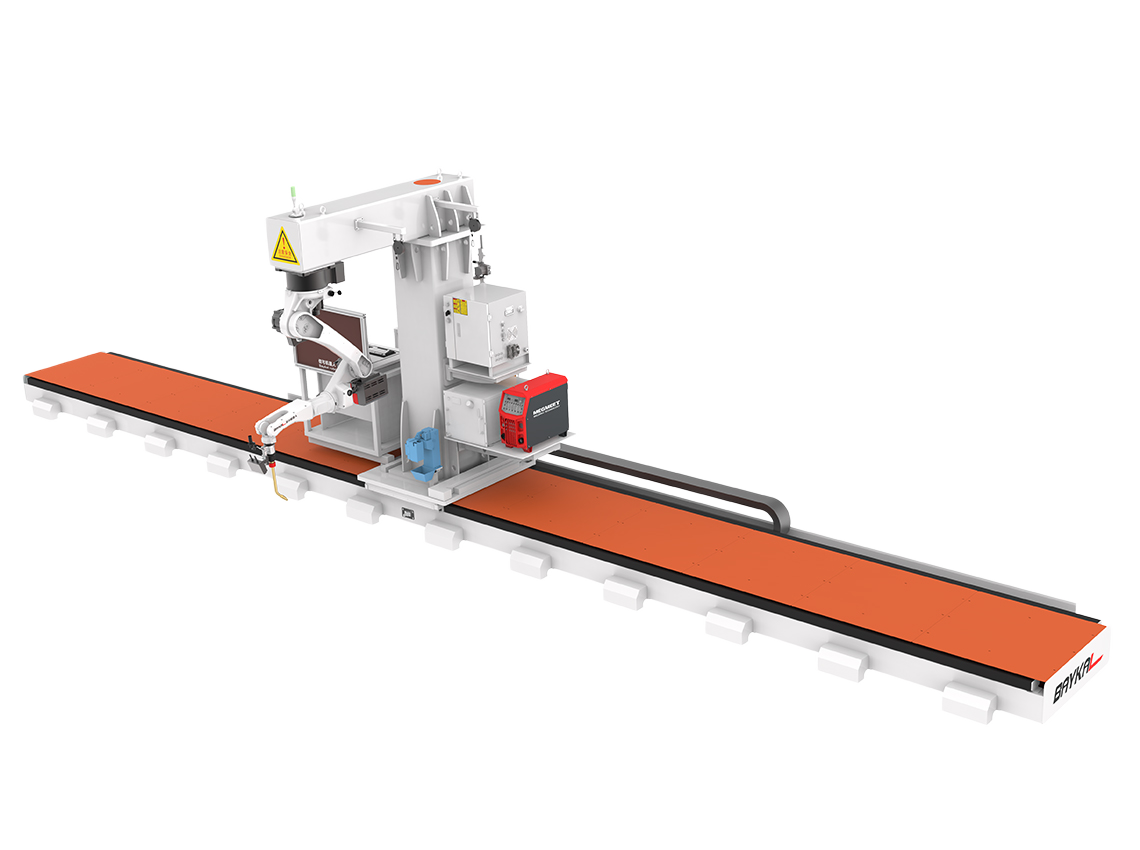
 7 axis railway type welding robotThe planned floor space for this equipment (exclusive of operator stations, material storage areas, cutting buffer zones, etc.) is 12 meters in width and 2 meters in depth. The system primarily comprises the following components: one dedicated robot rail, one slide carriage, one 6‑axis welding robot with its control system, one welding power supply, one torch cleaning station, one welding torch, and ancillary equipment.
![星星1]()
 7 axis cantilever type welding robot7 axis cantilever type welding robot for long steel workpieces up to 12m, featuring automatic seam tracking, 7 CNC axes, and efficient zone welding.
![星星1]()

Recommended blogs
Send Us A Message
Send us a Message
A dedicated person will follow up on your needs one-on-one and provide personalized customized solutions according
to your needs.
Get In Touch
We look forward to hearing from you for in-depth communication on how to fulfill your mixing requirements.