




CNC Cutting Machine Operating Costs: Power, Gas, and Maintenance Breakdown
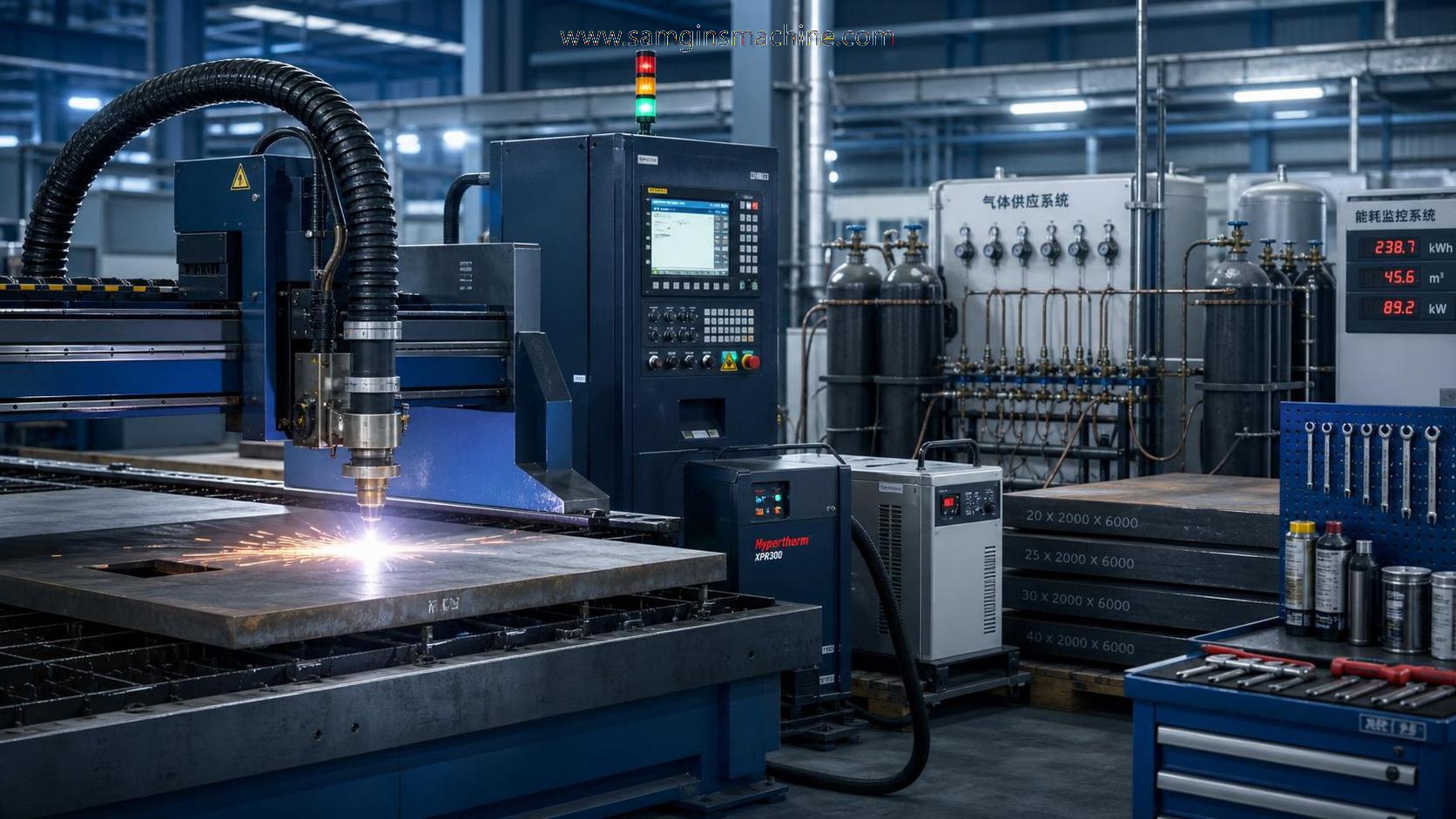
Why does CNC cutting machine operating cost matter so much after purchase?
A CNC cutting machine is rarely judged well by price alone.
In actual production, operating cost shapes payback speed, quoting accuracy, and scheduling flexibility.
That is why power use, gas consumption, and maintenance deserve the same attention as cutting capacity.
A machine with a lower purchase price can become the more expensive option within one or two years.
The more reliable approach is to look at total cost of ownership.
This means asking how the CNC cutting machine performs across daily shifts, material ranges, and service intervals.
For metal fabrication lines, energy spikes, unstable gas supply, and unplanned downtime often hurt margins faster than expected.
Companies with broad equipment exposure usually see this earlier.
Wuxi Samgins International Trade Co.,Ltd has supplied CNC cutting machines and related metalworking equipment since 2012.
Its experience across welding, machining, deburring, and forming lines reflects a practical truth.
Operating cost is not one line item. It is a system effect.
How much of the budget usually goes to power consumption?
Power cost depends on process type, duty cycle, and machine configuration.
A CNC cutting machine running thin sheet intermittently behaves very differently from one cutting thick plate all day.
The common mistake is to compare motor ratings only.
Real electrical use also includes drives, cooling units, control systems, extraction, compressors, and idle time.
For budgeting, three questions are more useful than a simple kilowatt label.
- How many hours per shift does the machine actually cut?
- What share of time is idle, loading, or waiting?
- Which support systems must run with the machine?
A higher-efficiency CNC cutting machine may reduce per-part cost even if its rated power looks larger.
That usually happens when nesting is better, pierce time is shorter, and scrap rates are lower.
So the real comparison is not electricity per hour.
It is electricity per qualified part or per ton processed.
A quick budgeting view helps separate assumptions from reality
Is gas cost predictable, or does it vary more than expected?
Gas cost is often more volatile than buyers expect.
The reason is simple.
Gas use changes with material, thickness, edge quality target, nozzle condition, and operator settings.
Even two similar CNC cutting machine models can show different gas bills if process control differs.
Oxygen, nitrogen, and compressed air each create a different cost structure.
Nitrogen usually delivers cleaner edges on some applications, but supply cost can rise sharply at volume.
Oxygen may cut some thicker steels economically, yet downstream finishing may still affect total cost.
Compressed air can look attractive, but quality depends heavily on stable preparation systems.
A useful way to judge gas cost is to connect it with secondary processing.
If edge quality reduces grinding, cleaning, or rework, the higher gas bill may still be the better decision.
This is where process-chain thinking matters.
For example, shops handling CNC parts, die-castings, or precision stampings sometimes offset finishing labor with a downstream solution such as Customized Magnetic polishing machine, especially when burr removal and surface brightness affect shipment quality.
What maintenance costs are easy to underestimate?
Most cost reviews focus on consumables and miss the hidden maintenance layer.
That layer includes preventive service time, calibration, lubrication, cooling checks, and wear-related drift.
The direct expense is visible.
The indirect expense, usually downtime and inconsistent part quality, is harder to spot.
A CNC cutting machine with unstable positioning or poor maintenance access can consume labor quietly.
Instead of asking only for a spare parts list, ask how maintenance affects production continuity.
- Are common service items standardized and easy to source?
- Can routine checks be completed during shift changes?
- Is remote diagnosis available for control or drive issues?
- How quickly can local or regional support deliver critical parts?
Experienced suppliers tend to answer these questions with examples, not broad promises.
That matters when equipment is exported across Southeast Asia, Europe, the Americas, or Oceania.
Distance is manageable if documentation, standards, and service discipline are mature.
ISO9001 organization and EU CE alignment are relevant here because they usually support consistency in design, assembly, and support records.
When comparing two CNC cutting machine options, what should be on the checklist?
A fair comparison needs more than a quotation sheet.
The strongest evaluations combine machine data with workload assumptions.
If that step is skipped, one attractive number can distort the whole decision.
Use a checklist built around operating reality.
That last point is often the turning point.
If post-cut deburring is a regular bottleneck, equipment selection should consider the full line.
In some plants, adding a compact finishing step handles burrs on irregular parts in minutes and reduces manual work significantly.
A model range like R-G110 to R-G3010, with 380V configuration and batch processing for metal workpieces, can fit that role where inner holes, threads, and corners need cleaner results without reshaping the part.
What are the most common mistakes in CNC cutting machine cost evaluation?
One mistake is treating operating cost as fixed.
In reality, it shifts with workload, maintenance discipline, and operator habits.
Another mistake is ignoring downtime because it does not appear on the quotation.
For many workshops, one lost production day costs more than several months of small efficiency gains.
There is also a tendency to isolate the CNC cutting machine from the rest of the fabrication process.
That creates blind spots around cleaning, polishing, deburring, part transfer, and inspection.
A lower cut cost can lose its advantage if secondary handling absorbs labor.
Needle-based magnetic finishing systems are a good example of where this line-level view helps.
For sectors such as electronics, medical parts, rail transit components, or aluminum die-castings, the ability to deburr, polish, clean, and brighten in one cycle can change the real economics of the cutting process.
That does not replace proper machine comparison.
It makes the comparison more honest.
So how should the final decision be made?
Start with your real workload, not the supplier’s best-case sample.
Map material types, thickness range, daily cutting hours, gas choice, and target edge quality.
Then calculate cost per part, cost per shift, and expected service burden.
A CNC cutting machine that performs steadily across those measures is usually the stronger investment.
It also helps to review adjacent process equipment, especially if finishing time limits throughput.
Where deburring and surface cleanup remain manual, Customized Magnetic polishing machine can be a practical reference point for reducing labor and preserving dimensional accuracy on irregular metal parts.
In the end, the best CNC cutting machine is not simply the fastest or cheapest to buy.
It is the one that keeps energy, gas, maintenance, and downstream handling in balance over time.
A useful next step is to build a comparison sheet with measured operating assumptions, service intervals, and post-processing needs before any final shortlist is approved.
search
Products Navigation
Send Us A Message