




Can a long reach handling robot arm reduce transfer stations?
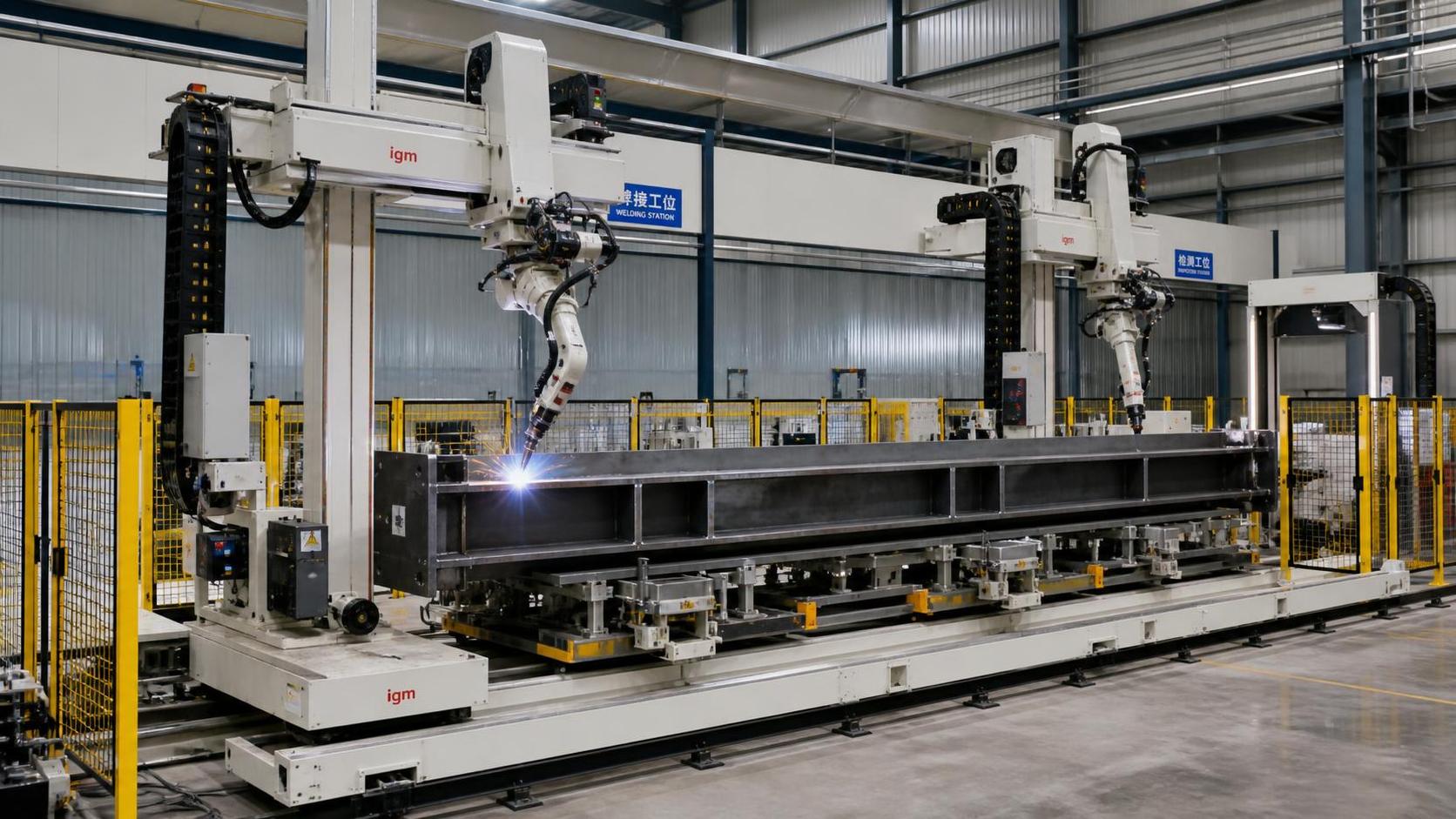
A long reach handling robot arm can reduce transfer stations, but only when it removes a real handoff rather than merely moving the same bottleneck to a larger robot cell. The strongest candidates are lines where parts travel through several short, repetitive transfers between machines, fixtures, inspection points, or welding positions. If one robot can safely reach those points, maintain the required orientation, and complete the movement within the available takt time, intermediate stations may become unnecessary.
For a project manager, the question is not simply whether the robot has enough reach on a specification sheet. The decision is whether a wider automation envelope improves the total material flow: fewer unload-and-reload actions, fewer fixture changes, fewer operators waiting for a handoff, and less floor space assigned to buffers. A long reach system can achieve that result, but it can also create an expensive central bottleneck if the layout, payload, access, and recovery plan are not evaluated together.
When fewer transfer stations are a realistic outcome
Transfer stations usually exist for one of four reasons: a machine cannot reach the next process, a part must be reoriented, production rates between processes do not match, or the line needs a buffer to keep one stoppage from stopping everything else. A long reach handling robot arm addresses the first reason directly and may help with the second. It does not automatically solve the last two.
The most favorable application is a stable production route in which the same family of workpieces moves across a broad but predictable area. For example, a robot on a linear track may pick a fabricated component from a load position, present it to a welding or machining operation, move it to a checking position, and place it on an outfeed rack. In that arrangement, two or three transfer points can sometimes be replaced by one managed robot workspace.
This is especially useful where transfer stations are lightly loaded but still demand guarding, conveyors, sensors, fixtures, and maintenance. Removing those small islands of equipment can make the line easier to supervise and can leave more useful space around the main process. It can also reduce the accumulation of positional error that occurs when a heavy or flexible workpiece is repeatedly clamped and released.
However, a long reach robot is not a substitute for every station. If a station performs a necessary process such as cooling, measurement, orientation correction, cleaning, or quality verification, its physical location may disappear while its function still needs to remain in the line. The project should distinguish between eliminating a transfer and eliminating a process requirement.
Start with the material-flow problem, not the robot model
A practical review begins by mapping the current route from first load to final unload. Record each handoff, the reason it occurs, the time spent waiting, the handling method, and the consequence if that position becomes unavailable. This exposes whether transfer stations are serving production or compensating for an inconvenient layout.
Then test the proposed automation route against the real part envelope. Reach alone is not enough. The robot must approach the part without passing through restricted zones, avoid clamps and fixtures, maintain clearance from adjacent equipment, and still have enough wrist freedom to grip, rotate, and release the workpiece. A nominal reach figure can look adequate while the usable working envelope is too limited at the actual pickup and placement angles.
Part condition matters as well. Flat, rigid, repeatable components are generally easier to move across a long span than long weldments, thin sheet assemblies, or parts with variable centers of gravity. A long item may swing during acceleration, interfere with guarding, or require slower motion than the initial concept assumed. In steel fabrication, the handling strategy must consider not only length and mass, but also the risk of distortion, sharp edges, residual heat, and how the part is supported during movement.
The central tradeoff: fewer handoffs versus a larger single point of failure
Reducing transfer stations simplifies a line only if the long reach robot has enough capacity margin. When every process depends on one robot, a gripper fault, track fault, collision recovery, or program interruption can affect the full cell. By contrast, separate transfer stations may be less elegant, but they can provide buffers and let adjacent processes continue for a period.
This does not mean the distributed layout is always safer operationally. Multiple stations also create more drives, sensors, controls, and places for alignment faults to develop. The better choice depends on where the line currently loses time. If most interruptions come from manual transfers and inconsistent part placement, consolidating movement can improve predictability. If upstream and downstream processes have highly variable cycle times, retaining a deliberate buffer may protect output better than making one robot responsible for every move.
Reach changes the layout, but it does not erase layout constraints
Long-reach handling is often considered when a plant has limited room for conveyors or multiple handling cells. A rail-mounted or cantilevered arrangement can cover a long working zone while preserving access along the sides. Yet the required footprint must include more than the arm or rail itself. Guarding, maintenance access, cable routing, loading clearance, operator walkways, fixture service space, and safe positions for abnormal recovery all need to be included in the layout.
A common planning error is to measure only the distance between pickup and drop-off points. The robot also needs a collision-free travel corridor and defined locations for people to load parts, inspect work, replace consumables, and respond to faults. If those activities require entering the robot envelope too often, the expected reduction in transfers can be offset by stops and access interlocks.
The control architecture also deserves early attention. Consolidating transfers means consolidating responsibility for part identity, location, and release conditions. The robot should not move a workpiece merely because a previous motion ended. It needs clear signals that the next fixture is ready, clamps are open, any process hazard has cleared, and the receiving position can accept the part. Where workpieces vary, sensing or laser positioning can help establish actual location, but the project still needs a defined response when the part is out of tolerance or incorrectly loaded.
A relevant configuration for long fabricated workpieces
In welding cells for structural steel or other long fabricated parts, the handling question often overlaps with welding access. A cantilevered system can reduce the need to shuttle a component between separate working positions when the automation covers a long table or rail-supported zone. For workpieces that exceed the main working length, zone-based processing may be more practical than moving the entire workpiece repeatedly between stations.
The BR-2010A Pro/XB12-A8DP MAX Eight-Axle Cantilever Dual-Motor illustrates this type of layout. It uses a single-cantilever, dual-robot inverted welding arrangement around one operating table, with a 12-meter-wide by 2-meter-deep stated floor-space arrangement and 12-meter ground-rail support. Its configuration is intended for coordinated welding, including zone-based work on parts longer than 12 meters and shorter than 25 meters. Laser positioning, automatic task allocation, and tracked weld correction are relevant where the objective is to reduce unnecessary repositioning while maintaining process access.
That does not make it a universal replacement for material transfer equipment. It is most relevant when handling, positioning, and welding are tightly connected in the same fabrication cell. A project involving unrelated machines, large changes in part geometry, or a need for independent buffering may require a different robot-track arrangement, conventional conveyors, or a hybrid design.
How to test the business case before committing
The return on investment should be assessed as a line-level change, not as a comparison between one robot price and one conveyor price. Include the stations that could genuinely be removed, their fixtures and controls, labor assigned to repetitive transfer, floor space recovered, and the expected reduction in handling-related waiting. Against that, include engineering time, guarding, end-of-arm tooling, rail or support structure, integration, programming, commissioning, training, spare parts, and the production impact of a centralized failure.
A short cycle-time study is more useful than broad assumptions. Time the full sequence: pickup confirmation, clamp release, robot travel, orientation, placement, clamp close, readiness confirmation, and any clearance delay. Repeat the study for the largest, smallest, and least stable workpieces in the intended range. The result should show whether the proposed arm has margin for normal variation, not merely whether it can complete an ideal movement once.
Before approving the concept, project teams should settle five questions:
- Which transfer stations perform no value-adding work and can truly be removed?
- Can the robot reach every required point with the actual gripper, part orientation, and safety clearance?
- Does its complete handling cycle fit the production schedule with usable recovery margin?
- What happens to work in process when the robot or the next machine is unavailable?
- Can operators load, inspect, maintain, and recover the cell without creating frequent access interruptions?
A long reach handling robot arm reduces transfer stations most effectively when it is designed as part of the production flow, not added after the flow has already been fixed. The best result is usually a hybrid of consolidation and deliberate buffering: remove the handoffs that create delay and handling risk, while keeping the locations that protect process stability or support necessary inspection and recovery.
search
Products Navigation
Send Us A Message