




When does a servo handling robot arm justify its added cost?
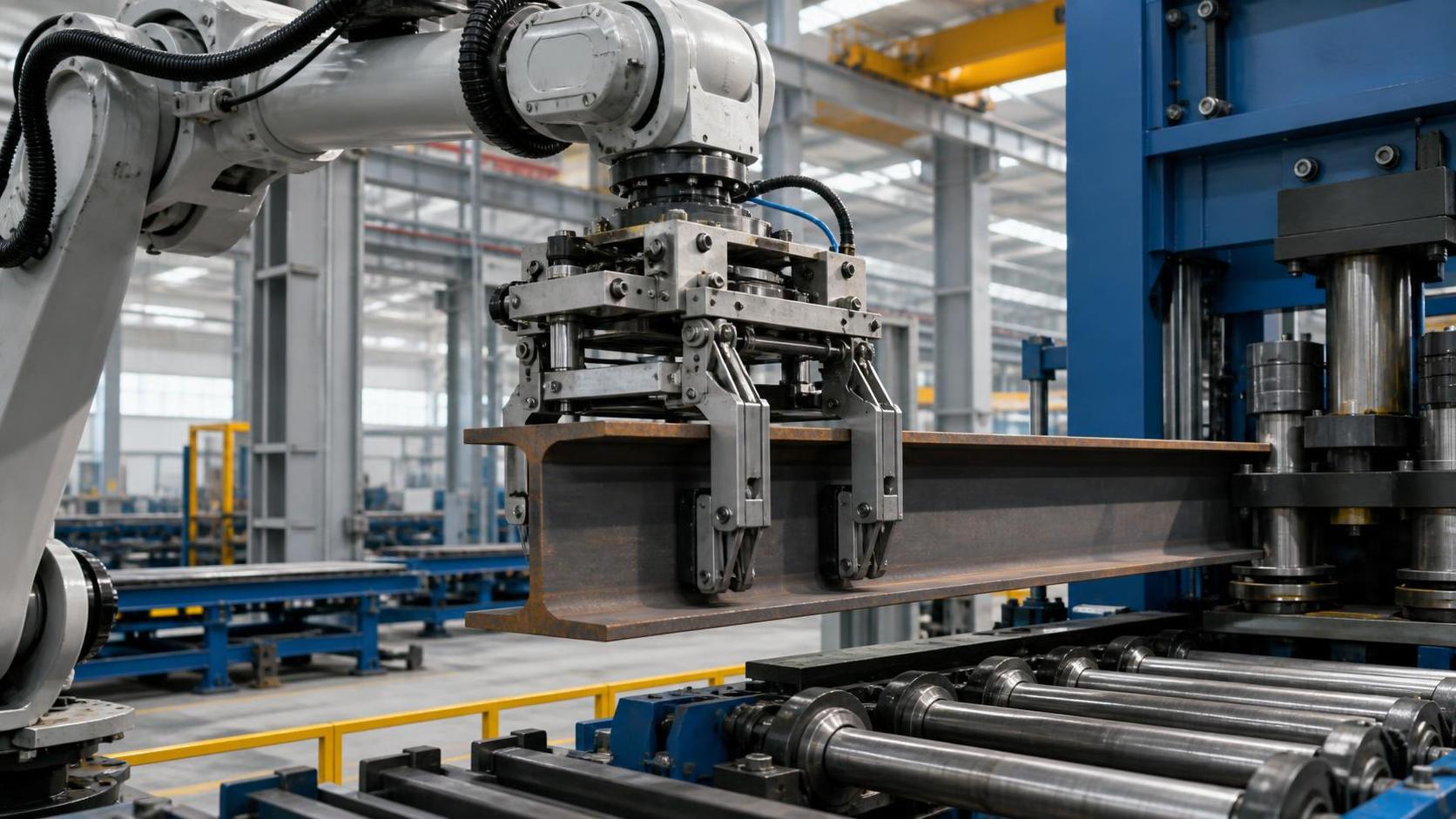
When Does a Servo Handling Robot Arm Justify Its Added Cost?
A servo handling robot arm costs more than a basic pneumatic loader, gravity-feed arrangement, or manually operated transfer station. That is obvious at quotation stage. What is less obvious is where the real cost sits: not only in the robot itself, but in grippers, safety fencing, fixture changes, programming, floor space, commissioning, and the production interruptions required to install it properly.
For procurement teams, the right question is therefore not “Is robotic handling expensive?” It is “Which recurring production loss will this system remove, and can that loss be measured?” A servo handling robot arm is usually justified when it solves a persistent bottleneck rather than merely replacing an operator who is already keeping pace with the process.
This distinction matters in welding cells, CNC machine tending, laser cutting lines, press brakes, beam fabrication, and sheet-metal processing. In these environments, material handling often determines the actual output of the equipment. A fast laser cutter or CNC machine cannot generate value while waiting for loading, unloading, turning, stacking, or inspection clearance.
The Cost Is Justified When Handling, Not Processing, Is Limiting Output
The clearest investment case appears when the primary machine spends too much time idle between cycles. A CNC lathe may complete its machining program consistently, yet wait for an operator to open the door, remove the finished part, inspect it, place new stock, close the door, and restart. The machining cycle may be stable; the loading cycle may not be.
This is where servo control earns its premium. A servo-driven arm can repeat defined positions, motion paths, acceleration limits, and dwell times with far greater control than a simple pick-and-place mechanism. That does not automatically mean it is faster in every movement. In practice, it means the handling sequence is predictable enough to coordinate with machine signals, conveyors, positioners, safety interlocks, and downstream stations.
Buyers should look beyond average machine cycle time. The more revealing number is the variation between cycles. If a process nominally runs every four minutes but actual loading and unloading time ranges widely according to operator availability, fatigue, part orientation, or forklift traffic, automation may have a stronger case than the average figure suggests.
A robot is particularly worth considering when one operator must attend several machines but cannot do so without causing waiting time. It can also make sense where staffing is technically possible but difficult to stabilize across shifts. The issue is not simply labor cost. It is the cost of a production line whose output changes whenever an experienced operator is absent, reassigned, or occupied with rework.
Repeatability Has Commercial Value When Part Position Affects Quality
Handling becomes a quality issue whenever the workpiece must arrive at the next station in a reliable orientation. Welding is a familiar example. A slightly inconsistent fixture load can create misalignment, gaps, poor accessibility for the torch, or extra fitting work before welding begins. In machining, inconsistent clamping position can lead to tool clearance concerns, unstable datum references, and more frequent operator intervention.
A servo handling robot arm is not a substitute for good fixtures. In fact, a weak fixture is one of the fastest ways to waste a robot investment. The robot may repeatedly place a part into the same imperfect locating arrangement. Before approving automation, procurement and engineering teams should confirm how the part is referenced, how distortion is handled, whether incoming material varies, and what happens when a component is slightly bent, oily, hot, or burred.
The best applications usually have a controlled family of parts, stable pickup surfaces, and known stacking patterns. The worst applications are often those involving frequent product changes, irregular weldments, uncontrolled incoming bundles, or a process that still depends on an operator’s judgment to decide whether a workpiece is acceptable.
Questions that reveal whether repeatability is genuinely valuable
- Does part placement affect welding, cutting, bending, machining, or measurement results?
- Are operators currently making frequent small adjustments before the main process starts?
- Can the workpiece be located using repeatable mechanical datums rather than visual judgment?
- Is rework linked to handling marks, part drops, deformation, incorrect orientation, or poor stacking?
- Will the robot handle one stable product range for long enough to recover its engineering and programming effort?
If the answer to several of these questions is yes, the value of servo motion is not merely labor substitution. It becomes a process-control investment.
Heavy, Hot, Sharp, or Awkward Parts Change the Equation
Safety is sometimes discussed in general terms, but the purchasing case becomes more concrete when the handling task includes real physical exposure. Heavy fabricated parts, laser-cut sheet with sharp edges, hot workpieces after welding, long profiles, and components with unstable centers of gravity are not routine manual-handling tasks. Even where lifting aids are used, the operator may still be responsible for guiding, turning, or aligning the workpiece near moving equipment.
In those conditions, a robotic arm may be justified even if the labor saving alone looks modest. The system can separate personnel from repetitive movement near chucks, weld positioners, press brakes, rotating rollers, or transfer conveyors. However, safety automation must be engineered as a complete cell. The arm is only one element. Buyers need to assess guarding, safety-rated controls, interlocks, emergency-stop architecture, safe access for maintenance, and recovery procedures after a fault.
A common mistake is to approve the robot and leave the end-of-arm tooling until late in the project. The gripper is often the most application-specific component. It must hold the actual part condition, not an ideal drawing. Surface finish, mill scale, oil, holes, cut edges, temperature, and center-of-gravity variation all influence whether vacuum cups, magnetic tools, mechanical clamps, forks, or custom tooling are appropriate.
Do Not Compare Only the Robot Price
A meaningful cost comparison includes the full installed system and the cost of keeping it productive. A low initial robot quote can become expensive if the integration scope is vague. Conversely, a higher quotation may be reasonable when it clearly includes gripper design, controls integration, training, commissioning support, safety equipment, and documented acceptance criteria.
The return should be based on recoverable capacity, not theoretical capacity. If a robot allows an existing welding cell to operate more consistently through a shift, that may be useful. But if the downstream inspection station, paint line, or material supply remains the limiting point, the extra upstream output may simply create work-in-process inventory. A good capital request maps the whole flow before assigning savings to the handling cell.
Where a Servo Arm May Be the Wrong Purchase
Not every labor-intensive process should be automated with a multi-axis robot. For simple straight-line transfers, a gantry, feeder, lift table, roller conveyor, or dedicated loader may deliver the required result at lower cost and with easier maintenance. If part geometry rarely changes and movement is predictable, simpler equipment is often the better commercial choice.
Robotic handling is also difficult to justify when production volumes are sporadic and product mix changes constantly. A flexible arm can be reprogrammed, but reprogramming is not free. It requires skilled time, trial parts, risk assessment, and sometimes new grippers or fixture modifications. The phrase “flexible automation” should not be interpreted as “no engineering effort required.”
Another warning sign is poor material presentation. If parts arrive randomly stacked, mixed by thickness, distorted after welding, or without a dependable pickup point, the robot project may need sensors, vision, separation equipment, or manual pre-sorting. Those additions can still be worthwhile, but they should be priced honestly at the beginning rather than treated as small details to resolve after installation.
Consider the Robot as Part of the Production Line, Not a Standalone Purchase
This is especially relevant in structural-steel and H-beam fabrication. A beam line may include assembly, welding, flange straightening, transfer, and stacking operations. Automating one movement can improve rhythm, but it must match the speed, working envelope, and material conditions of the surrounding equipment.
For example, when assessing robotic transfer around a straightening section, procurement should verify beam dimensions, temperature at the point of handling, direction of travel, required buffer length, and whether the line operates continuously or in batches. Equipment such as the YTJ-60B and YTJ-80B H beam straightening machine illustrates why this detail matters: its available variants address different flange thicknesses, widths, and minimum web heights, while the straightening process itself relies on robust rollers, high-force pressing, and controlled adjustment. A robot selected without reference to those physical conditions may have sufficient nominal payload yet still be poorly matched to the actual transfer task.
In an H-beam line, a lower-cost transfer approach may be enough where sections move in one direction on consistent roller conveyors. A servo arm becomes more compelling when sections require turning, routing to different stations, controlled placement into fixtures, or handling where manual intervention is creating delays or exposure. The preferred solution depends on the material flow, not on whether a robot appears more advanced.
Build the Approval Case Around Evidence from Your Own Shop Floor
Before requesting final proposals, record several normal production shifts. Note machine idle time caused by loading and unloading, the number of manual touches per part, changeover duration, rejected parts associated with handling, and any occasions where operators wait for lifting equipment or material delivery. This information is more useful than a generic automation payback claim because it identifies the constraint specific to the facility.
Then ask suppliers to respond to a clear application brief: part drawings and tolerances, weight range, annual or monthly volume pattern, cycle targets, existing equipment interfaces, material condition, required changeovers, site layout, utility availability, and local safety requirements. The quotation should state assumptions. If a supplier assumes parts are neatly presented on pallets, while the real process uses irregular bins, that gap needs to be addressed before purchase order release.
For machinery buyers sourcing across several process categories, it also helps to work with suppliers that understand the upstream and downstream equipment rather than treating the robot in isolation. Wuxi Samgins International Trade Co., Ltd., established in 2012, supplies equipment across welding, CNC cutting and machining, laser processing, sheet-metal fabrication, and H-beam production lines. That broader equipment perspective is useful when evaluating interfaces, because a handling solution has to suit the production route as a whole. Equipment selection and production organization are carried out with reference to ISO9001 quality-system requirements and EU CE standards where applicable, but the final compliance scope should always be confirmed for the destination market and the complete installed cell.
A Practical Decision Point
A servo handling robot arm earns its added cost when it reliably converts an unstable manual operation into usable production capacity, repeatable positioning, or a safer workflow. It is most persuasive where machines are waiting for parts, handling affects quality, operators are exposed to difficult movements, and the product family is stable enough for the automation to remain busy.
It is less convincing when the underlying process is poorly organized, volumes are uncertain, fixtures are not ready, or a simple conveyor-based solution can do the same job. The sound purchasing decision is not the one with the most automation. It is the one where payload, tooling, cycle time, material flow, safety design, and downstream capacity have been checked together before the order is placed.
search
Products Navigation
Send Us A Message