




Can an Automatic Handling Robot Arm Improve Cycle Time on a Repetitive Production Line?
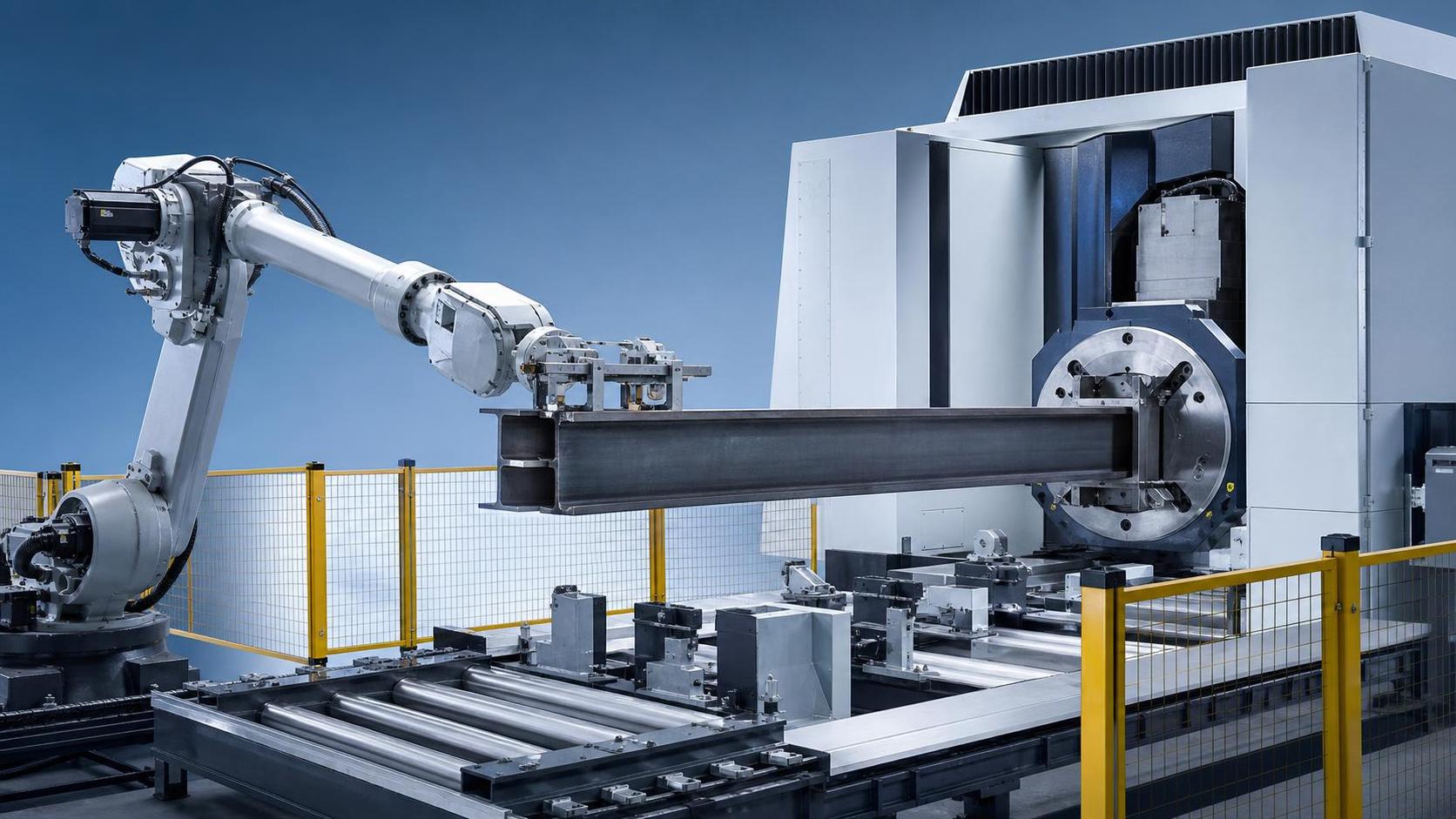
Can an Automatic Handling Robot Arm Improve Cycle Time on a Repetitive Production Line?
For a repetitive production line, cycle time is rarely lost in one dramatic event. More often, it disappears in small gaps: an operator waits for a machine door to open, a finished part is not removed promptly, the next blank is positioned slightly differently, or a downstream station is not ready when the upstream machine completes its program. These interruptions may seem minor when viewed individually, but they accumulate across every shift.
An automatic handling robot arm can improve cycle time when those gaps are caused by manual loading, unloading, transfer, orientation, or positioning. It does not make a slow cutting process faster by itself, and it cannot solve poor process planning. Its value is in making material movement repeatable, synchronized, and less dependent on operator availability. For decision-makers, the central question is therefore not whether robotics is “advanced,” but whether handling is the real constraint in the current line.
That distinction matters. A robot that is selected around a realistic production rhythm can reduce machine idle time and make output more predictable. A robot chosen only by payload or purchase price can introduce a new bottleneck through awkward access, slow gripper changes, difficult recovery after faults, or excessive safety-zone travel.
Where Cycle Time Is Actually Being Lost
Before specifying an automatic handling robot arm, it is worth separating machine cycle time from total station cycle time. A CNC machine may complete a program consistently, yet the station still underperforms because the operator needs time to open the door, remove chips or remnants, inspect the workpiece, load the next item, confirm clamping, and restart the program. In welding, cutting, milling, or structural fabrication, part transfer can be even more variable because workpieces differ in shape, temperature, surface condition, and orientation.
A useful observation exercise is to record the sequence from “machine cycle complete” to “next cycle starts.” The review should include normal operation, shift change, material replenishment, rejected parts, and the time required to recover from a mispick. This often reveals whether automation should focus on one machine, a pair of linked machines, or a larger material-flow section.
The strongest candidates tend to have stable part families and a repeated movement pattern. Typical examples include loading blanks into CNC lathes, transferring cut components to welding fixtures, removing finished plate parts from a machine, or feeding structural members through successive machining stations. High volume helps justify the investment, but volume alone is not enough. A lower-volume line with difficult, repetitive handling and frequent labor interruptions may also be a credible application.
What a Robot Arm Can Improve—and What It Cannot
A properly integrated robot can begin its approach while the machine is completing its final operation, then load or unload during the shortest practical interruption. This overlap is often more important than the arm’s maximum speed. Consistent pickup points, controlled placement, and programmed motion also reduce variation between shifts. In operations where positioning affects the next process, repeatable handling can support better fit-up, steadier weld preparation, and fewer interruptions caused by poorly seated parts.
However, it is a mistake to treat automation as a cure for unstable manufacturing conditions. If incoming material is heavily warped, parts arrive in random orientations, fixtures are worn, or upstream output changes without a buffer strategy, the robot may stop frequently while a manual operator would have improvised. Automation exposes inconsistency. That can be useful, because it points to underlying process issues, but it must be accounted for in the project scope.
The practical gain comes from the entire cell: robot motion, gripper action, machine signals, door operation, fixture clamping, part presentation, inspection requirements, and pallet or conveyor replenishment. A fast robot attached to a slow peripheral system does not create a fast line.
The Selection Criteria That Deserve More Attention Than Payload
Payload is essential, but it is only the starting point. The robot must carry the workpiece, gripper, cables, sensors, and any safety margin required by the application. A selection based only on the nominal part weight can leave insufficient capacity for a robust end effector. Large structural parts also create a moment load that may be more demanding than their mass suggests, particularly when they are held far from the wrist center.
Reach and access deserve equally careful review. Can the arm reach into the machine without colliding with doors, clamps, tooling, chip conveyors, guarding, or adjacent equipment? Can it approach from a safe angle? Is there enough clearance to remove a part that is longer, hotter, or slightly less predictable than the ideal workpiece? A layout simulation or physical reach study is often more valuable than comparing catalog specifications alone.
Gripper selection deserves special caution. Vacuum systems may suit clean, flat sheet material but require evaluation where surfaces are oily, porous, perforated, or irregular. Mechanical grippers may provide stronger control but can need different jaws for varied profiles. Magnetic handling can be effective for ferrous material, yet residual magnetism, surface scale, temperature, and safe release must be considered. The best choice is the one that can handle normal production variation without turning every exception into a manual task.
A Structural Fabrication Example: Automation Around End-Face Milling
Structural fabrication illustrates why the handling question must be tied to the machine process. Beam ends, box beams, cross beams, and columns often require flat, accurate end faces before welding or assembly. Where a workpiece must be loaded, clamped, machined, released, and moved to the next operation repeatedly, transfer time can affect the pace of the entire work cell.
For example, a Standard NC Face milling machine can be used for face milling metal structural components, including beam ends up to 2500mm × 2000mm at maximum capacity. Its CNC-controlled tool path and feed rate are intended to create precise end surfaces for subsequent fit-up and alignment. In a repetitive arrangement, the automation discussion should not stop at whether a robot can lift the beam. It should examine how the workpiece is located before pickup, whether it requires rotation, how it enters the milling position, and whether a downstream welding or assembly station can receive it without waiting.
For heavy or long members, a robot may not be the only—or the best—handling method. Gantry systems, roller conveyors, transfer carts, positioners, or a hybrid arrangement can be more suitable depending on part length, allowable floor space, and required orientation. An automatic handling robot arm is generally strongest where it performs controlled pick-and-place movements within a defined envelope. When components are especially large, the decision should compare the full material-handling architecture rather than assume an articulated arm is the default answer.
Safety and Recovery Are Part of the Productivity Calculation
Safety provisions affect layout, access, and operating rhythm from the beginning. Guarding, interlocked doors, safety scanners, light curtains, emergency stops, safe speed functions, and lockout procedures should be planned alongside the robot path. Requirements vary by application and destination market, so the final cell design needs to be assessed against applicable local requirements and the machinery involved.
Equally important is fault recovery. A production manager should ask simple but revealing questions: What happens if the robot cannot confirm a grip? How is a skewed workpiece removed? Can operators safely access the fixture? Does recovery require a programmer, or can trained production staff follow a defined sequence? A cell that runs well only under ideal conditions may produce disappointing availability even if its theoretical cycle time is attractive.
The best projects distinguish between planned intervention and unexpected intervention. Tool change, material replenishment, and scheduled inspection can be designed into the workflow. Random resets, unclear alarms, and inaccessible grippers cannot. This is one reason that maintainability should influence equipment selection as much as nominal automation level.
Build the Business Case From the Bottleneck, Not From a Robot Price
A sound business case begins with the constraint. If a CNC machine is idle between parts because handling is slow, the value of automation is linked to recovered productive machine time, steadier output, reduced dependence on hard-to-staff repetitive work, and potentially more consistent part flow. If the actual constraint is cutting time, welding deposition rate, frequent engineering changes, or lack of material supply, robot loading may deliver less than expected.
The investment review should include more than the arm itself: grippers, fixtures, guarding, sensors, electrical integration, programming, commissioning, operator training, spare parts, and any changes to conveyors or machine interfaces. It should also consider the operational cost of keeping the cell running. This does not weaken the argument for automation; it makes the decision more credible and prevents a low initial quotation from becoming an expensive implementation.
For mixed production, the question becomes whether flexibility is worth its additional complexity. Stored robot programs, quick-change jaws, adjustable locating fixtures, and clear part identification may allow several related products to run through one cell. But if each job has different geometry, routing, and handling rules, a simpler semi-automated solution can sometimes provide a better operational result.
A More Practical Route to Selection
Decision-makers considering an automated cell should prepare a short but accurate application package before requesting a proposal: part drawings and weight ranges, annual and shift-level production expectations, existing machine models, current cycle observations, required changeovers, available floor space, utility conditions, and destination-market requirements. Videos of normal handling are often valuable because they show issues that drawings do not: operator movement, part instability, accumulated chips, inconsistent stacking, or access restrictions.
Wuxi Samgins International Trade Co., Ltd., established in 2012 in Wuxi, Jiangsu Province, works across equipment categories that commonly intersect in this kind of project: CNC machine tools and lathes, automatic welding equipment, welding robots, laser and CNC cutting machines, H-beam production equipment, milling machines, bending and shearing machines, leveling and deburring equipment, and related fabrication machinery. Its location is approximately 30 minutes from Shanghai by high-speed rail, which can be useful for coordinating equipment review and project communication.
For buyers planning cross-border installation, supplier evaluation should also cover documentation, electrical and control compatibility, installation boundaries, commissioning support, training expectations, and service access after delivery. Samgins states that production and design are organized in accordance with ISO9001 quality-system certification and EU CE standards; for a specific project, the applicable machine configuration and destination requirements should still be confirmed in writing.
An automatic handling robot arm can materially improve cycle time on a repetitive line, but only when it is designed around the real bottleneck and the real variation in production. Start with the seconds between machine cycles, map the exceptions that interrupt flow, and then select the handling method that makes those seconds predictable. That is a more reliable basis for automation than choosing a robot because it appears to be the most sophisticated component in the factory.
search
Products Navigation
Send Us A Message