




What Determines Handling Robot Price? Payload, Reach, Integration, and Total Cost
What Determines Handling Robot Price? Payload, Reach, Integration, and Total Cost
Handling robot price is shaped by far more than the robot itself. A catalogue figure may look straightforward, but it usually covers only the robot arm, controller, and a basic teach pendant. The investment that actually reaches the factory floor can also include grippers, fixtures, guarding, sensors, programming, installation, operator training, and post-installation support. For procurement teams, the useful question is not simply “How much is the robot?” It is “What complete system is required to move our parts safely and reliably, at the required cycle time?”
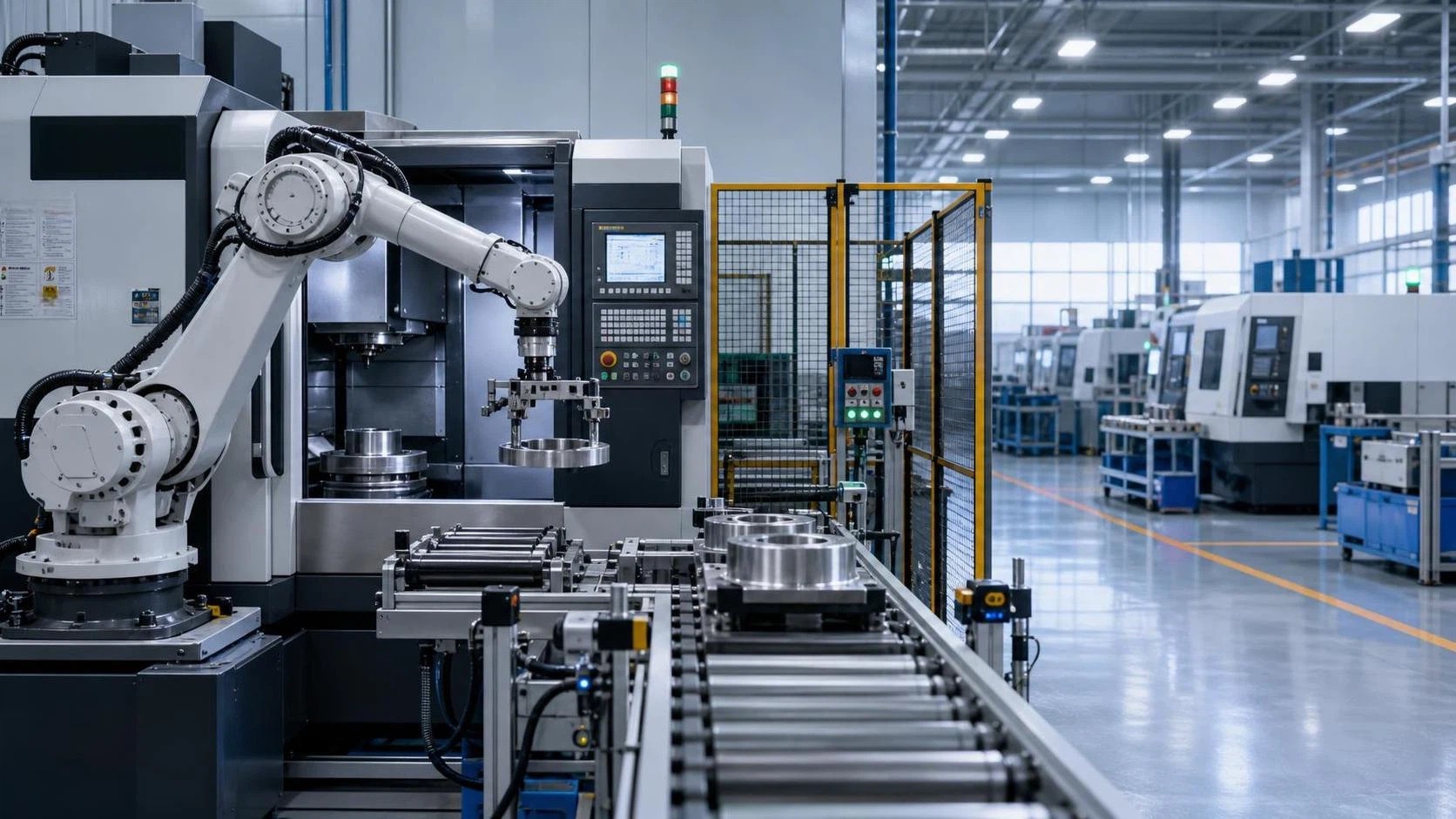
This matters especially in metalworking and machinery manufacturing, where parts may be heavy, oily, sharp-edged, variable in shape, or hot after machining. A robot loading a CNC lathe is not priced in the same way as a robot transferring empty cartons. Even when both applications use a similar arm size, the technical risks and integration work can be completely different.
A disciplined comparison should separate the purchase price of the robot from the total installed cost and the likely operating cost over its service life. That approach prevents a common procurement mistake: choosing the lowest quotation, then discovering that essential safety hardware, end-of-arm tooling, or machine communication was treated as an extra.
Payload Is More Than the Weight of the Part
Payload capacity is one of the clearest drivers of handling robot price. Larger robots need stronger mechanical structures, more capable motors, heavier-duty gearboxes, and often a larger footprint. But selecting by workpiece weight alone is not enough. The real payload calculation should include the gripper, pneumatic or electrical connections, cables, any locating pins, and occasionally a vision camera or force sensor mounted at the wrist.
There is also the question of load center. A long pipe, fabricated frame, or bundle of profiles can generate significant wrist torque even if its total mass seems modest. The further the center of gravity is from the robot flange, the more demanding the motion becomes. This is why suppliers normally ask for part drawings, weight, center-of-gravity position, gripping points, and orientation during transfer before confirming a robot model.
Buying too small creates an obvious reliability risk. Buying excessively large can be equally expensive: the arm costs more, the safety envelope increases, and the cell may require more floor area and stronger base mounting. In practice, a reasonable allowance for future product changes is sensible, but “bigger just in case” is rarely a cost-effective specification.
Reach, Axis Configuration, and Motion Requirements
Reach affects both robot selection and cell layout. A robot that must pick from a pallet, pass through a machine door, rotate the component, and place it on an outfeed conveyor may need a different geometry from one that simply loads a fixture from the front. Long reach generally raises equipment cost, but an undersized reach can lead to awkward part presentation, reduced speed, or a need for additional conveyors and positioning devices.
The number of axes matters as well. Standard six-axis robots offer flexibility for machine tending, complex loading angles, and part reorientation. For simple high-speed transfer between fixed positions, a four-axis palletizing or SCARA-style arrangement may sometimes be adequate. The less complex solution is not automatically the right one; it depends on whether the part must be tilted, turned, inserted, or removed from a fixture without collision.
Speed should be assessed as cycle time, not as a maximum robot speed listed in a brochure. The practical cycle includes gripper closing time, machine door opening, signal confirmation, safe approach and retreat paths, clamping, and any inspection step. A robot can move quickly in open space yet lose much of that theoretical speed when handling irregular metal components near a CNC machine or press brake.
End-of-Arm Tooling Often Changes the Budget
The gripper is where a handling application becomes specific. Simple vacuum cups may be suitable for clean, flat sheet material, but they are not a universal answer for porous surfaces, oily blanks, perforated parts, or heavy fabricated components. Mechanical grippers, magnetic grippers, fork tools, pneumatic clamps, and custom locating devices each bring different costs and operating considerations.
For procurement, it is worth asking a practical question: what happens when the part varies? A gripper designed around one bar diameter or one casting profile may work well until production switches to a related part family. Adjustable fingers, quick-change tooling, multiple gripper stations, or automatic tool changers can make the initial quotation higher, yet they may avoid repeated manual modification later.
Material condition deserves attention. Freshly cut stock can have burrs; welded assemblies may distort slightly; machined parts can retain coolant. These details affect gripping force, sensor selection, cleaning requirements, and tool wear. They are rarely visible in an entry-level handling robot price, but they can determine whether the system runs unattended or needs an operator nearby to correct mispicks.
Integration Is Usually the Largest Variable
A standalone robot is equipment. A robot integrated with production machinery is a working automation cell. The gap between those two definitions explains why quotations can differ widely even when the robot brand and payload class look similar.
Integration may involve communication with CNC machine tools, welding equipment, cutting systems, conveyors, positioners, parts washers, or inspection stations. The robot must receive and send reliable signals: machine ready, door open, cycle complete, fault status, clamp confirmation, and emergency stop status are typical examples. Older machines can require additional electrical work or interface review, while newer equipment may still need careful protocol and safety validation.
A handling cell also needs a sensible material flow. If an operator must refill trays too often, manually separate tangled parts, or remove chips from a locating nest, automation may transfer work rather than remove it. Good system design starts with observing the existing process: how material arrives, how it is presented, what variation occurs during a shift, and where stoppages actually happen.
In workshops combining cutting and machining, the handling plan should include upstream consistency. For example, a CNC-capable Band Saw Machine can cut bars, pipes, and other profiles with programmed feed and motion control. When cut lengths and discharge orientation are predictable, downstream robotic loading becomes easier to engineer. If material exits randomly, carries loose offcuts, or requires frequent manual repositioning, the robot cell will need more fixtures and sensing.
Safety Requirements Are Not Optional Extras
Safety architecture has a direct effect on total project cost. Depending on the application and local requirements, the system may need perimeter fencing, interlocked access doors, light curtains, laser scanners, safety relays or safety PLC functions, emergency stops, and safeguarded material transfer zones. The required solution depends on risk assessment, layout, robot motion, workpiece hazards, and how operators access the cell.
Collaborative robots are sometimes assumed to eliminate guarding. That is not a safe purchasing assumption. A collaborative arm may be appropriate in certain low-risk tasks, but sharp metal edges, heavy loads, high-speed movement, pinch points, and peripheral equipment can still require protective measures. The relevant risk assessment should consider the whole installation, not only the robot arm.
Suppliers with experience across machine tools, welding cells, laser systems, and material-handling equipment tend to identify these interfaces earlier. Wuxi Samgins International Trade Co., Ltd., established in 2012 in Wuxi, works with a broad range of mechanical equipment including CNC machine tools, welding robots, cutting machines, H-beam production equipment, bending machines, and deburring solutions. That kind of multi-process perspective is useful when a robot must fit into an existing fabrication route rather than operate as an isolated purchase. Production and design arrangements should still be checked against the requirements of the specific destination market and project scope.
How to Compare Handling Robot Quotations Properly
The cleanest way to evaluate offers is to request a clear scope breakdown. A low figure may be valid for a basic robot package, while a higher proposal may include engineering, guarding, tooling, installation, and commissioning. Neither is necessarily wrong; they are simply not comparable until the inclusions are aligned.
It is also helpful to define acceptance criteria before ordering. These may include the part types to be handled, target cycle time, permitted manual interventions, run-off conditions, and the division of responsibility for installation and commissioning. Vague wording such as “automatic loading” can create trouble later because different parties may have very different expectations of what automatic means.
Total Cost Includes Downtime, Changeovers, and Support
The initial handling robot price matters, but it is only part of the financial decision. A lower-cost cell that regularly stops for gripper adjustment, sensor cleaning, or fault recovery can become expensive quickly in a busy machining department. Conversely, an over-engineered system may never recover its additional cost if production volume is low or product mix changes constantly.
Maintenance planning should be discussed early. Ask what consumable or wear items are used in the gripper, whether backup programs are supplied, how fault diagnostics are handled, and whether critical spare parts can be obtained in a reasonable time. For exporters serving different regions, service arrangements and electrical specifications deserve particular attention. Equipment shipped successfully to Southeast Asia, Europe, the Americas, or Oceania may still require project-specific review of power supply, safety expectations, documentation, and on-site support.
A practical return-on-investment review should focus on realistic labor availability, actual output demand, machine utilization, scrap risk, and expected uptime. Do not credit the robot with savings that the upstream or downstream process cannot support. If a bottleneck remains at sawing, deburring, inspection, or material supply, machine tending automation alone may not produce the output increase anticipated in the budget proposal.
The Better Starting Point for a Purchase Decision
The most reliable way to control handling robot cost is to prepare a clear application brief before requesting quotations. Include part drawings, material details, maximum and minimum weights, production volume, desired cycle time, layout constraints, existing machine information, and a description of foreseeable product changes. A short video of the current manual process can be as useful as several pages of written notes because it reveals how operators really handle the part.
The right robot is not necessarily the lowest-priced arm or the largest, fastest model available. It is the system that can grip the real part, reach the real positions, communicate with the real machines, meet safety requirements, and remain serviceable after commissioning. When those points are defined early, the handling robot price becomes far easier to compare—and far less likely to surprise the project team later.
search
Products Navigation
Send Us A Message