




Cobot Robot Welding for Small Batches: When Collaborative Automation Makes Sense
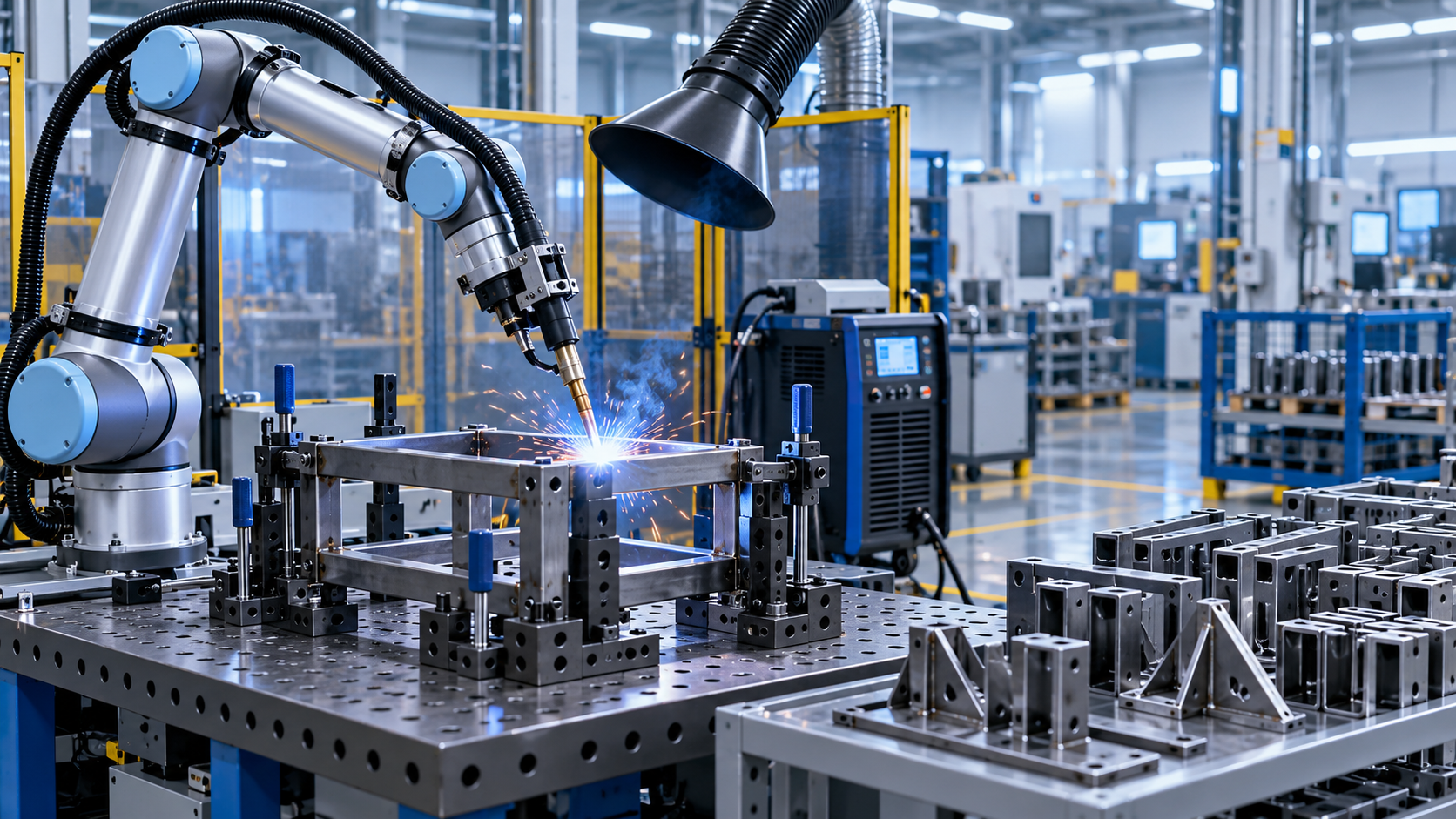
Small-batch fabrication becomes difficult to manage when weldments change every few days, operators spend more time setting up than welding, and delivery dates depend on a limited number of skilled welders. In this situation, automation can seem attractive but also risky: a conventional robot cell may require dedicated fixtures, fencing, lengthy programming, and enough repeat volume to justify the investment.
Cobot robot welding makes sense when the work is repetitive enough to benefit from consistent motion, but variable enough that fast changeovers matter more than maximum arc-on speed. It is usually a better fit for high-mix, low-volume work than a large fixed robotic cell, provided that parts can be presented consistently, weld access is reasonable, and the business is prepared to standardize at least part of its welding process. It is not a substitute for welding engineering, poor fit-up control, or sound production planning.
The production pattern that usually supports a cobot
The most suitable environment is not necessarily a shop producing only a few parts per month. It is a shop with recurring families of parts: brackets, frames, cabinets, supports, small structural assemblies, machine bases, pipe subassemblies, or fabricated components that return in different dimensions or configurations. Individual orders may be small, yet the weld types, joint positions, material thicknesses, and handling steps often repeat.
Consider a production area where an experienced welder must switch between short fillet welds on mild-steel brackets, corner welds on small frames, and repeated tack-and-weld operations on similar assemblies. Each item may only require minutes of arc time, but the total labor burden includes positioning, checking fit-up, maintaining consistent travel speed, and reworking variation. A collaborative system can take over the repeatable weld path while the welder handles fit-up, tacking, inspection, difficult joints, and exceptions.
That division of work is often more realistic than expecting a single automated station to run unattended. For small batches, the financial case is commonly tied to reduced dependency on manual repetition, steadier quality, easier redeployment between jobs, and better use of welding expertise—not simply to replacing one person or achieving continuous lights-out operation.
Start with the part, not the robot
A frequent purchasing mistake is evaluating a cobot by payload, reach, or advertised ease of programming before confirming whether the parts are automatable. Collaborative robots are flexible, but their flexibility has limits. The part must allow the torch to reach the joint without collisions, the assembly must be stable during welding, and the joint location must be sufficiently repeatable from one piece to the next.
Before comparing systems, select several representative assemblies rather than choosing only the easiest demonstration part. Include the part that creates the most manual welding time, one that changes frequently, and one with a quality issue that comes from inconsistent torch angle or travel speed. Then review the following conditions with the production and welding teams:
- Joint repeatability: Can parts be located in the same position each cycle, or do cut edges, forming variation, and loose tack-up move the seam too much?
- Access: Can the torch maintain the required work angle and travel angle throughout the weld without hitting clamps, part features, or the table?
- Part size and weight: Is the assembly practical for an operator to load and unload? Does it remain within the robot’s working envelope after allowing for fixtures and torch clearance?
- Weld procedure stability: Are material grade, thickness, wire, shielding gas, and joint design reasonably controlled? A robot repeats the procedure it is given, including an unsuitable one.
- Fit-up quality: Are gaps, misalignment, and contamination within a range that the selected process can tolerate?
- Fixture effort: Can a simple modular fixture locate the part, or would each small batch require a costly dedicated jig?
Small-batch operations do not need perfect parts, but they do need predictable reference points. A cobot can be programmed by guiding its arm to points along a weld path, yet teaching a path does not correct a seam that shifts unpredictably from unit to unit. Seam tracking, touch sensing, or vision may expand tolerance, but these options add cost, setup work, and another process to validate.
Where collaborative welding has a clear advantage
The practical advantage of a cobot is its ability to be moved between suitable tasks and programmed without the same level of specialist intervention expected for many conventional robot installations. This matters when production changes frequently. A cell that takes too long to retool will sit idle between orders, even if its welding speed is excellent.
Collaborative welding is often well suited to work with short and medium-length welds, repeat assemblies, and manageable part handling. Examples include repeated fillet welds on fabricated brackets, frame corners, reinforcement plates, small tanks or enclosures with accessible seams, and standardized subassemblies used across several final products. It can also help when a shop needs to stabilize weld appearance or reduce variation in non-critical repetitive work while reserving experienced manual welders for more complex fabrication.
The ability to place an operator near the process should not be misunderstood as permission to ignore safety planning. Welding creates arc radiation, fumes, hot surfaces, spatter, and pinch or collision hazards related to workholding and moving equipment. The required safeguards depend on the complete application, including torch type, welding parameters, part geometry, loading method, and local safety requirements. Screens, fume extraction, safe operating procedures, emergency stops, and an application-specific risk assessment remain necessary.
When a conventional robot cell may be the better choice
A collaborative system is not automatically the best automation choice merely because batch sizes are small. If one product family runs for long periods, parts are consistently loaded automatically, and output demand depends on the highest possible deposition and travel performance, a conventional industrial robot cell may offer a stronger long-term fit. Larger robots may also be more appropriate for heavy torches, large fixtures, oversized assemblies, or applications requiring reach and speed beyond a cobot’s practical range.
The comparison should be based on the full cell, not the arm alone. A lower-cost robot can become an expensive project when fixtures, positioners, safety equipment, fume management, welding power source integration, programming time, operator training, and validation are added later. Conversely, an initially more substantial cell may be justified when it eliminates a persistent throughput constraint.
Calculate the opportunity from lost production time
For small-batch work, total arc-on time is only one part of the equation. Decision-makers should map the current sequence from parts arriving at the welding station to the completed assembly leaving it. Record preparation, locating, tacking, welding, repositioning, inspection, touch-up, and rework separately. This exposes whether automation should focus on welding itself or whether the real constraint is upstream material preparation or downstream handling.
For example, a cobot may produce a stable weld path but still wait for parts because cut blanks arrive with inconsistent dimensions, burrs, or distorted edges. In that case, improving preparation can have as much impact as robot programming. Where fabricated components begin as plate, tube, or structural sections, cutting quality affects fit-up directly. A CNC cutting process with narrow, consistent kerfs and minimal burrs can reduce the amount of manual adjustment required before a part reaches the welding fixture. For beam-related fabrication, an H beam cnc fiber laser cutting machine may be relevant where its material range, CNC shape capability, and non-contact cutting approach support repeatable pre-weld part preparation.
Do not convert every saved minute into a claimed labor reduction. In many operations, the released time is absorbed by more inspection, better fixture preparation, additional throughput, or reassignment of skilled welders to work that does not suit automation. The useful calculation is whether the station can complete the expected mix of work with less schedule risk and more predictable labor demand.
A sensible pilot should test variation, not just a perfect sample
Vendor demonstrations often show a clean, well-prepared component in an open position. That is useful for verifying basic motion, but it is not enough for a buying decision. A worthwhile trial should include representative material, real joint access, typical tack-up, and the range of variation normally seen on the floor. The objective is to identify where the process becomes sensitive.
During a pilot, review the time needed to teach a new part, adjust a fixture, make a first acceptable weld, and return to a previously programmed job. Observe whether operators can load parts comfortably without interfering with the torch path. Confirm that the weld procedure produces acceptable fusion and profile under the actual joint condition, rather than judging only visual consistency. The production team should also note how frequently manual intervention is required.
Questions that reveal hidden limitations include: Does a small gap change the result? Can the operator access every clamp? Is part distortion moving the final seam? Does the torch need cleaning between cycles? Is the welding sequence creating heat buildup that affects later joints? Can the same fixture support several related variants, or does each variation require substantial redesign?
Programming ease does not remove process discipline
The teach-by-demonstration approach associated with cobot robot welding can reduce the barrier to creating simple paths, but a reliable program still requires process knowledge. Travel speed, torch orientation, stick-out, weave settings, start and stop behavior, sequence, and gas coverage affect the result. Programs also need controlled naming, revision management, and clear connection to the fixture and part version they were created for.
A practical approach is to create a repeatable release method. First, confirm the drawing revision and material. Next, set the fixture and locate a first-off part. Teach or retrieve the program, then verify clearance using dry runs where appropriate. Produce a first welded piece and inspect the required joints before releasing the job for repeated cycles. When a problem is found, determine whether it comes from the program, fixture, incoming part, consumables, or welding parameters. Changing the robot path to compensate for an uncontrolled upstream issue can make the next batch harder to run.
Ownership should be assigned early. Production may operate the cell, but responsibility for weld procedure settings, fixture condition, program changes, and inspection criteria should not be vague. Small-batch automation succeeds when these handoffs are simple and documented, not when the system depends on one person remembering informal adjustments.
Signals that the investment should wait
It may be premature to purchase a cobot when part designs are changing so rapidly that no recurring weld geometry exists, when incoming components vary widely without a practical locating method, or when welding demand is too intermittent to keep the equipment meaningfully utilized. It is also a weak fit when most work involves inaccessible joints, frequent overhead positions, large assemblies that require complex manipulation, or highly variable repair welding.
Another warning sign is an attempt to use automation to solve a staffing issue without defining the work package. A cobot cannot independently decide how to clamp an unstable assembly, select a procedure for unknown material, repair a poor tack weld, or resolve a drawing ambiguity. Those tasks must be addressed through engineering and workflow design before the cell can deliver dependable value.
The strongest small-batch applications are usually built around a limited starting scope: a group of parts with recurring joints, a shared fixture concept, known welding parameters, and a realistic operator role. Once that work is stable, additional part families can be added with better cost and lower disruption than trying to automate every weld in the shop at once.
search
Products Navigation
Send Us A Message