




Dust collection requirements for sheet metal deburring equipment
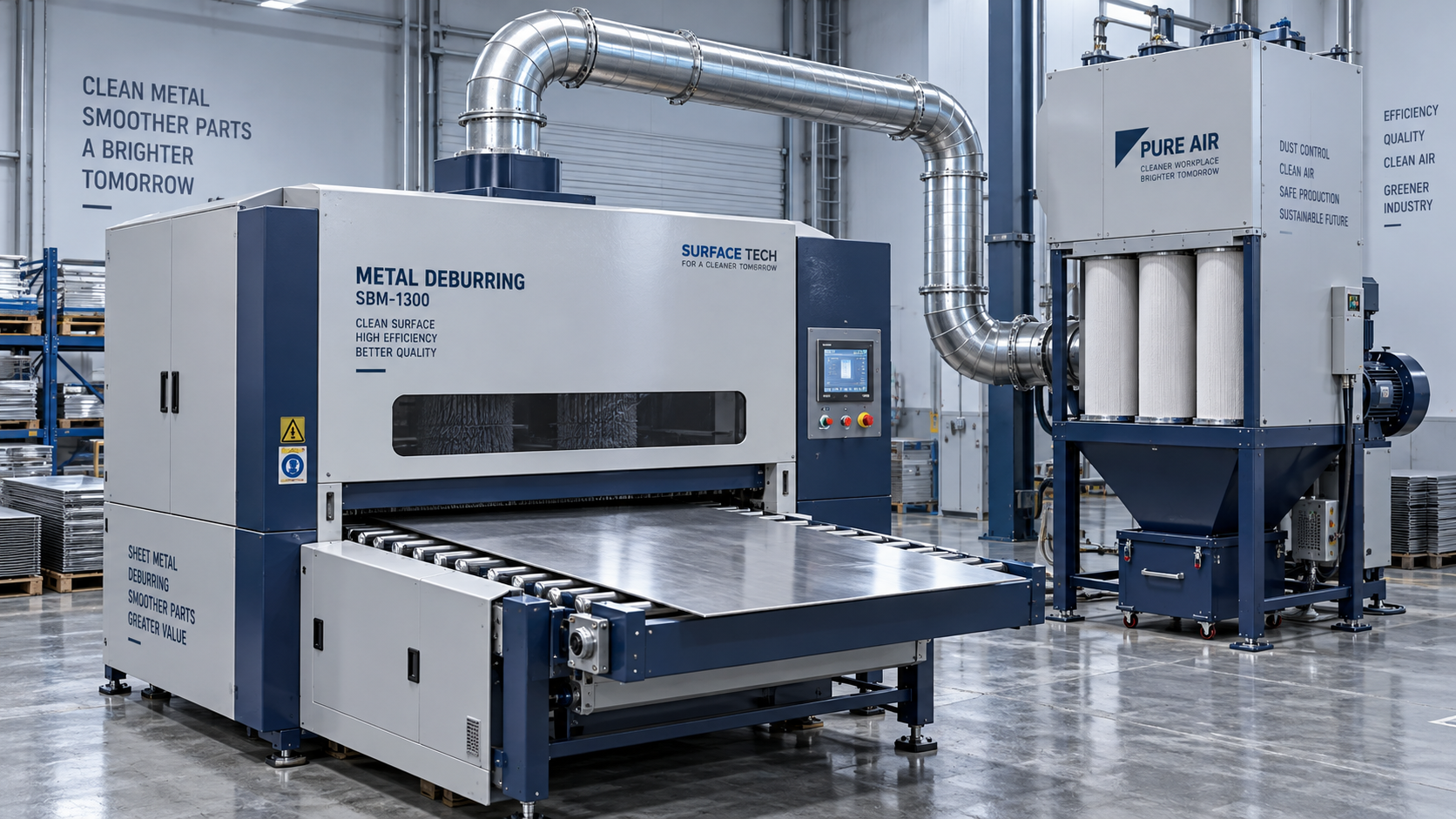
A deburred sheet can look clean while the surrounding process is anything but. Fine particles may remain on the surface, escape through machine openings, or accumulate inside ducts long before anyone notices a visible dust cloud. For quality control and safety teams, effective dust collection is therefore part of the operating specification for sheet metal deburring equipment—not an accessory to consider after installation.
The requirements depend on what is being processed, how the abrasive system generates particles, and where those particles travel. Surface cleanliness, worker exposure, fire prevention, and reliable machine operation all have to be addressed together. A collector selected only by motor power or filter area may solve one problem while leaving another unresolved.
Define the dust before specifying the collector
“Metal dust” is not a sufficient description for system design. A deburring machine may generate a mixture of base metal, abrasive fragments, oxide scale, protective coatings, and residues from upstream cutting operations. Different combinations can change the health hazards, ignition behavior, filter loading, and waste-handling requirements.
Start with a material and process inventory covering normal production, occasional jobs, and foreseeable changes:
- Base metals: carbon steel, stainless steel, aluminum, magnesium, titanium, or other alloys.
- Incoming surface condition: laser-cut oxide, mill scale, paint, plating, oil, or protective film.
- Deburring method: abrasive belts, rotating brushes, discs, or combinations of these.
- Production conditions: stock removal, feed speed, operating hours, and simultaneous use of multiple heads.
- Material changeovers: whether different metals will share the machine, ductwork, or collector.
Do not assume that a solid metal’s behavior describes the dust produced from it. Finely divided material can present different combustion risks, and even steel dust should not automatically be classified as noncombustible. Where combustibility is uncertain, obtain representative dust testing through a qualified laboratory. Relevant properties may include explosibility, maximum explosion pressure, deflagration index, and ignition sensitivity, as appropriate to the assessment.
Testing must represent the actual process. A sample of raw sheet material or coarse chips does not necessarily characterize the fine fraction collected after abrasive finishing.
Which standards apply to sheet metal deburring equipment?
There is no universal airflow value or single certificate that establishes compliance for every installation. Requirements come from the destination country, local authorities, occupational exposure rules, fire codes, and the assessed hazards of the process.
In the United States, combustible-dust design should be evaluated against applicable fire codes and the relevant NFPA provisions. NFPA 660 consolidates guidance previously covered by several combustible-dust standards, including standards addressing combustible metals. However, a jurisdiction may still reference an earlier edition or predecessor standard. Confirm the adopted requirements with the authority having jurisdiction rather than assuming the newest publication is automatically enforceable.
OSHA requirements for ventilation, hazardous substances, housekeeping, and other workplace controls may also apply. A dust hazard analysis should identify credible fire and explosion scenarios and document the required safeguards where combustible dust is involved.
For European installations, assess the applicable machinery requirements and, where explosive atmospheres may occur, the relevant ATEX workplace and equipment obligations. Zone classification and equipment selection require a site-specific assessment; a general CE marking does not establish suitability for every combustible-metal application.
ISO 9001 certification concerns quality management. It does not, by itself, demonstrate adequate extraction airflow, acceptable worker exposure, or explosion protection. Purchasing teams should distinguish management-system credentials from evidence supporting the safety of the installed process.
Capture performance matters more than a large airflow number
The first task is to capture particles where they are generated. Abrasive contact can throw dust at considerable speed, so a distant hood may perform poorly even when connected to a powerful fan. Enclosed working zones, well-positioned extraction openings, and controlled airflow through sheet entry and exit points are usually more dependable than trying to collect dust after it enters the room.
Ask the machine supplier to specify the required extraction volume and connection pressure for the actual operating configuration. Those figures should cover all active abrasive heads and the anticipated loading conditions, not merely an unloaded demonstration.
Read airflow and pressure together
A fan’s free-air capacity is not the airflow delivered at the machine. Duct bends, branch connections, separator losses, filters, and discharge arrangements all create resistance. Selection should use the fan performance curve and the system’s calculated pressure losses, including the expected condition of loaded filters.
The basic relationship is Q = v × A, where Q is volumetric airflow, v is air velocity, and A is duct cross-sectional area, using consistent units. This helps check sizing, but it does not determine the correct conveying velocity. That depends on particle properties, loading, duct orientation, and applicable design guidance.
Too little velocity can allow material to settle in ducts. Excessive velocity may increase abrasion, noise, and energy consumption without improving capture. Avoid choosing either airflow or duct diameter from a generic rule alone.
Check the installation, not just the machine outlet
- Keep duct runs practical and avoid unnecessary bends or pockets that encourage accumulation.
- Provide suitable inspection and cleaning access without compromising required protective measures.
- Balance shared branches so opening one connection does not starve another machine.
- Account for replacement air; excessive building negative pressure can undermine extraction.
- Verify performance with the intended sheet sizes, feed rates, and abrasive combinations.
Smoke visualization or another suitable airflow demonstration can help reveal leakage paths, provided the method is safe for the process. However, it cannot replace airflow measurements or occupational exposure sampling.
Dry filtration or wet collection: make the decision around risk
Dry collectors are often considered because they can provide effective particle removal and straightforward recovery of dry waste. Their suitability depends on the dust, filter media, ignition sources, and required fire or explosion protection. A cartridge collector suitable for one steel-finishing operation should not automatically be used for aluminum or mixed-metal production.
Wet collection can be appropriate for certain combustible-metal applications, but it is not a blanket solution. Some metals can react with water and generate hydrogen. Collector design, ventilation, liquid chemistry, water-level control, sludge management, and shutdown procedures must therefore be evaluated together.
Neither collector type removes the need for a hazard assessment. Separating incompatible dust streams may be necessary, particularly when combustible metals are involved. Material segregation must extend to collection containers and housekeeping equipment, not stop at the machine.
Control ignition and prevent the collector from spreading an incident
Deburring can produce hot particles, and mechanical faults may create additional ignition sources. Damaged abrasives, unexpected contact, bearing problems, or foreign objects deserve attention during both design and maintenance.
Where the assessment identifies combustible-dust hazards, engineered safeguards may include appropriate collector placement, explosion venting or suppression, and explosion isolation. Their selection must consider the dust test results, enclosure characteristics, connected equipment, and consequences of an event.
A spark arrestor is not explosion isolation. Likewise, spark detection and extinguishing should not be assumed effective for every particle stream or installation. These measures require application-specific engineering and do not replace other required protection.
Bonding and grounding help control electrical and electrostatic hazards, but they cannot eliminate all ignition sources. Filters, flexible connections, and duct components should be selected for the identified service rather than treated as interchangeable accessories.
If extraction failure leaves the machine unsafe to operate, the control system should prevent startup or stop processing appropriately. Use a monitored parameter that demonstrates effective extraction—not merely a signal showing that the fan motor is energized.
Use commissioning to establish a quality and safety baseline
Acceptance testing is the point at which supplier claims become measurable operating conditions. Run representative production, including demanding stock-removal conditions and relevant material changeovers. Record airflow, static pressure at defined points, filter differential pressure, machine settings, and the condition of the finished parts.
For quality control, inspect for residual fines, scratches caused by redeposited particles, and contamination that could affect coating, bonding, or subsequent joining. Define a repeatable cleanliness check appropriate to the downstream process. A wipe test can be a useful production indicator, but its method and acceptance criteria need to be agreed internally.
For safety, arrange exposure monitoring for the relevant substances. Stainless-steel processing, for example, warrants consideration of chromium- and nickel-containing particulate; coatings may introduce additional hazards. A visibly clean workspace does not prove that exposure is below applicable limits.
Return-air arrangements also need assessment. High-efficiency filtration alone does not establish that recirculation is acceptable. Consider hazardous constituents, filter failure, monitoring requirements, local restrictions, and the combustible-dust assessment.
In an integrated fabrication line, upstream cleanliness and downstream ventilation should remain distinct responsibilities. For example, Samgins’ 9 axis cantilever type welding robot supports welding automation for large steel workpieces, with 3D drawing import and automatic arc tracking. Cleaner prepared parts can support process consistency, but deburring extraction does not replace welding-fume controls. The two operations require separate assessments, even when they share a production area.
What purchasing teams should request before approval
Wuxi Samgins International Trade Co.,Ltd supplies fabrication machinery, including cutting, bending, deburring, and welding equipment. When evaluating sheet metal deburring equipment from any supplier, request documentation that defines the extraction interface clearly enough for the collector designer and site safety team to work from the same assumptions.
- Operating envelope: approved materials, process restrictions, and permitted changeovers.
- Extraction specification: airflow, required pressure, connection sizes, and measurement conditions.
- Hazard basis: dust characterization and responsibilities for site-specific assessment.
- Protective functions: extraction monitoring, alarms, interlocks, and applicable fire or explosion safeguards.
- Maintenance instructions: duct inspection, filter or sludge handling, cleaning methods, and isolation procedures.
- Acceptance criteria: demonstrated capture, exposure-control verification, surface cleanliness, and baseline operating readings.
After commissioning, trend those baseline readings rather than waiting for dust to become visible. Investigate changes in airflow, pressure, surface residue, or housekeeping demand. Avoid compressed-air cleaning that disperses hazardous dust, and use cleaning equipment suitable for the material and location.
The strongest dust collection specification connects the material hazard to measurable capture performance and practical maintenance. That gives quality personnel a repeatable finishing process and safety personnel evidence that the controls are working—not simply reassurance that a collector has been installed.
search
Products Navigation
Send Us A Message