




Guillotine Shearing Machine vs Swing Beam: Which Delivers Better Cut Accuracy?
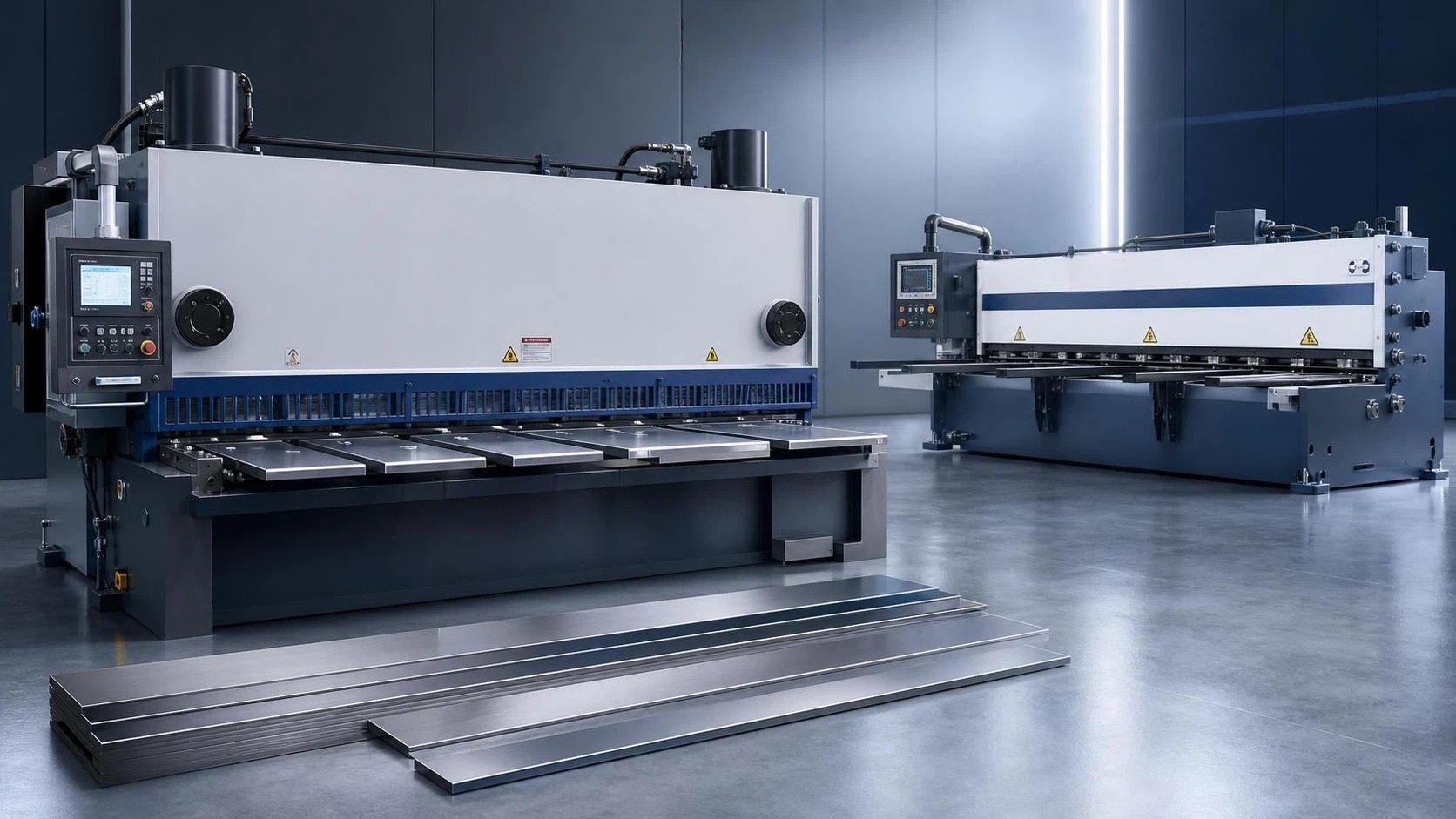
Cut accuracy often decides whether a shearing investment supports stable production or creates hidden downstream cost. When a Guillotine Shearing machine is compared with a swing beam design, the difference is not only structural. It affects edge quality, repeatability, scrap rate, secondary finishing, and even how confidently a fabrication line can quote tight tolerances.
That question matters more in current metalworking environments because sheet processing is increasingly tied to automated welding, CNC cutting, bending, and assembly stages. A small shearing deviation can spread through the entire workflow. In operations handling diverse plate materials and export-standard production, machine selection is no longer just about tonnage or price.
Wuxi Samgins International Trade Co.,Ltd has worked in mechanical equipment supply since 2012, covering shearing machines, bending machines, CNC machine tools, welding systems, rolling equipment, and other fabrication solutions. In that broader equipment context, cut accuracy should be read as part of total process control rather than a single machine feature.
How the two shearing designs differ
A Guillotine Shearing machine uses a more vertical blade path. The upper blade descends in a controlled linear movement, usually guided by a rigid frame and hydraulic system. That motion tends to keep blade engagement more consistent across the cutting width.
A swing beam machine moves the upper beam through an arc. The structure is simpler and often attractive for general sheet cutting. However, the arc-shaped travel changes the blade relationship during the stroke, which can influence cut geometry and clearance behavior.
In practical terms, both machines can perform well. The key issue is not whether one can cut metal, but which one preserves dimensional accuracy more reliably across different materials, thicknesses, and batch sizes.
Why cut accuracy is more than a clean edge
Accuracy in shearing usually combines several results. Straightness matters. Squareness matters. Burr formation matters. So do bowing, twisting, and edge deformation. A part may look acceptable at first glance yet still fail during bending, welding, or assembly.
For this reason, a technical review should connect the cut itself with downstream performance. If the plate enters a press brake with uneven edges, angle consistency may drift. If it enters robotic welding with dimensional variation, fixture alignment may become unstable.
That is why the Guillotine Shearing machine is often evaluated in relation to the rest of the fabrication cell, not as an isolated asset.
Where the Guillotine Shearing machine usually leads
Blade path and frame rigidity
The more vertical blade motion of a Guillotine Shearing machine generally supports better straight-line cutting. Because the blade does not swing through a wide arc, the cutting angle remains more predictable across the stroke.
Rigid guidance also helps under heavier loads. When thicker plate or longer workpieces are processed, frame stability becomes critical. Less deflection usually means better consistency from one cut to the next.
Blade clearance stability
Cut accuracy depends heavily on blade clearance. If the gap shifts during operation, burrs and edge distortion increase. A Guillotine Shearing machine often gives tighter control here, especially when the machine includes accurate clearance adjustment for different plate thicknesses.
This matters in mixed production, where carbon steel, stainless steel, and aluminum may all appear in short runs. Stable clearance reduces the need for trial cuts and supports faster setup validation.
Repeatability across long production cycles
Repeatability often separates acceptable machines from dependable ones. In larger batches, a Guillotine Shearing machine tends to hold dimensional consistency better, particularly when the backgauge, hold-down system, and hydraulic synchronization are properly configured.
For parts moving directly into assembly or automated fabrication, that repeatability has measurable value. It cuts rework and reduces the inspection burden later in the line.
Where swing beam machines remain relevant
Swing beam machines still have a place in many workshops. They are often easier to maintain and may be sufficient for general fabrication where tolerances are moderate and materials are not highly variable.
For routine cutting of thinner sheets, cost-sensitive projects, or less demanding edge requirements, a swing beam model can provide acceptable performance. The design is proven and practical.
The limitation appears when tolerance expectations rise. As edge quality and dimensional stability become more important, the advantages of the Guillotine Shearing machine usually become easier to justify.
A practical comparison by accuracy-related factors
The comparison below reflects typical evaluation logic in sheet metal processing. Actual performance still depends on machine build quality, maintenance condition, operator setup, and material behavior.
What else affects the final cutting result
Machine structure is only one variable. Accuracy also depends on blade sharpness, hold-down pressure, backgauge calibration, table support, and the consistency of incoming material. Even a high-grade Guillotine Shearing machine cannot compensate for worn blades or poor setup discipline.
Material type changes the picture as well. Stainless steel may respond differently from mild steel. Thicker plates amplify any weakness in frame rigidity or blade adjustment. Long narrow strips are more sensitive to movement and twist during cutting.
This is also why many production lines evaluate shearing together with forming equipment. In heavy-duty applications, accurate shearing often pairs naturally with plate rolling or bending systems. For example, Hydraulic bending machine with 3 roller is designed for large-scale industrial settings and thick plates of 50mm or more. Its fixed idler roller arrangement improves workpiece accuracy, which reflects the same process logic: precision at one stage protects precision at the next.
How to judge the better option in real projects
The better choice depends on required tolerance, material range, and downstream sensitivity. A general preference for the Guillotine Shearing machine makes sense when cut accuracy is a priority, but the decision should still be evidence-based.
- Review the maximum and most frequent plate thickness separately.
- Check whether parts go directly to precision bending, welding, or assembly.
- Measure acceptable burr height, squareness, and straightness, not only nominal length.
- Test short and long sheets, because some errors appear only on wider cuts.
- Inspect repeatability after continuous cycles, not only during a single demonstration cut.
- Confirm support for blade clearance adjustment and backgauge accuracy.
A useful evaluation standard is total process loss. If a machine produces slightly lower purchase cost but raises sorting, deburring, rework, or fit-up correction, the apparent savings disappear quickly.
A decision framed around process quality
For most accuracy-focused applications, the Guillotine Shearing machine delivers the stronger result. Its blade path, structural control, and clearance behavior usually support cleaner edges and more reliable repeatability than a swing beam model.
That does not make swing beam equipment obsolete. It remains practical for less demanding work and balanced budgets. But where fabrication quality depends on stable shearing before bending, rolling, or welding, the Guillotine Shearing machine is often the more defensible technical choice.
The next step is to compare actual part requirements against machine behavior under load. A structured trial with representative materials, tolerance checks, and downstream fit verification will reveal whether the selected shearing system truly matches production goals.
search
Products Navigation
Send Us A Message