




How do automatic handling robots perform in humid, oil-mist environments common in gear manufacturing?
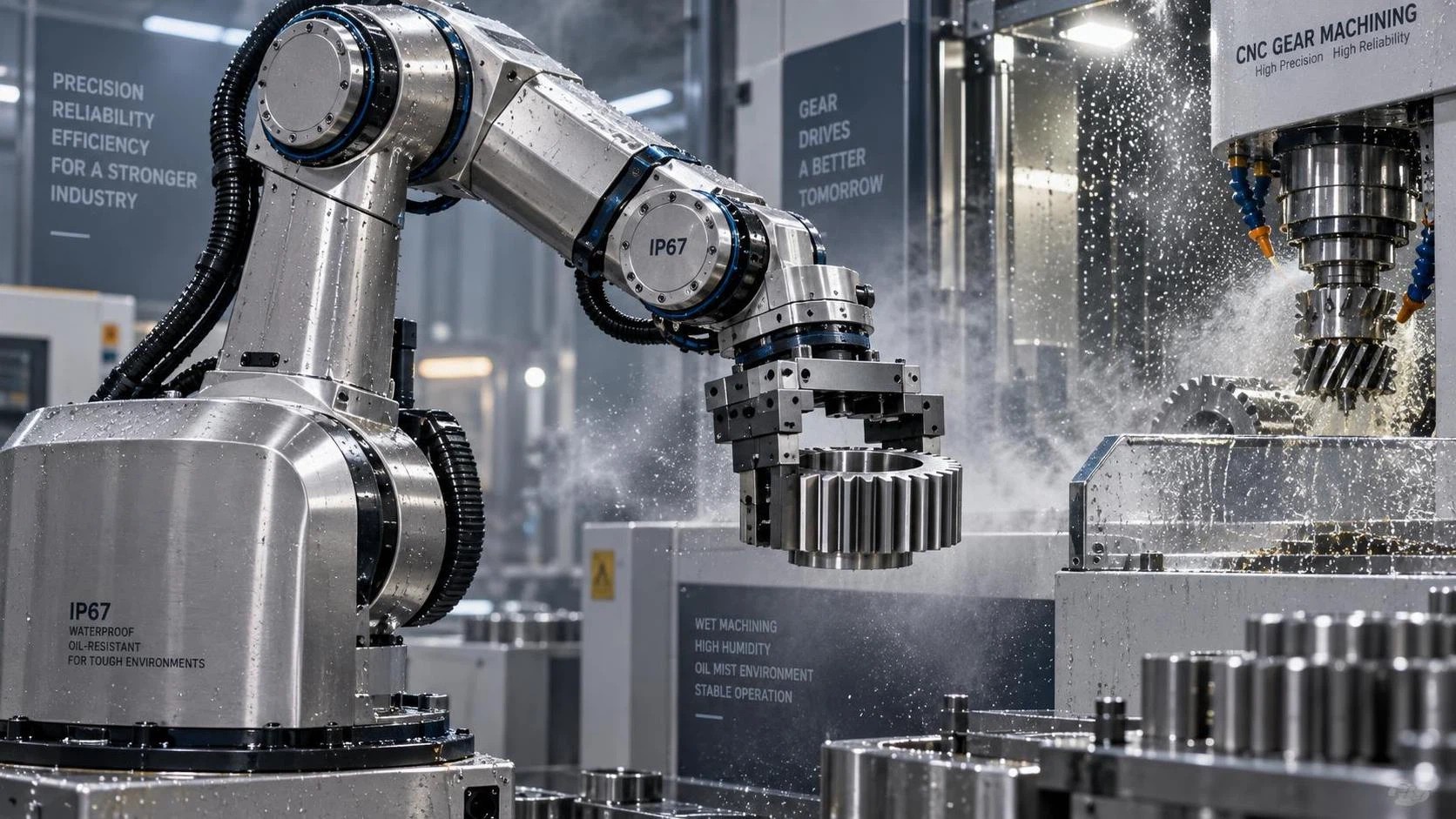
When humidity and oil mist meet precision: what really matters for automatic handling robots in gear shops
Gear manufacturing isn’t just about tight tolerances—it’s about surviving the environment. Coolant-laden air, condensation on machine surfaces, and fine oil mist suspended for hours aren’t incidental conditions. They’re part of the daily operational reality. And when you introduce an automatic handling robot into that space—not as a lab demo, but as a shift-long workhorse—its performance hinges less on advertised payload or repeatability specs, and more on how well its design anticipates corrosion, seals against ingress, and maintains functional integrity over weeks of continuous exposure.
We’ve seen too many cases where a robot runs flawlessly in dry, clean-room validation—then starts dropping parts or triggering fault codes after two weeks on a gear hobbing line. Not because the controller failed, but because moisture crept past a poorly rated connector, or oil film built up on a linear guide, or thermal cycling caused condensation inside a servo housing. These aren’t edge cases. They’re predictable outcomes when environmental hardening is treated as optional—or worse, assumed.
Three things operators actually check before trusting a robot with their workpiece
Floor-level decisions rarely hinge on datasheet footnotes. What matters on the shop floor is observable, testable, and repairable. Here’s what experienced machinists and line supervisors consistently verify:
- IP rating isn’t theoretical—it’s verified at the joint level. An IP67 enclosure means nothing if the wrist seal is only IP54, or if cable glands weren’t torqued to spec during installation. Real-world reliability comes from consistent sealing across every moving interface—not just the main cabinet.
- Stainless steel isn’t everywhere it should be. It’s easy to specify stainless fasteners or frame plates—but what about bearing housings? Linear rail mounts? The internal structure of the end-effector? Corrosion often starts where steel meets aluminum or where dissimilar metals contact in humid conditions.
- Drive systems are sealed—not just shielded. A dust cap over a ball screw doesn’t cut it. True protection means integrated wipers, positive-pressure purge options (where appropriate), and lubricants formulated for high-humidity stability—not just “industrial grade” generic grease.
At Wuxi Samgins International Trade Co., Ltd., our industrial-grade automatic handling robots are built around those three checks—not as add-ons, but as foundational constraints. Based in Wuxi City, Jiangsu Province—just 30 minutes from Shanghai by high-speed rail—we’ve supported gear manufacturers across Southeast Asia, Europe, and the Americas since 2012. Our experience tells us that reliability in this environment isn’t about one standout feature. It’s about consistency across materials, sealing, thermal management, and service access—even when ambient RH hovers near 85% and oil mist concentration fluctuates with machining load.
Where material flow meets machine logic—and why bending fits in
Gear lines don’t operate in isolation. They feed into downstream processes—heat treatment, surface finishing, assembly. That’s why material handling can’t be siloed from other equipment logic. Consider pipe bending: a process common in power engineering, boiler manufacturing, and shipbuilding—industries where gear sets often end up. When a CNC hydraulic pipe bending machine handles complex multi-plane bends, it generates its own set of environmental challenges: hydraulic oil mist, localized heat buildup, and vibration transmitted through shared foundations.
That’s where integration becomes practical—not theoretical. A robust automatic handling robot doesn’t just move blanks between stations. It interfaces cleanly with PLC-based machines like the CNC hydraulic pipe bending machine, syncing cycle start/stop signals, confirming tooling presence, and adapting to minor timing variances without requiring manual re-teach. Its sealed I/O modules handle signal integrity even when mounted adjacent to high-noise hydraulic systems. And its maintenance intervals align with typical servicing windows—so downtime doesn’t cascade.
This isn’t about making robots “compatible.” It’s about designing them to coexist—physically and functionally—with the full ecosystem of gear production machinery: lathes, milling machines, deburring units, H-beam lines, and bending systems alike. All our equipment—from welding robots to laser cutters—is developed under ISO 9001 and CE compliance frameworks, not as checkboxes, but as design guardrails. That includes specifying component-level certifications (like EN 60529 for enclosures) and validating thermal performance across real-world ambient ranges—not just lab conditions.
What to ask—not just what to specify
Before committing to any system, operators benefit most from asking questions that expose implementation realities:
- Can you show me photos—or better, a video—of the same model running in a live gear shop for >6 months? Not a showroom, not a demo cell.
- What’s the documented mean time between failures for the wrist seal assembly under 80% RH + oil mist? Is that data from accelerated testing or field use?
- How does the robot’s thermal management respond when ambient temperature swings between 15°C and 32°C overnight—especially if it’s mounted above a coolant-saturated floor?
- Are firmware updates field-deployable without requiring full system shutdown—or do they force coordination with other line equipment?
These aren’t technical hurdles meant to stall procurement. They’re operational filters. Because in gear manufacturing, uptime isn’t measured in annual percentages—it’s measured in completed gear sets per shift, and in whether the operator trusts the system enough to walk away for lunch without watching it.
Wuxi Samgins’ approach reflects that pragmatism. We don’t sell robots as standalone units. We position them within workflows—alongside CNC machine tools, deburring systems, and bending solutions—based on actual project experience, not catalog cross-references. If your current bottleneck isn’t speed, but consistency amid humidity and mist, then the right question isn’t “what robot should I buy?” It’s “what environmental thresholds must this unit sustain—without supervision—for 12 consecutive shifts?”
That threshold varies. But it’s always defined by the shop—not the spec sheet.
search
Products Navigation
Send Us A Message