




Can a machine unloading handling robot reliably handle hot castings above 300°C without thermal drift?
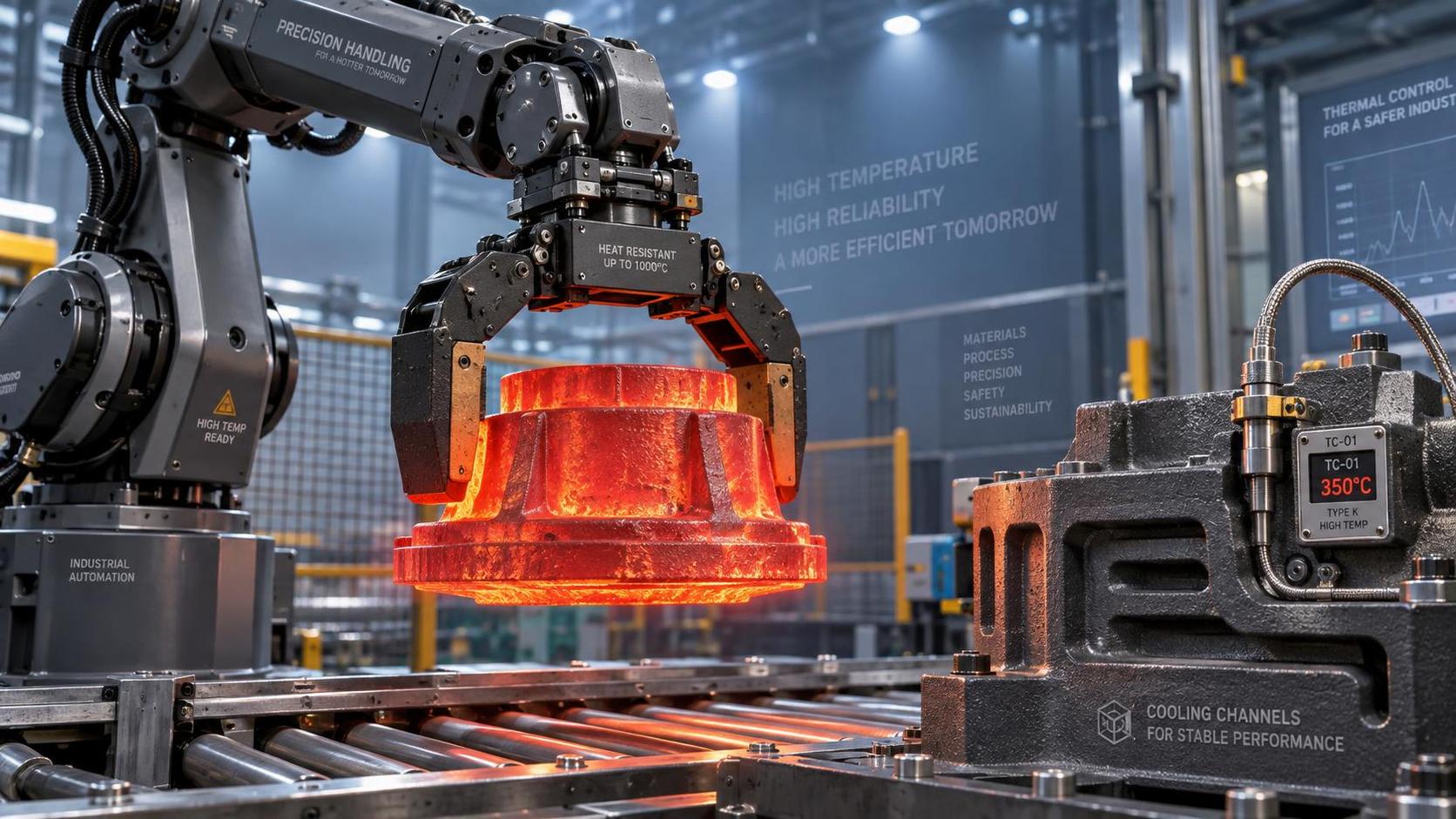
Can a machine unloading handling robot reliably handle hot castings above 300°C without thermal drift?
Yes—but only under tightly controlled conditions, and not all systems labeled “high-temperature capable” meet the functional requirements of precision foundry post-processing. For technical evaluators assessing automation for casting lines, the real question isn’t whether a machine unloading handling robot can survive near red-hot parts—it’s whether it maintains sub-millimeter repeatability, consistent grip force, and safe trajectory integrity over extended cycles when ambient radiated heat exceeds 300°C.
Thermal drift here isn’t theoretical. It’s mechanical: expansion in aluminum alloy arms, viscosity shifts in hydraulic fluid, encoder signal noise from heated motor windings, and cumulative positional error in servo feedback loops—all converging to degrade pick-and-place accuracy after just 15–20 minutes of continuous operation near freshly poured ductile iron or steel castings. Field reports from European foundries confirm that robots rated “up to 400°C” often begin drifting beyond ±0.8 mm at 320°C—well within tolerance for rough handling, but unacceptable for downstream CNC machining where misalignment risks tool breakage or scrapped billets.
Three non-negotiable design layers—not just specs—determine reliability
Most vendors cite maximum operating temperature as a single number. That’s misleading. What matters is how three interdependent layers interact under sustained radiant load:
- Structural thermal stability: Frame materials must resist both conductive heating (from gripper contact) and radiative heating (from surrounding casting). Cast iron bases with graphite-reinforced polymer coatings outperform standard aluminum extrusions below 350°C—but require active cooling channels if ambient air exceeds 70°C. Critical joints—especially wrist and shoulder actuators—must use low-coefficient-of-expansion alloys (e.g., Invar 36) or ceramic bearings. Standard industrial servos rarely qualify.
- Real-time compensation architecture: Passive insulation delays heat transfer; it doesn’t eliminate drift. Reliable systems embed thermocouple arrays at six strategic points (base, arm joint, wrist housing, end-effector mount, control cabinet inlet, power supply) feeding data into closed-loop kinematic correction algorithms. These don’t just adjust position—they modulate acceleration profiles and grip torque dynamically. Systems lacking this layer may hold static pose at 300°C but fail on repeatable pathing during multi-axis transfers.
- Control system hardening: PLCs and motion controllers rated IP65 aren’t enough. At 300°C radiant exposure, enclosure surface temperatures routinely hit 90–110°C—even with forced-air shielding. True resilience requires conformal-coated PCBs, high-temp tantalum capacitors, and optical isolation on all I/O channels. CE certification alone doesn’t guarantee this: EN 60204-1 covers general safety, not thermal endurance of embedded electronics. ISO 9001 process compliance helps traceability—but won’t stop a servo amplifier from derating at 85°C internal temp.
Where thermal drift becomes operational—not just technical—risk
Drift manifests differently across process stages. In unloading, it’s most dangerous during transition between casting removal and positioning onto a quench conveyor or inspection station. A 0.5 mm cumulative error over 10 cycles may cause:
- Gripper misalignment leading to slippage or surface gouging on machined flanges;
- Collision with adjacent fixtures due to skewed approach vectors;
- Repeated micro-impacts at the gripper-casting interface accelerating wear on refractory-coated fingers;
- Unplanned downtime from recalibration cycles exceeding 12 minutes per shift—eroding ROI faster than any hardware cost.
Crucially, drift isn’t linear. It accelerates nonlinearly past 320°C. Testing at 300°C for 30 minutes gives false confidence if the actual process involves 350°C castings handled every 90 seconds. Thermal mass matters: a 45 kg nodular iron casting radiates ~1.8 kW/m² at 350°C—enough to raise local ambient by 25°C within 1.5 m. Robot placement geometry—distance, shielding, airflow—directly determines whether drift stays manageable or cascades.
Contextual alternatives—and why they matter for evaluation
Not every hot-handling challenge demands a full robotic cell. For medium-to-large batch foundries running mixed-part families, a hybrid approach often delivers better uptime and lower validation burden. Consider this scenario: castings exit the mold at 380°C, cool to 280°C within 90 seconds on a roller hearth, then require precise orientation for deburring or drilling prep. Here, a manually loaded Radial drilling machine with hydraulic clamping and hardened guide rails—capable of holding ±0.02 mm positional accuracy across its 500 mm spindle stroke—may be more reliable than attempting robotic positioning at peak temperature. Its thermal mass stabilizes faster, and mechanical rigidity avoids the feedback loop complexity of servo-based compensation.
This isn’t a rejection of robotics—it’s an alignment check. If your bottleneck is loading speed into a CNC line, prioritize thermal-hardened end-effectors and offline path optimization over raw payload rating. If it’s operator safety near pour zones, passive shielding + vision-guided coarse positioning may suffice until castings drop below 250°C. The right solution depends less on what the robot *can* do at 300°C and more on where in your thermal profile it *must* act—and what downstream tolerance allows.
What to verify—not just specify—before procurement
Avoid relying on vendor thermal test reports. Instead, request:
- Time-stamped video of ≥100-cycle repeatability testing at your target casting temperature (not ambient chamber temp), with overlay of actual vs. commanded TCP position;
- Full bill of materials highlighting thermal coefficients for all structural and actuation components—not just “high-temp” labels;
- Documentation of thermal compensation algorithm latency and update frequency (sub-10 ms required for dynamic path correction);
- Validation of control cabinet derating curves—specifically, maximum ambient temperature at which full servo bandwidth is maintained.
Finally: insist on a site-specific thermal mapping study before final acceptance. Radiant heat distribution around your pouring station isn’t uniform—and no robot performs identically at 300°C in still air versus turbulent, dust-laden foundry atmosphere. What works in a German test lab may fail in your Southeast Asian facility without localized calibration.
Reliability above 300°C isn’t about surviving heat. It’s about sustaining precision while immersed in it. That requires engineering—not marketing—and verification—not assumption.
search
Products Navigation
Send Us A Message