




Is a 4 axis handling robot arm the right fit for palletizing?
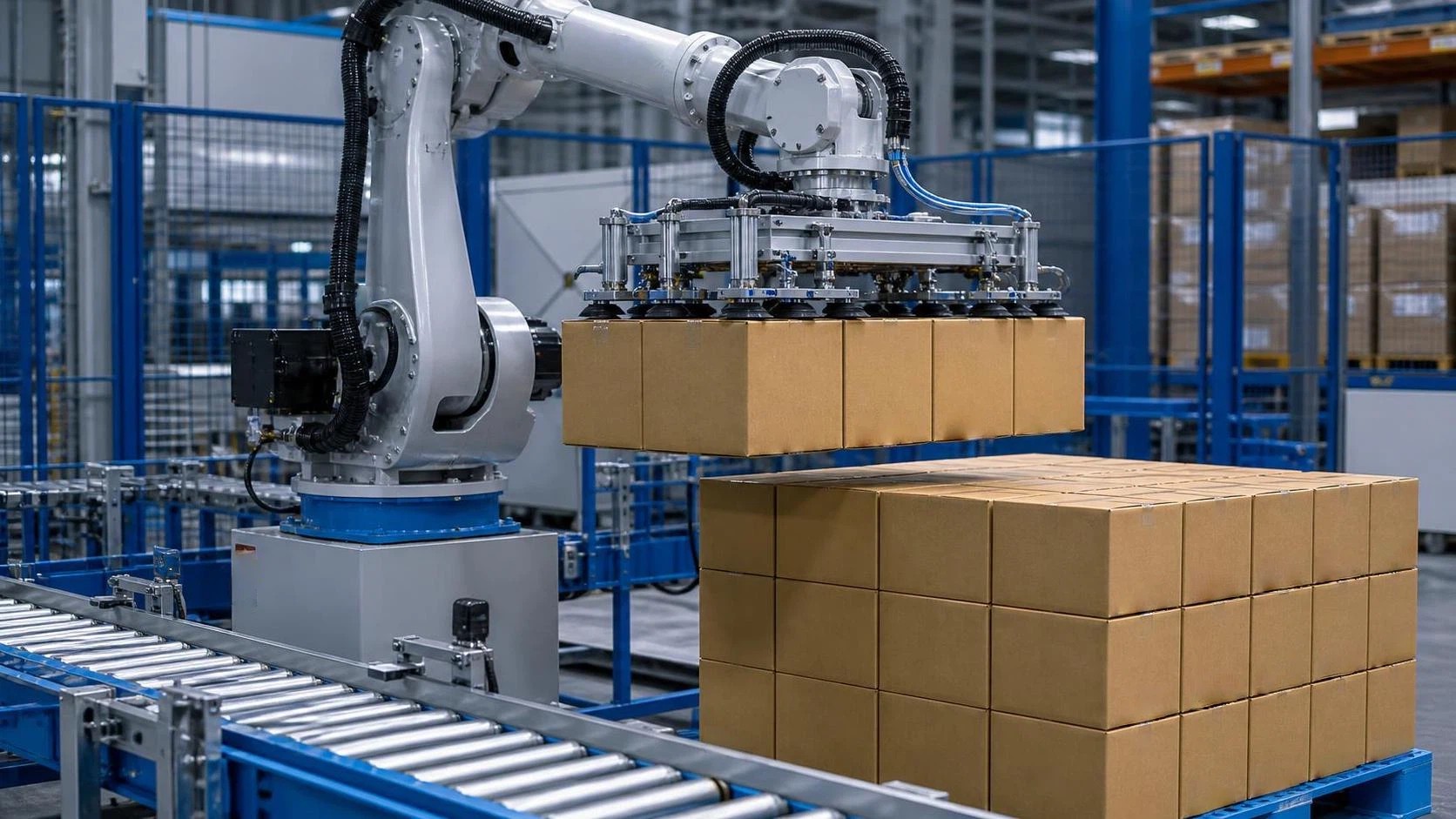
Is a 4 Axis Handling Robot Arm the Right Fit for Palletizing?
For project managers planning a palletizing upgrade, robot selection affects throughput, floor space, integration effort, safety performance, and the total cost of operating the finished cell.
A 4 axis handling robot arm is frequently an effective palletizing solution for stable, repetitive loads, but it is not automatically the right option for every facility.
The practical question is whether its speed, reach, payload, motion pattern, and end-of-line flexibility match the products, pallets, changeovers, and future capacity targets.
This guide explains where a 4 axis handling robot arm delivers strong value, where it creates constraints, and how project teams can evaluate it objectively.
Start With the Palletizing Decision, Not the Robot Specification
Many projects begin by comparing robot payload ratings, but the more useful first step is defining the palletizing task in measurable operational terms.
Project leaders should document product dimensions, unit weight, packaging strength, target cases per minute, pallet pattern, stacking height, and the number of active SKU formats.
They should also identify whether the line handles cartons, bags, pails, trays, bundles, or mixed loads, because each product type changes gripping and stability requirements.
A robot that performs well with consistent corrugated cartons may require a very different end effector when handling porous bags or unstable shrink-wrapped bundles.
The same applies to pallet flow. A single inbound conveyor and one outbound pallet position require less robot reach and coordination than a multi-lane layout.
Operational variability usually matters more than theoretical robot speed. A highly flexible cell may provide better business value than a faster machine with difficult changeovers.
Define acceptable downtime before selecting equipment. A palletizing investment should include planned maintenance, product transitions, pallet replenishment, fault recovery, and operator intervention.
When these conditions are clear, a project team can determine whether four-axis motion is sufficient or whether extra articulation will reduce operational risk.
What a 4 Axis Handling Robot Arm Does Well
A 4 axis handling robot arm typically uses four controlled joints to move products horizontally, vertically, and rotationally around the palletizing work envelope.
This configuration is especially suited to repetitive pick-and-place applications where cases approach in predictable orientations and stacks follow preprogrammed pallet patterns.
Its mechanical design commonly supports fast cycles, straightforward programming, and a compact footprint relative to more complex articulated robot arrangements.
For a standard case palletizing line, the robot can pick one or multiple cases, orient the load, and place it accurately at defined pallet coordinates.
Fewer axes can simplify motion planning. That often means faster commissioning, more predictable path behavior, and easier troubleshooting for maintenance teams.
High-speed palletizing is one of the strongest use cases. When products arrive consistently and require limited tilting, four-axis robots can achieve dependable output.
They are also useful where access around the pallet is relatively open. The robot does not need to navigate around obstacles or approach products from unusual angles.
For facilities replacing manual palletizing, this combination of repeatability, speed, and modest space demand can deliver a practical route toward automation.
When Four Axes May Limit the Cell
The main limitation is orientation freedom. A four-axis robot may not provide the wrist flexibility needed to tilt, angle, or manipulate products during complex transfers.
This matters when product infeed orientation changes often, packaging must remain level, or the robot must reach around guarding, conveyors, dispensers, or pallet structures.
Mixed-SKU palletizing creates another challenge. Different box sizes, layer patterns, weights, and gripping surfaces may demand more adaptable motion and tooling strategies.
A project should not assume that a robot can handle every future SKU simply because its rated payload exceeds the heaviest current product.
Payload calculations must include the gripper, vacuum generator, hoses, cables, adapter plates, and any load stabilizing equipment, not only the packaged product.
Reach limitations can appear late in poorly defined projects. A robot may technically reach pallet corners, yet operate slowly or near mechanical limits at those positions.
Cycle-time margins are equally important. A robot running at its maximum published rate may leave insufficient allowance for accumulation, interruptions, and recovery movements.
If the application requires frequent angled picks, variable case orientations, deep access into confined positions, or complex layer handling, six-axis equipment deserves serious comparison.
Assess Throughput Using Real Cycle Conditions
Throughput should be calculated from the complete cell cycle, rather than from a robot brochure’s maximum cycles-per-minute figure under ideal test conditions.
A usable calculation includes pick travel, placement travel, acceleration, deceleration, grip confirmation, conveyor indexing, pallet changes, slip-sheet handling, and safety-zone coordination.
For example, a robot may complete a simple short-distance motion quickly, while actual line output falls because pallet exchange interrupts productive work.
Buffer conveyors can reduce this problem, but they add footprint, controls complexity, and equipment cost. Their value depends on the severity of upstream variation.
Ask the integrator to model the intended layout using actual product dimensions and required stack patterns, including the farthest and highest placement positions.
Request performance assumptions in writing. These should state product weight, pick quantity, distance, pallet size, infeed speed, and the expected availability rate.
Availability is often overlooked. A 98 percent available system producing a sustainable rate can be financially stronger than a nominally faster but fragile installation.
Project managers should set a required average output, a peak output, and a recovery requirement after short production interruptions, then validate all three.
Choose the End Effector as Carefully as the Robot
The gripper is central to palletizing reliability. A suitable robot cannot compensate for an end effector that damages cartons, loses vacuum, or handles loads inconsistently.
Vacuum grippers work well for sealed cartons with stable surfaces, while mechanical clamps may be preferable for porous, dusty, irregular, or uneven packages.
Layer grippers can increase throughput substantially by moving several cases together, but they require reliable product presentation and enough load stability during transfer.
For bags, a fork-style, clamp, or specialized bag gripper may be needed. The package surface and fill condition should be tested under production speeds.
Tooling selection should consider compressed-air use, energy consumption, cleaning access, spare-part availability, and how quickly operators can switch between product formats.
Include a gripper test using representative packaging. Empty cartons, new samples, or manually positioned products rarely reveal all real production handling issues.
Packaging variability should be measured, not described vaguely. Small changes in carton compression, tape placement, dust, or humidity can affect gripping performance.
A robust tool design also supports safe recovery. Operators need clear procedures when a case shifts, a vacuum circuit alarms, or a product jams.
Check Layout, Safety, and Material Flow Early
Robot selection cannot be separated from cell layout. The required reach, pallet positions, infeed orientation, guarding, and operator access determine whether the cell remains efficient.
A compact robot footprint does not guarantee a compact installation. Safety fences, light curtains, pallet magazines, access doors, conveyors, and maintenance clearance consume substantial floor area.
Consider how empty pallets arrive, how full pallets depart, and who responds when a pallet is misaligned or a slip sheet fails to feed.
Manual pallet exchange may reduce initial capital cost, but it can constrain output and expose personnel to repetitive or forklift-related risks.
Automatic pallet dispensers and powered outfeed systems improve autonomy, although they increase controls integration and require reliable material replenishment processes.
Safety design should address normal operation and abnormal conditions. This includes access zones, emergency stops, restart behavior, trapped-key arrangements, and safe fault recovery.
Involving operators and maintenance personnel during layout reviews helps identify access problems that are easy to miss in a conceptual drawing.
A good layout allows inspection, cleaning, gripper replacement, and sensor maintenance without requiring extensive guard removal or awkward working positions.
Plan Integration Around Upstream and Downstream Equipment
Palletizing cells fail to meet expectations when interfaces are treated as secondary details. The robot must coordinate reliably with conveyors, scanners, pallet equipment, and plant controls.
Define the control handshakes early, including product-ready signals, product tracking, reject handling, pallet-ready confirmation, alarms, and line-stop communication.
Barcode readers, vision systems, and label orientation checks may be necessary where different products share a line or pallet patterns vary by order.
Product tracking becomes especially important during accumulated conveyor flow. The system must know which case belongs to which pattern before the robot makes a pick.
Specify the factory control platform, network requirements, remote support method, and data needed by production teams before integration begins.
Acceptance criteria should cover more than successful placement. They should include stack quality, pallet stability, recovery behavior, product damage, changeover duration, and alarm response.
For manufacturers processing sheet-metal components, upstream finishing consistency can support smoother automated handling and downstream packaging operations.
For example, the RNS 800 Sheet metal deburring machine removes burrs from stamped, sheared, laser-cut, plasma-cut, and flame-cut metal sheets.
Its pass-through process can preserve workpiece dimensional accuracy while preparing edges and holes with a controlled small-radius finish for subsequent production stages.
Although it is not a palletizing robot, evaluating upstream equipment in this way helps project teams prevent handling problems from being transferred downstream.
Compare Total Cost of Ownership, Not Purchase Price
The initial robot price is only one part of project cost. Tooling, guarding, conveyors, controls, installation, commissioning, training, and support can materially change the investment.
Operating costs include energy, compressed air, gripper wear parts, preventive maintenance, spare parts, software support, and unplanned downtime.
Labor savings should be estimated realistically. Automation may reduce repetitive manual stacking, but workers may still be needed for replenishment, quality checks, and exception handling.
The financial model should also include reduced injury exposure, improved stack consistency, lower product damage, greater traceability, and capacity gained during difficult labor periods.
Calculate payback using conservative production assumptions. Base the model on sustainable annual operating hours and expected availability, not continuous full-speed operation.
Future expansion has financial value as well. A cell designed for an extra pallet position or additional gripper may avoid expensive reconstruction later.
Compare vendor proposals on a common scope sheet. Differences in commissioning, acceptance testing, training, warranty coverage, and spare parts can otherwise obscure the actual cost.
For international projects, confirm installation support, local service capability, electrical compatibility, documentation language, and relevant CE or regional compliance requirements.
Use a Structured Evaluation Process Before Approval
A disciplined selection process reduces expensive late changes. Begin with a written user requirement specification that defines products, rates, layouts, safety expectations, and performance targets.
Next, request a preliminary simulation or reach study from qualified suppliers. Review motion limits, collision zones, robot posture, and cycle time across all required patterns.
Where possible, conduct a physical handling trial with representative products, pallets, slip sheets, and the intended gripper configuration before placing a final order.
Evaluate supplier experience in comparable applications. Ask for evidence involving similar payloads, packaging materials, speeds, operating environments, and production variability.
Confirm whether the supplier provides only the robot or a complete engineered cell. The latter can simplify accountability for performance across integrated equipment.
Define factory acceptance testing and site acceptance testing before the contract is signed. Both should use measurable criteria rather than subjective impressions.
Training should cover daily checks, format changes, basic fault recovery, safety procedures, and escalation paths for maintenance personnel and supervisors.
Finally, preserve room in the schedule for commissioning adjustments. Real production conditions nearly always reveal details that are not visible during early design.
Make the Choice Based on Application Fit
A 4 axis handling robot arm is usually the right fit when products are consistent, pallet patterns are predictable, required orientations are limited, and high repeatable speed is essential.
It becomes less suitable when the line requires complex angled motions, highly variable SKU handling, confined access, frequent format changes, or unusual gripping orientations.
For project managers, the best decision is not the robot with the most impressive specification. It is the system that meets sustainable production requirements with manageable risk.
Assess the complete cell, including product quality, gripper design, layout, controls, safety, pallet logistics, maintenance access, and supplier accountability.
When these factors align, a four-axis palletizing solution can provide dependable throughput, improved workplace safety, and a clear operational return on investment.
When they do not align, selecting a more flexible robot configuration early is usually less costly than redesigning an underperforming cell after installation.
search
Products Navigation
Send Us A Message