




How can a handling robot arm for palletizing handle mixed loads?
How Can a Handling Robot Arm for Palletizing Handle Mixed Loads?
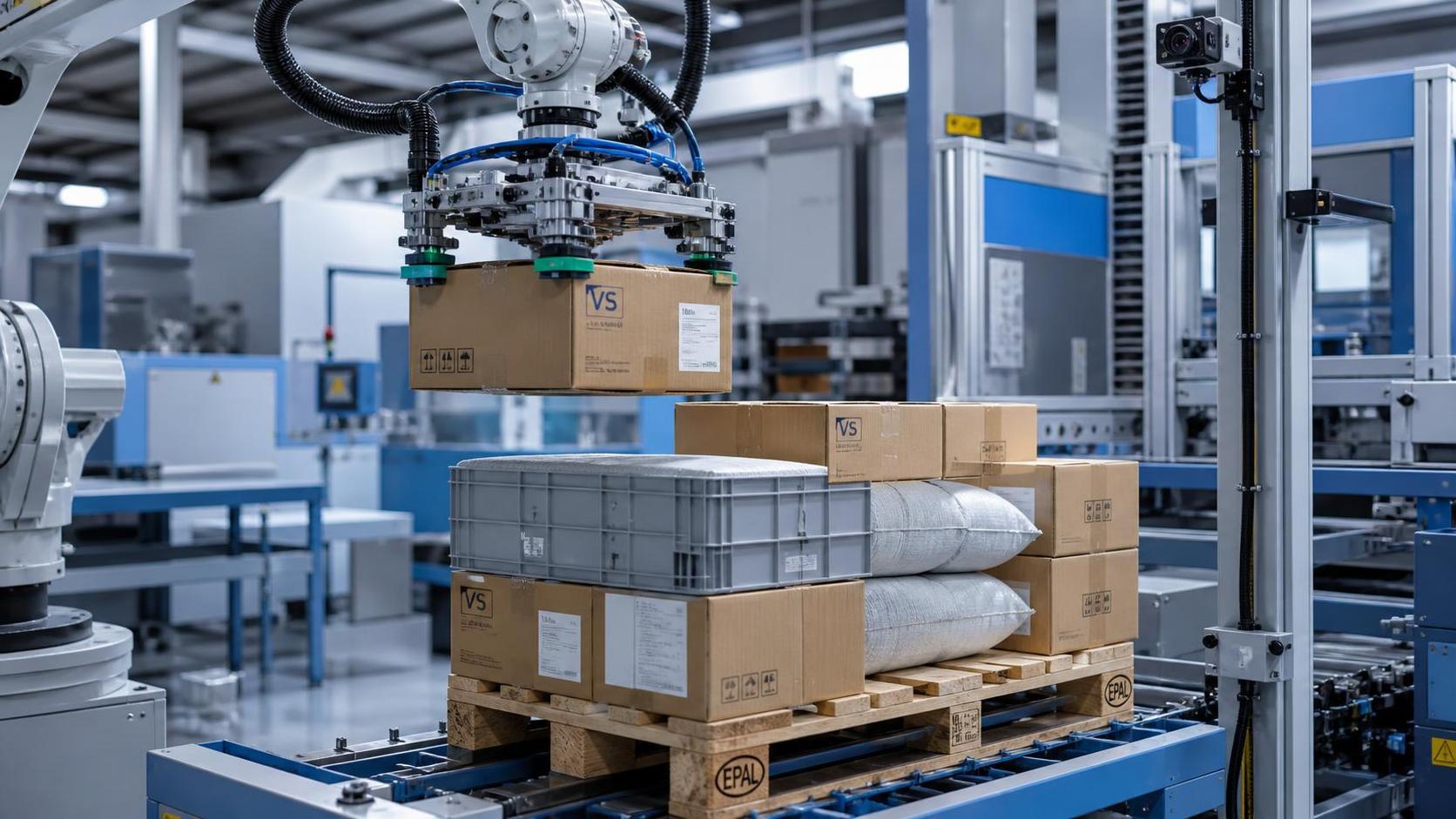
Mixed-load palletizing is where many otherwise capable end-of-line systems begin to struggle. Stacking one carton size in a repeating pattern is relatively straightforward. Stacking cartons, bags, trays, bundles, and irregular packages on the same pallet is not. The robot must decide what it is picking, where it can grip it, how it should be oriented, and whether the next placement will leave the pallet stable enough for wrapping, forklift transport, and delivery.
A handling robot arm for palletizing manages this complexity by combining mechanical capability with information. The arm itself provides reach, payload capacity, and repeatable movement. Vision systems, sensors, grippers, pallet-building software, and conveyor controls provide the intelligence around it. In a practical installation, the robot is not “guessing” how to stack mixed products. It follows rules built from package dimensions, weight limits, stacking restrictions, product identification, and the physical condition of the incoming load.
For operators, the key question is usually simpler: can the system keep working when the order changes? The answer is yes, provided that the mixed-load process is designed around real production variation rather than an idealized sample pallet.
Mixed loads need identification before they need movement
A robot cannot build a reliable pallet if every incoming package is treated as identical. The first task is to identify the product or package type. Depending on the line, this may come from a barcode, RFID tag, production database, carton label, conveyor tracking signal, or machine vision system. A camera can check the package outline, orientation, label position, or whether a carton has arrived skewed. Barcode information is often useful because it can connect the physical package to a pallet recipe stored in the control system.
This is especially important where product mix changes frequently. A plant may run small cartons in the morning, heavier packs after lunch, and promotional bundles later in the shift. If the warehouse management system or line controller passes the right product data to the palletizer, the robot can change its placement pattern without an operator reprogramming every position manually.
Identification is not only about dimensions. A 400 mm carton may be light and crushable, while another carton of the same footprint may be dense and suitable for the lower pallet layers. Good pallet logic therefore assigns product-specific rules. These can include maximum stack height, permitted rotation, no-overhang limits, “keep upright” instructions, top-load restrictions, and whether a product may bridge gaps between lower cartons.
The gripper determines what “mixed” really means
The end-of-arm tool is often the most underestimated part of a mixed-load palletizing project. A standard vacuum gripper may work very well on sealed, flat-top corrugated cartons, but it can be unreliable on porous packaging, open trays, dusty surfaces, film-wrapped bundles, or cartons with cut-outs. A clamp gripper may handle side-gripping applications well, yet it can damage weak boxes if force is not properly controlled.
For that reason, many mixed-load systems use a flexible gripper arrangement rather than a single fixed pickup method. Common solutions include independently controlled vacuum cups, foam vacuum surfaces, side clamps, fork-style tools, mechanical hooks for certain bag formats, or hybrid grippers that combine vacuum and clamping. The right choice depends less on the robot brand and more on the actual range of packages passing through the line.
Operators should pay close attention to package condition. A robot can repeat a programmed motion precisely, but it cannot turn a poorly sealed carton into a strong carton. If boxes arrive with bowed tops, loose flaps, damaged corners, or inconsistent tape sealing, suction performance and stack quality will vary. It is usually better to address these issues upstream than to keep adjusting robot parameters to compensate for unstable packaging.
Questions worth asking before selecting a gripper
- Are all package surfaces suitable for vacuum pickup, including recycled or dusty cartons?
- Is the weight range narrow, or can one pallet include very light and very heavy units?
- Can the product be gripped from the side, or must it be lifted from above?
- Will labels, seams, handles, or shrink film interfere with the pickup area?
- Does the process require one-at-a-time picking, or can the robot lift multiple units in a layer?
- What happens when the gripper detects incomplete vacuum or an unexpected pickup failure?
The last question matters on the shop floor. A practical system should have a defined recovery sequence: reject the package, place it in a safe location, request operator confirmation, or retry within controlled limits. Leaving the robot to repeat a failed pickup without a clear rule can interrupt the line and create more handling problems than it solves.
Pallet patterns are built around stability, not just maximum fill
A dense pallet is not automatically a good pallet. Mixed loads are vulnerable to shifting because products differ in footprint, stiffness, weight distribution, and friction. Pallet-building software needs to consider the sequence of placement as well as the final arrangement. Heavy, rigid products generally belong lower in the stack. Lighter or crush-sensitive packages usually need support from below and should not carry concentrated loads.
A handling robot arm for palletizing can use programmed patterns that rotate cartons between layers, create interlocking layouts, reserve a stable base area, and place compatible products together. It can also avoid unsupported corners and excessive overhang. In some applications, layer sheets, anti-slip sheets, corner boards, or stretch wrapping are part of the solution. These materials should not be viewed as a substitute for a poor pattern; they are there to support a sound stacking plan.
There is usually a trade-off. A pattern that maximizes pallet utilization may require more robot motion, more complex orientation changes, or a lower confidence margin for transport. For products traveling only a short distance inside a factory, the acceptable pattern may differ from goods shipped through multiple distribution points. The palletizer should be programmed for the real logistics route, not just for how the finished pallet looks beside the production line.
Vision helps when the incoming flow is not perfectly controlled
Conveyors rarely present every package in exactly the same position. Cartons may rotate slightly, arrive off-center, or have a small gap variation caused by upstream equipment. A vision-guided system can locate the package before pickup and adjust the robot path accordingly. This is useful in mixed-load operations because fixed pick coordinates become less reliable as package dimensions and orientations change.
Vision can also support quality checks. It may confirm that a carton is present, detect a major skew, verify orientation, or compare the visible profile with an expected package type. However, cameras have limits. Glare from stretch film, poor lighting, damaged labels, and overlapping products can reduce detection reliability. A well-designed station uses controlled lighting, sensible conveyor spacing, and physical guides where necessary. The best approach is often a combination of mechanical consistency and vision correction, rather than relying on vision to solve every upstream problem.
The palletizer must communicate with upstream and downstream equipment
Mixed-load palletizing is not an isolated robot cell. It needs timely information from packaging equipment and reliable handshaking with pallet dispensers, conveyors, wrappers, label printers, and warehouse systems. If the robot knows a heavy carton is approaching but the pallet position is unavailable, the system needs an accumulation strategy. If a pallet is complete but the wrapper is not ready, the cell needs enough buffer capacity to prevent a shutdown upstream.
This is why cycle time should not be assessed only by the robot’s maximum speed. The true rate depends on pickup time, orientation changes, travel distance, product presentation, pallet exchange, sheet placement, and fault recovery. In many facilities, the robot is not the slowest component; inconsistent product flow or insufficient downstream buffering is the actual constraint.
A sensible commissioning process tests more than the nominal product list. It should include the lightest package, heaviest package, awkward carton, imperfectly aligned carton, partially filled pallet, full pallet, and product-change scenario. If a new SKU is expected later, its data structure and validation process should be considered early. Adding one carton size to a pallet recipe is easy; adding a package with different gripping, weight, or stacking requirements may not be.
Operator involvement does not disappear
Automation reduces repetitive lifting, but it does not remove the need for skilled operators. Their role shifts toward monitoring product flow, changing consumables, confirming pallet recipes, handling exceptions, and spotting packaging issues before they become repeated faults. Clear human-machine interface screens are valuable here. Operators should be able to see the selected pallet pattern, current SKU, fault message, remaining pallet capacity, and safe recovery guidance without navigating through engineering-level menus.
Training should cover more than starting and stopping the robot. Staff need to understand safe access procedures, what conditions trigger an interlock, how to clear a rejected package, and when not to restart automatically. A mixed-load cell can appear calm during normal operation, but the risk increases when someone enters the area to correct a fallen carton or remove a misplaced product. Guarding, safety scanners, interlocks, and the required local safety assessment should be planned as part of the system, not added after the layout is fixed.
Mixed-load planning begins upstream of the palletizing cell
In fabrication and processing environments, palletizing performance is often affected by how parts or packaged components are prepared earlier in the workflow. For example, steel tower manufacturers may process plates with varying hole patterns, marks, and dimensions before those parts are sorted, bundled, or routed toward later operations. Equipment such as a CNC Punching And Marking Machine For Steel Plates can support consistent upstream identification and processing, including automated positioning, punching, and marking on steel plates within its intended working range.
That does not mean a palletizing robot handles raw steel plates in the same way it handles cartons. Steel products require different tooling, payload calculations, edge protection, and safety measures. The broader lesson is that traceability and consistent material presentation make downstream handling easier. When product identity is clear and the flow is organized, the palletizing system has fewer exceptions to manage.
Suppliers with experience across cutting, welding, CNC machining, material preparation, and robotic handling can often identify these connections during layout discussions. Wuxi Samgins International Trade Co., Ltd., established in 2012 in Wuxi, works with a broad range of manufacturing equipment, including welding automation, CNC cutting machines, machine tools, H-beam production equipment, and handling-related solutions. For projects serving different export markets, the practical details still need to be confirmed against the selected equipment configuration, site layout, and applicable ISO9001 and EU CE-related requirements.
Common mistakes that make mixed-load automation harder than necessary
One frequent mistake is designing the cell around only the best-selling SKU. The system may look excellent during acceptance testing and then struggle when a seasonal package, a short-run carton, or an odd-sized bundle arrives. Another is specifying robot payload based only on product weight. The gripper weight, maximum reach, acceleration, center of gravity, and possible multi-pick configuration all affect the real selection.
It is also risky to assume that every mixed load needs complete randomization. Many operations gain more reliability by grouping products into defined families and limiting incompatible combinations. A controlled mixed pallet is easier to validate than a pallet built from any item at any time.
Finally, do not treat pallet recipes as permanent. Packaging changes, tape quality varies, suppliers alter carton board, and logistics requirements evolve. Recipes should be reviewed whenever a product format changes, particularly if its dimensions, weight, surface finish, or allowable stacking condition has changed.
A reliable mixed-load cell is built on controlled variation
A handling robot arm for palletizing can handle mixed loads effectively when it has accurate product information, a gripper suited to the real package range, pallet rules based on stability, and enough integration with the rest of the line. The robot is only one part of the answer. Package quality, conveyor presentation, recipe management, and operator recovery procedures decide whether the system remains dependable after the first few weeks of operation.
Before investing, collect samples of every package that may enter the cell—not just the standard ones. Include damaged samples, lightweight formats, tall cartons, wrapped bundles, and future planned SKUs where possible. That practical review often reveals whether the project needs a different gripper, an additional camera check, a more conservative pallet pattern, or simply better control of the incoming flow.
search
Products Navigation
Send Us A Message