




Pipe Bending Machine Safety Risks You Should Fix Early
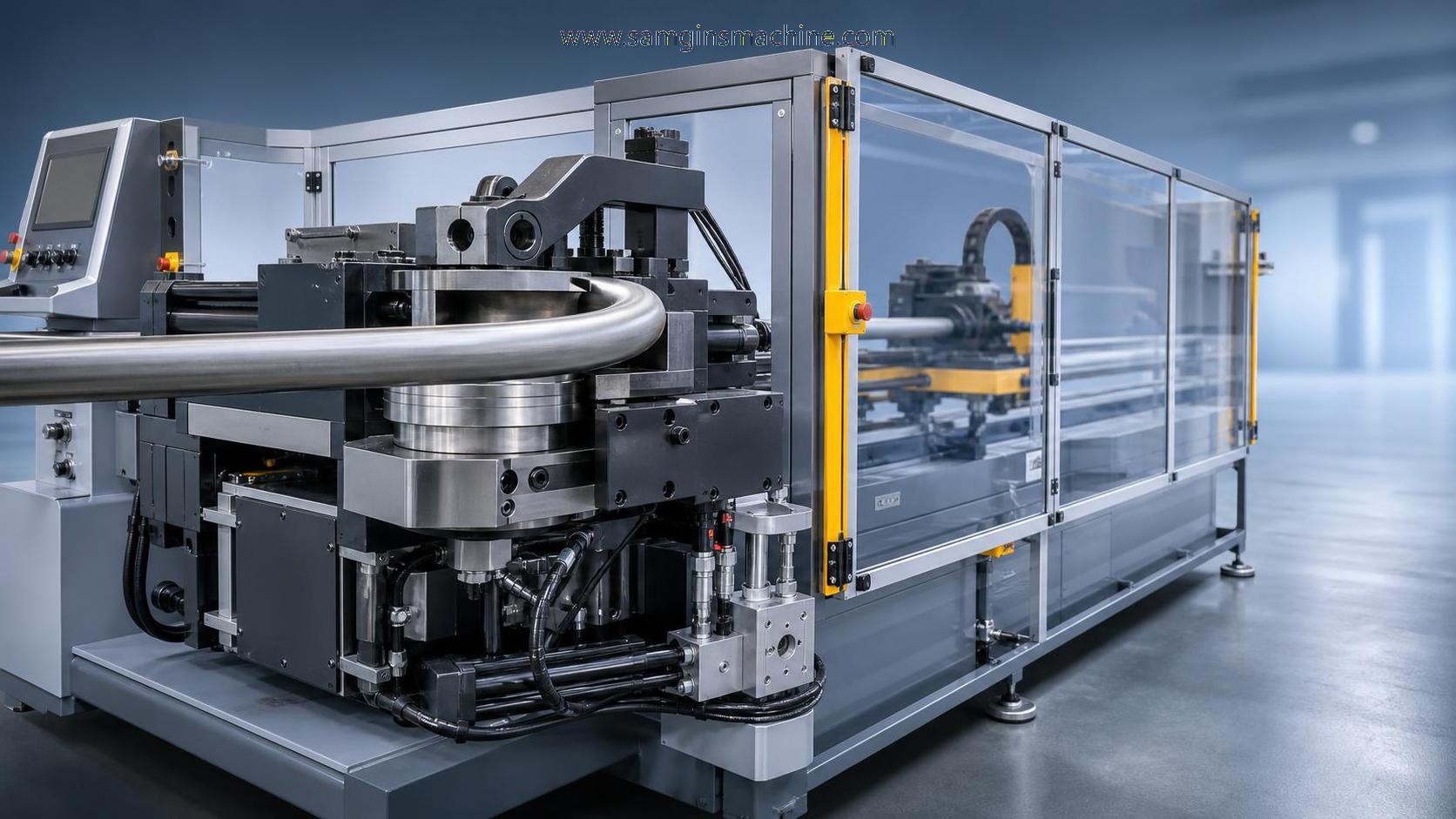
Early Pipe Bending Machine Risks Usually Start Small
A pipe bending machine rarely becomes dangerous in one obvious moment.
In most workshops, safety trouble begins with small changes.
A clamp holds less firmly, a die wears unevenly, or a guard is left open during repeated jobs.
When those details are ignored, the result is usually more than a maintenance issue.
It can lead to hand injuries, unstable bend quality, hydraulic failure, scrap, and production interruption.
For businesses handling fabrication equipment across different markets, early correction matters because safety, consistency, and compliance are linked.
That is especially true where equipment is expected to align with ISO9001 discipline and CE-oriented operating expectations.
In actual use, the right safety response depends on where the pipe bending machine is used, how often setups change, and how stable the input material remains.
Why One Pipe Bending Machine Can Face Different Risk Profiles
Two shops may run the same pipe bending machine and still face very different hazards.
The reason is not only machine specification.
Risk changes with tube diameter variation, wall thickness tolerance, fixture replacement frequency, operator habits, and floor layout.
A stable batch line usually worries about repetitive wear and overlooked drift.
A mixed-order workshop is more exposed to setup mistakes, tooling mismatch, and rushed parameter changes.
More common judgment should start with production reality.
Ask what is changing most often: material, geometry, people, pace, or surrounding equipment.
That answer usually reveals which pipe bending machine safety risks should be fixed first.
High-Volume Repetition Makes Wear Easier to Miss
On repeat production lines, a pipe bending machine may appear safer because the task looks familiar.
That impression is often misleading.
When the same bend cycle runs all day, small wear on dies, pressure blocks, mandrels, and clamps can pass unnoticed.
The machine still runs, but force distribution changes.
That creates tube slipping, unexpected springback, and sudden ejection at release points.
In this setting, the early warning signs are usually physical rather than electronic.
Look for polished spots on tooling, clamp marks becoming irregular, hydraulic temperature rising, and bend angle correction becoming more frequent.
If output quality drifts before alarms appear, the pipe bending machine is already telling you something important.
The practical fix is short inspection intervals tied to cycle count, not only calendar days.
Short-Run Fabrication Often Fails at Setup and Changeover
A different pattern appears in job shops and custom metal fabrication.
Here, the pipe bending machine is not stressed by repetition alone.
It is stressed by constant switching between sizes, radii, materials, and tooling combinations.
The main hazard is not always component failure.
It is incorrect setup that still looks acceptable until force is applied.
A wrong die set, poor lubrication, or inaccurate centerline adjustment can create side loading and unstable bending.
This is where pinch points become more dangerous.
Operators are more likely to intervene manually during trial pieces, especially when deadlines are tight.
A useful control is to make first-piece approval include safety verification, not only dimensional verification.
If the pipe bending machine needs manual correction on every first run, the setup standard is too weak.
When Material Changes, the Same Settings Can Become Unsafe
Many avoidable incidents begin when new material is treated like the previous batch.
That happens with stainless steel, thin-wall tubes, coated pipes, or higher-strength sections.
The pipe bending machine may have enough capacity, yet the safe process window becomes narrower.
Clamp force, lubrication method, support position, and return speed all matter more.
A tube that collapses or twists is not only a quality defect.
It can create sudden recoil, sharp edge exposure, or jam conditions during unloading.
In actual application, material certificates should not be separated from machine settings.
Linking batch identity to tested bending parameters reduces both scrap and unsafe trial-and-error.
Different shop conditions change the safety focus
The table below shows why the same pipe bending machine cannot be assessed with one fixed checklist.
Risks Increase When the Pipe Bending Machine Sits Inside a Larger Line
Pipe bending is often part of a wider fabrication route rather than a standalone process.
That changes the safety picture again.
When upstream cutting, downstream welding, or robotic transfer is added, the pipe bending machine must be judged at interface points.
A safe machine can still become a dangerous station if material queues force awkward lifting or if stop signals do not synchronize.
This is why experienced equipment suppliers usually look beyond one machine body.
In workshops that also run H-beam lines, welding systems, and CNC equipment, layout discipline often determines whether local safety controls remain effective.
A related example is T type gantry h beam welding machine integration.
Equipment with automatic tracking, steady speed control, and coordinated movement reduces manual correction.
The same principle applies to a pipe bending machine.
The more predictable the motion and transfer logic, the lower the chance of unsafe intervention.
The Most Common Misjudgments Happen Before Failure
Several mistakes appear repeatedly across metalworking sites.
- Treating output accuracy as proof that the pipe bending machine is safe.
- Reviewing nominal machine capacity without checking floor conditions, operator access, and part handling space.
- Buying replacement tooling by size only, while ignoring material compatibility and wear pattern.
- Comparing purchase cost, yet overlooking downtime from setup error or preventable hydraulic leaks.
- Assuming similar pipe jobs require identical clamping force and lubrication practice.
These are early-stage judgment failures.
Once they accumulate, the pipe bending machine starts showing unstable behavior that is harder and more expensive to correct.
What to Fix Early on a Working Shop Floor
The strongest safety improvements are usually simple and disciplined.
- Record tooling condition by cycle count, not by rough visual memory.
- Separate setup approval from production release when bending new material or geometry.
- Check guard interlocks after maintenance, not only after installation.
- Track hydraulic pressure fluctuation and abnormal temperature as safety indicators.
- Review manual handling paths around the pipe bending machine during busy shift changes.
- Tie machine settings to material batch records where quality variation is known.
Where production includes welding, cutting, bending, and structural fabrication together, consistency across machines becomes even more valuable.
Companies with broad equipment experience across those categories often see the pattern sooner.
That broader view matters because a pipe bending machine does not fail in isolation from the process around it.
A Practical Way to Judge the Next Step
If a pipe bending machine already shows small inconsistencies, do not wait for a major shutdown or injury event.
Start by mapping real operating scenes.
Separate repeat production from mixed-order work.
List the materials that behave differently.
Check where manual intervention still happens.
Then compare those findings against guarding, tooling condition, hydraulic stability, and setup discipline.
That approach gives a more reliable safety picture than looking at parameters alone.
For any pipe bending machine, early fixes are usually the cheapest ones, and they protect both output stability and long-term equipment value.
search
Products Navigation
Send Us A Message