




Press Brake Tonnage Calculation for Accurate Machine Sizing
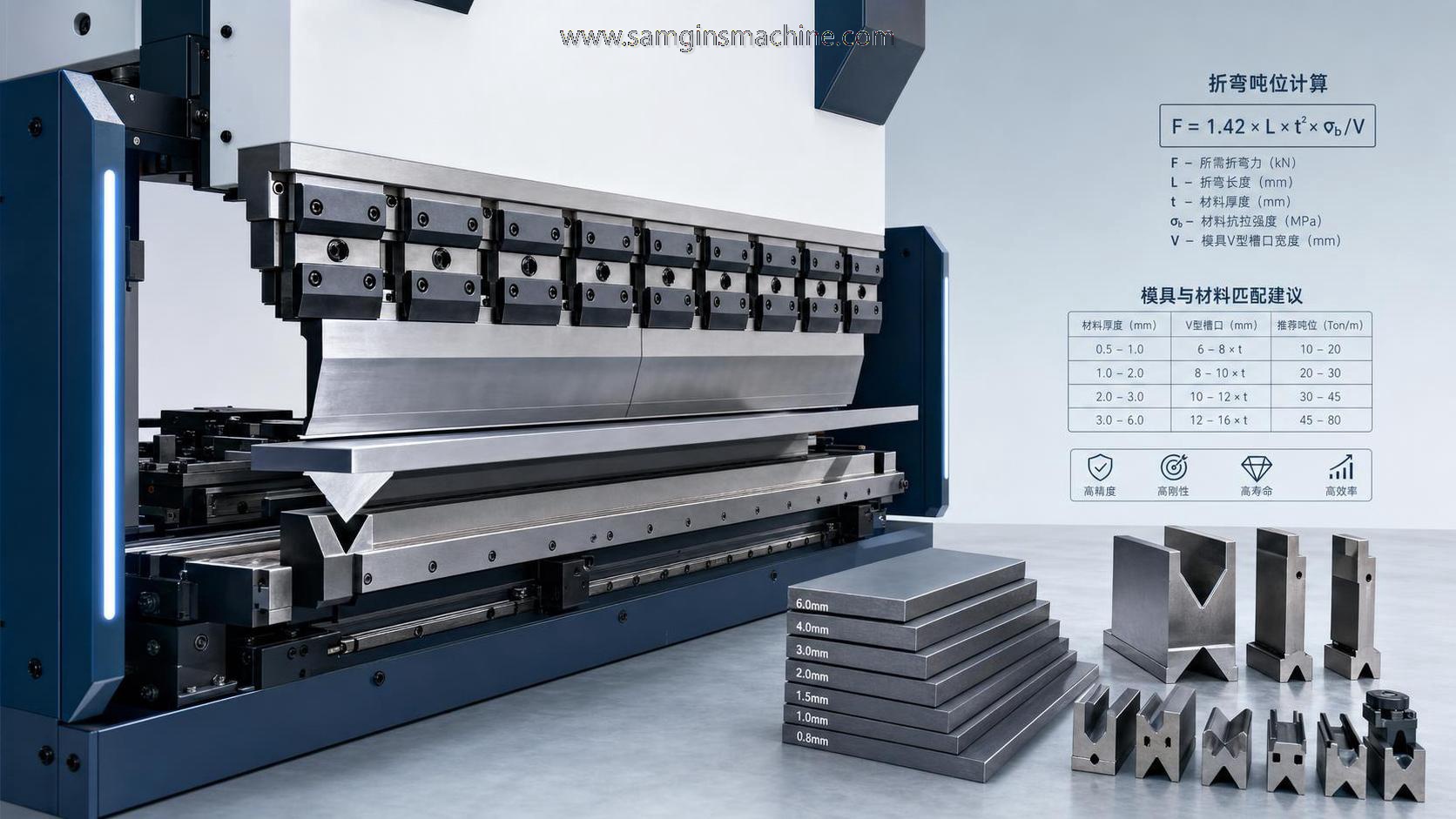
Press Brake Tonnage Calculation for Accurate Machine Sizing
Selecting the right Press brake starts with accurate tonnage calculation.
Material type, thickness, bend length, and tooling all change the required force.
If the estimate is too low, the machine may stall or produce unstable bends.
If it is too high, capital cost rises without adding useful production value.
That is why Press brake tonnage calculation matters during machine evaluation.
A good calculation supports safety, tooling life, energy use, and part consistency.
It also helps compare equipment on a technical basis, not just by nominal capacity.
In real production planning, that difference is often where good investments are made.
What Press Brake Tonnage Really Means
Press brake tonnage is the forming force needed to bend a material along a defined length.
It is usually expressed as tons over the full working length.
However, the rated machine tonnage is only part of the story.
Actual bending force depends on the job, not just the machine nameplate.
For example, mild steel and stainless steel of equal thickness need different force levels.
Air bending, bottoming, and coining also require very different tonnage values.
So, accurate Press brake sizing must start with the specific forming method.
The Core Formula Behind Press Brake Calculation
A common air bending formula is based on material strength, thickness, bend length, and die opening.
In practical terms, tonnage rises quickly when thickness increases.
It also rises with longer bend lengths and stronger materials.
A wider V-die usually lowers the force requirement.
A narrower die increases force, even when the part geometry stays similar.
This is why generic tonnage charts are useful, but never enough on their own.
They provide a baseline, not a complete machine selection answer.
Final Press brake assessment should always verify the full application envelope.
Typical Inputs Used in Calculation
- Material grade and tensile strength
- Sheet or plate thickness
- Overall bend length
- Die opening width
- Bending method and required angle accuracy
- Tooling condition and allowable safety margin
Factors That Change Tonnage More Than Expected
Thickness is usually the first variable people watch.
But material strength often creates the bigger error in early estimates.
A Press brake sized for mild steel may struggle with high-strength steel or stainless jobs.
Tool selection creates another common gap between theory and production reality.
Using a small V-opening can improve form control, but it sharply raises required force.
Long parts can also introduce deflection issues across the bed and ram.
That means machine crowning and frame rigidity become part of the sizing decision.
In short, tonnage is about force, but accurate bending depends on machine structure too.
Three Common Sources of Miscalculation
- Assuming all steels behave like mild steel
- Ignoring tooling geometry in the force estimate
- Choosing machine capacity without reserve for mixed production
How to Size a Press Brake for Real Production
The best approach is to size the Press brake around the heaviest regular job.
Do not size only for occasional prototype parts.
Instead, define the actual mix of materials, lengths, and thickness ranges.
Then add a realistic margin for tooling wear, part variation, and future orders.
Many buyers use a reserve capacity of around 20% to 30%.
That reserve helps the Press brake work steadily without running near its limit every shift.
It also improves durability when production includes variable lots and frequent setup changes.
This is especially important in contract fabrication and mixed-model manufacturing.
A Practical Evaluation Sequence
- List the maximum and most frequent bend jobs
- Confirm material grades, not just thickness
- Match each part to the intended die opening
- Calculate tonnage by job type and bend length
- Check bed length, daylight, stroke, and backgauge limits
- Add a working reserve before final machine selection
Why Tonnage Alone Does Not Guarantee the Right Machine
A Press brake can meet tonnage and still fail the job in practice.
That usually happens when working length, open height, or tooling compatibility is overlooked.
Large parts may need more throat depth or a different frame configuration.
Heavy plate work can also point toward another forming process entirely.
For thick plate applications, rolling may be more efficient than repeated brake forming.
In that context, Mechanized bending machine with 3 roller is relevant for heavy metal fabrication.
It is suited for plate thicknesses of 50mm or more and forms cylindrical or conical sections.
That kind of comparison helps avoid forcing a Press brake into work it should not carry.
A sound evaluation looks at process fit first, then equipment capacity.
Useful Reference Table for Initial Screening
Where Supplier Capability Also Matters
Machine sizing is a calculation task, but it is also a supplier evaluation task.
A supplier should explain how the Press brake capacity was matched to the job range.
That includes standards, tolerances, tooling assumptions, and reserve capacity.
Wuxi Samgins International Trade Co., Ltd focuses on mechanical equipment and related products.
Its range covers Press brake systems, CNC machine tools, laser cutting machines, and welding equipment.
Production and design are organized under ISO9001 quality management and EU CE standards.
That matters because technical documentation should support the tonnage claim with usable detail.
A machine quote is stronger when the force calculation can be traced and defended.
Final Checks Before Choosing a Press Brake
Before final approval, verify more than the tonnage number.
- Confirm the tonnage at the full required working length
- Check whether rated force matches air bending or another method
- Review tooling limits and die compatibility
- Assess frame rigidity, crowning, and repeatability
- Verify open height, stroke, throat depth, and backgauge travel
- Leave enough capacity for future material changes
A Press brake should fit the production plan, not just a single sample part.
When tonnage is calculated correctly, machine sizing becomes much clearer.
It reduces risk, supports stable forming quality, and keeps investment aligned with output.
That is the practical value of accurate Press brake evaluation.
Start with the real jobs, run the force numbers carefully, and choose the machine from there.
search
Products Navigation
Send Us A Message