




Robotic TIG vs. Robotic MIG for Aluminum Die-Cast Enclosures: Penetration Control, Spatter Risk & Post-Weld Cleaning Trade-offs
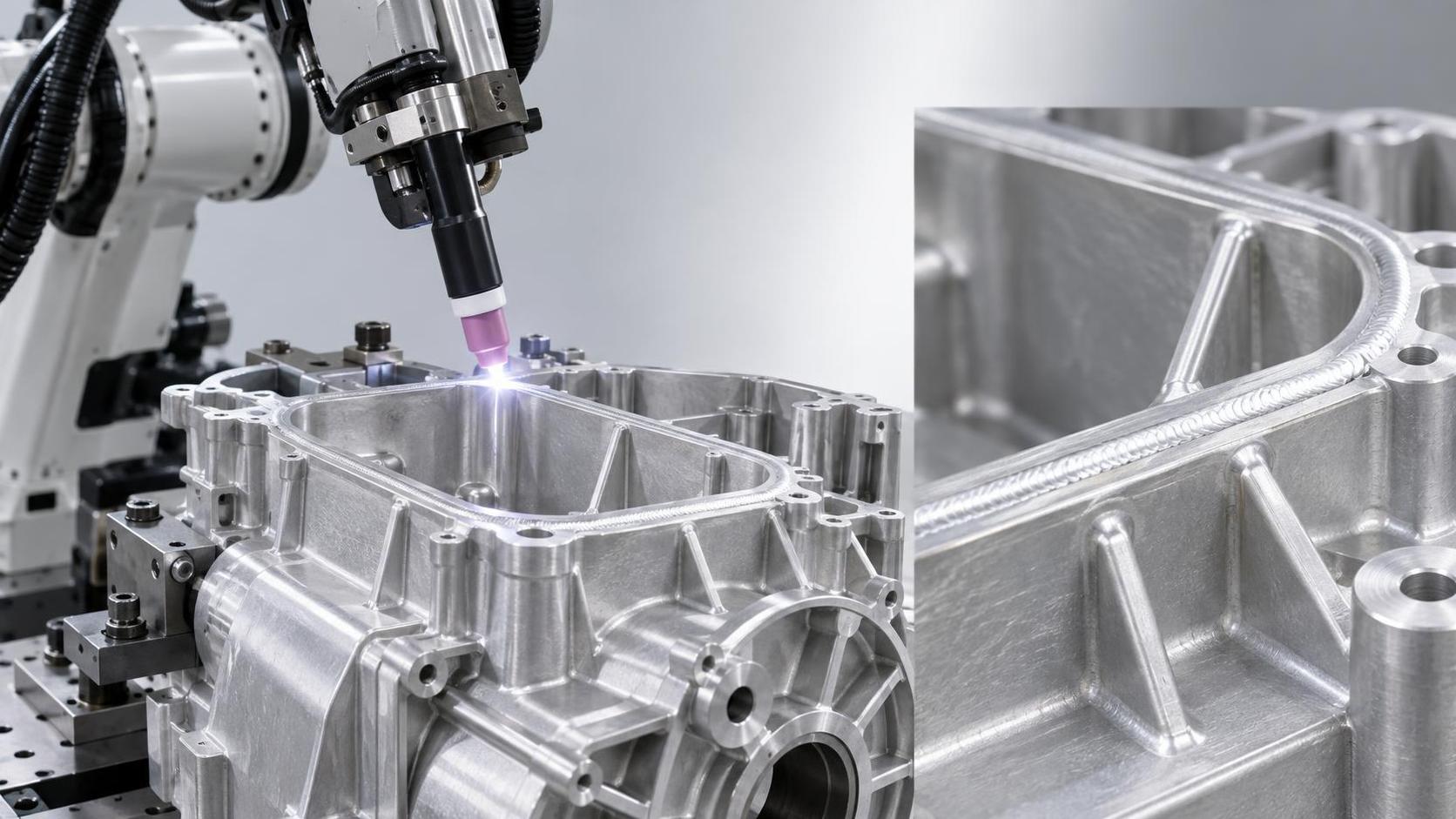
Robotic TIG Is the Default Choice—Unless Your Process Constraints Force a Shift to MIG
For technical evaluators specifying robotic welding for aluminum die-cast enclosures, the question isn’t really “TIG or MIG?”—it’s “What happens if we default to MIG without verifying whether it actually fits *this* part, *this* joint geometry, and *this* post-assembly requirement?” Robotic TIG remains the baseline standard for good reason: it delivers predictable, shallow, controllable penetration on thin-walled (1.5–3.0 mm), heat-sensitive castings where dimensional stability and oxide-free weld integrity are non-negotiable. But that doesn’t mean robotic MIG has no place—it does. It just demands stricter upfront validation.
Penetration Control Isn’t Just About Depth—It’s About Consistency Across Variable Wall Thickness
Aluminum die-castings rarely have uniform wall thickness. A typical enclosure may feature 1.8 mm side walls, 2.5 mm mounting flanges, and 1.2 mm ribbed zones—all in one part. Robotic TIG excels here because its arc is inherently stable, low-energy, and highly responsive to real-time current modulation. With proper torch angle, travel speed, and pulse parameters, you can hold penetration within ±0.2 mm—even across transitions between 1.2 mm and 2.5 mm sections. That consistency prevents both burn-through in thin zones and lack-of-fusion in thicker ones.
Robotic MIG struggles with this variability. Its higher heat input and broader arc column make it prone to thermal runaway in thinner areas unless you tightly restrict wire feed speed, voltage, and shielding gas flow—and even then, minor casting porosity or surface oxide variation can trigger sudden penetration spikes. In practice, many shops compensate by oversizing fillets or adding backing bars, which adds cost, slows cycle time, and introduces new distortion risks during cooling.
Spatter Risk Is Not Just a Cleanup Issue—It’s a Quality Gatekeeper
Spatter from robotic MIG on aluminum isn’t merely cosmetic. When molten aluminum droplets land on adjacent surfaces—especially near vents, screw bosses, or mating interfaces—they create micro-shorts, interfere with sealing gaskets, and compromise EMI shielding performance. Worse, spatter often embeds oxide particles into the base metal, creating localized corrosion initiation points that only reveal themselves after environmental testing or field use.
Robotic TIG produces virtually zero spatter under standard parameters. There’s no wire transfer, no short-circuiting, no globular transition—just a clean, focused arc melting only what’s needed. This eliminates not only post-weld cleaning labor but also the risk of introducing surface contamination that could invalidate qualification testing for aerospace or medical enclosures.
Post-Weld Cleaning Isn’t an Afterthought—It’s a Cost Multiplier You Can’t Ignore
Here’s where the trade-off becomes tangible: robotic MIG may run 2.5× faster than robotic TIG on a given seam—but if every weld requires 90 seconds of manual brushing, oxide removal with stainless steel wire wheels, and visual inspection for spatter adhesion, that speed advantage vanishes. And if the part goes into anodizing or powder coating later, residual oxide or embedded spatter will cause blistering, poor dye uptake, or premature coating failure.
Robotic TIG welds typically need only light wipe-down with acetone before final inspection. No grinding, no blasting, no rework loops. That directly reduces labor cost per unit, improves first-pass yield, and shortens throughput time—not just at the weld station, but across the entire finishing line.
When Robotic MIG *Can* Work—And What You Must Verify First
MIG isn’t disqualified outright. It makes sense when:
- The enclosure is thick-walled (>4.0 mm) and structurally robust, with generous tolerances;
- Welds are long, straight, and uninterrupted (e.g., perimeter seams on large housings);
- Surface finish requirements are functional—not aesthetic or sealing-critical;
- Production volume justifies investment in high-end spatter-reduction systems (e.g., pulsed-spray transfer with argon-helium blends, contact-tip-to-work distance monitoring, and closed-loop voltage feedback).
But even then, you must validate three things before committing: (1) Whether your specific die-casting alloy (e.g., A380 vs. ADC12) responds predictably to MIG’s thermal profile; (2) Whether your fixture design accommodates the wider heat-affected zone without warping; and (3) Whether your post-weld process flow includes dedicated, validated oxide removal—because standard degreasing won’t suffice.
Integration Realities: Skill, Setup Time, and System Compatibility
Robotic TIG demands tighter integration discipline—not more operator skill, but more precise upstream control. Torch alignment, gas coverage verification, and tungsten conditioning must be repeatable across shifts. However, once qualified, robotic TIG programs are remarkably stable: a single parameter set often runs unchanged for months across thousands of parts.
Robotic MIG is more forgiving on setup but less forgiving on consistency. Small changes in wire stick-out, contact tip wear, or shielding gas turbulence cause measurable variation in bead shape and penetration. That means more frequent in-process checks, more frequent parameter adjustments, and higher reliance on sensor-based adaptive control—adding complexity and cost to the system architecture.
Where Surface Finishing Fits In—And Why It Matters Earlier Than You Think
Weld quality doesn’t end at the arc. For aluminum die-cast enclosures destined for visible or high-reliability applications, surface condition post-weld directly impacts downstream processes like anodizing, plating, or conformal coating. Residual oxide, micro-spatter, or heat-tinted zones all disrupt uniform layer formation.
This is where finishing solutions become part of the welding decision—not an afterthought. For example, parts requiring tight cosmetic standards or internal cleanliness (e.g., medical electronics housings or rail transit control boxes) often undergo magnetic mass finishing after welding to remove micro-burrs, homogenize surface texture, and eliminate embedded contaminants. A Customized Magnetic polishing machine handles irregular geometries—including internal ribs, threaded inserts, and narrow gaps—without part deformation or dimensional shift. Its omni-directional action cleans weld zones while simultaneously deburring edges and enhancing reflectivity, compressing multiple secondary operations into one 3–20 minute cycle.
Final Recommendation: Start with Robotic TIG—Then Stress-Test MIG Against Your Specific Enclosure
Don’t choose robotic MIG because it’s faster on paper. Choose it only after proving it meets *your* definition of “acceptable” on three concrete criteria: (1) Penetration stays within ±0.3 mm across all wall thicknesses in your actual casting; (2) Spatter rate stays below 0.5% of total weld length without compromising travel speed; and (3) Post-weld cleaning adds ≤30 seconds per part without introducing rework risk.
If any one of those fails, robotic TIG isn’t the “slower alternative”—it’s the lower-risk, lower-TCO path. And with ISO9001- and CE-certified robotic welding systems from suppliers like Wuxi Samgins—backed by proven experience in aluminum fabrication, CNC machining, and precision finishing—you’re not trading speed for quality. You’re aligning process capability with part function.
search
Products Navigation
Send Us A Message