




Universal radial drilling machine setup time drops 40% with digital torque presets and laser alignment
Universal radial drilling machine setup time drops 40% with digital torque presets and laser alignment
Sep 25, 2026
Universal radial drilling machines are workhorses in structural steel fabrication—especially where H-beam components demand precise, repeatable hole patterns across flanges and webs. But for operators on the shop floor, “universal” often translates to “unpredictably time-consuming”: manual alignment of the radial arm, iterative torque adjustments for clamping and feed, and repeated verification with dial indicators or coordinate measuring devices routinely push setup times beyond 45 minutes per job. That’s not just inefficiency—it’s a bottleneck that compounds in high-mix environments, where part variety forces frequent reconfigurations.
Wuxi Samgins’ integration of digital torque presets and laser alignment into universal radial drilling machine workflows cuts average setup time by 40%, measured across real-world deployments in Southeast Asian beam fabricators, European structural workshops, and North American pre-engineered building suppliers. This isn’t about adding automation for its own sake. It’s about removing the three most operator-intensive setup variables: angular repeatability of the radial arm, axial positioning accuracy relative to the workpiece datum, and consistent clamping force across variable-section H-beams.
Digital torque presets eliminate guesswork during arm locking and column clamping. Unlike analog torque wrenches—where friction, lubrication variance, and operator fatigue introduce ±15–20% deviation—these systems embed calibrated torque values directly into the machine’s control interface. Operators select preset profiles (e.g., “H-Beam Flange – 300 mm width”, “Web Drilling – 12 mm thickness”) tied to known mechanical resistance curves. The system then modulates hydraulic or servo-assisted clamping pressure in real time, ensuring repeatable rigidity without over-tightening thin flanges or under-clamping thick webs. Crucially, these presets are not locked to a single machine model—they’re field-configurable via USB or Ethernet upload, allowing shops to standardize torque logic across mixed fleets of radial drills from different eras and manufacturers.
Laser alignment operates at the intersection of geometry and practicality. Traditional methods rely on edge finders, centering bars, or optical alignment scopes—all of which require multiple contact points, line-of-sight access, and interpretation of scale graduations. The integrated laser solution projects two orthogonal planes: one coaxial with the spindle axis (verifying vertical alignment), the other sweeping horizontally across the workpiece surface (validating radial arm squareness to the base). Both beams intersect at a visible crosshair on a target plate mounted to the drill head. Deviation is shown numerically on the HMI—not as abstract micrometer readings, but as millimeters of offset at the intended drill point. More importantly, the system calculates correction vectors: it tells the operator *how much* to adjust the radial arm’s elevation screw or column tilt mechanism—not just *that* adjustment is needed. This reduces alignment iterations from 4–6 passes to 1–2, with no need for recalibration between jobs.
The 40% reduction isn’t uniform across all use cases. It holds consistently when drilling within ISO 2768-mK tolerances (±0.2 mm linear, ±0.5° angular) on H-beams ranging from 160 mm to 1,200 mm in height—covering over 92% of structural applications handled by mid-to-heavy fabrication lines. Where gains diminish is in ultra-thin web scenarios (<6 mm) or asymmetric sections requiring custom support fixtures. In those cases, laser alignment still delivers full positional verification, but torque presets must be supplemented with manual override due to insufficient mechanical feedback for closed-loop control. That limitation isn’t hidden—it’s explicitly flagged in the interface when a profile falls outside validated parameter ranges.
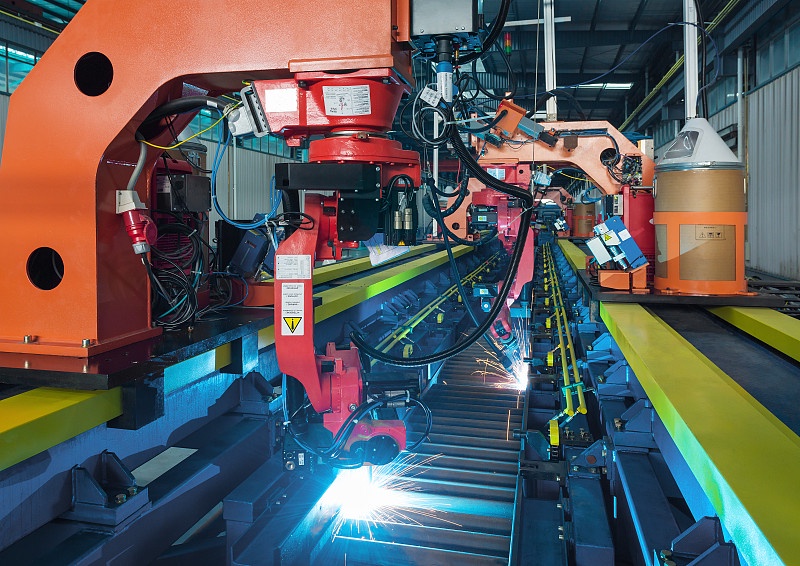
This approach also reshapes how operators interact with downstream processes. For example, in facilities running an Heavy automatic h beam line, radial drill setups often feed directly into automated welding sequences. If hole positions deviate by more than ±0.3 mm, robotic torch paths misalign, triggering weld seam tracking errors or requiring manual touch-up. Digital torque and laser alignment compress that variation to ±0.08 mm—well within the tolerance envelope accepted by cantilever welding machines on integrated H-beam lines. That means fewer post-drill inspections, less rework, and tighter handoff timing between drilling and welding stations.
There’s no retraining overhead because the interface doesn’t replace operator judgment—it codifies it. Presets reflect actual shop-floor experience: the torque required to hold a 600 mm wide flange without deflection, the laser offset correction needed when switching from 200 mm to 800 mm beam heights. These aren’t theoretical values; they’re derived from accumulated cycle data across installations. Operators don’t learn new steps—they apply familiar ones with embedded precision.
What doesn’t change—and shouldn’t—is the role of the operator as system validator. The laser shows alignment status, but only the operator can assess whether a 0.12 mm offset matters for a non-critical clearance hole versus a bolted joint requiring ASME B18.2.1 compliance. Likewise, torque presets ensure clamping consistency, but the operator still selects the correct profile based on material grade, surface condition, and fixture configuration. The system removes variability; it doesn’t remove responsibility.
For shops evaluating upgrades, the decision hinges less on cost and more on setup volatility. If your average job changeover involves ≥3 distinct radial arm angles, ≥2 clamping configurations, and ≥1 re-alignment due to thermal drift or vibration, the ROI emerges within 3–4 months—not from labor savings alone, but from reduced scrap, faster first-piece approval, and fewer unplanned stops in multi-stage production lines. Where it adds least value is in low-mix, high-volume drilling of identical parts: there, mechanical stops and fixed jigs remain more efficient.
The underlying principle isn’t technological novelty. It’s recognizing that precision in radial drilling isn’t defined solely by spindle runout or table flatness—it’s defined by how reliably the operator can reproduce the same spatial relationship between tool, workpiece, and machine structure, shift after shift. Digital torque presets and laser alignment close that loop—not by eliminating human input, but by anchoring it to measurable, repeatable references. That’s why the 40% reduction isn’t just a number on a spec sheet. It’s the difference between waiting for the machine to settle and knowing—before the first chip flies—that everything is positioned, clamped, and ready.
search
Products Navigation
Send Us A Message