




What’s driving the shift toward modular automatic space frame welding machine configurations in prefabricated construction?
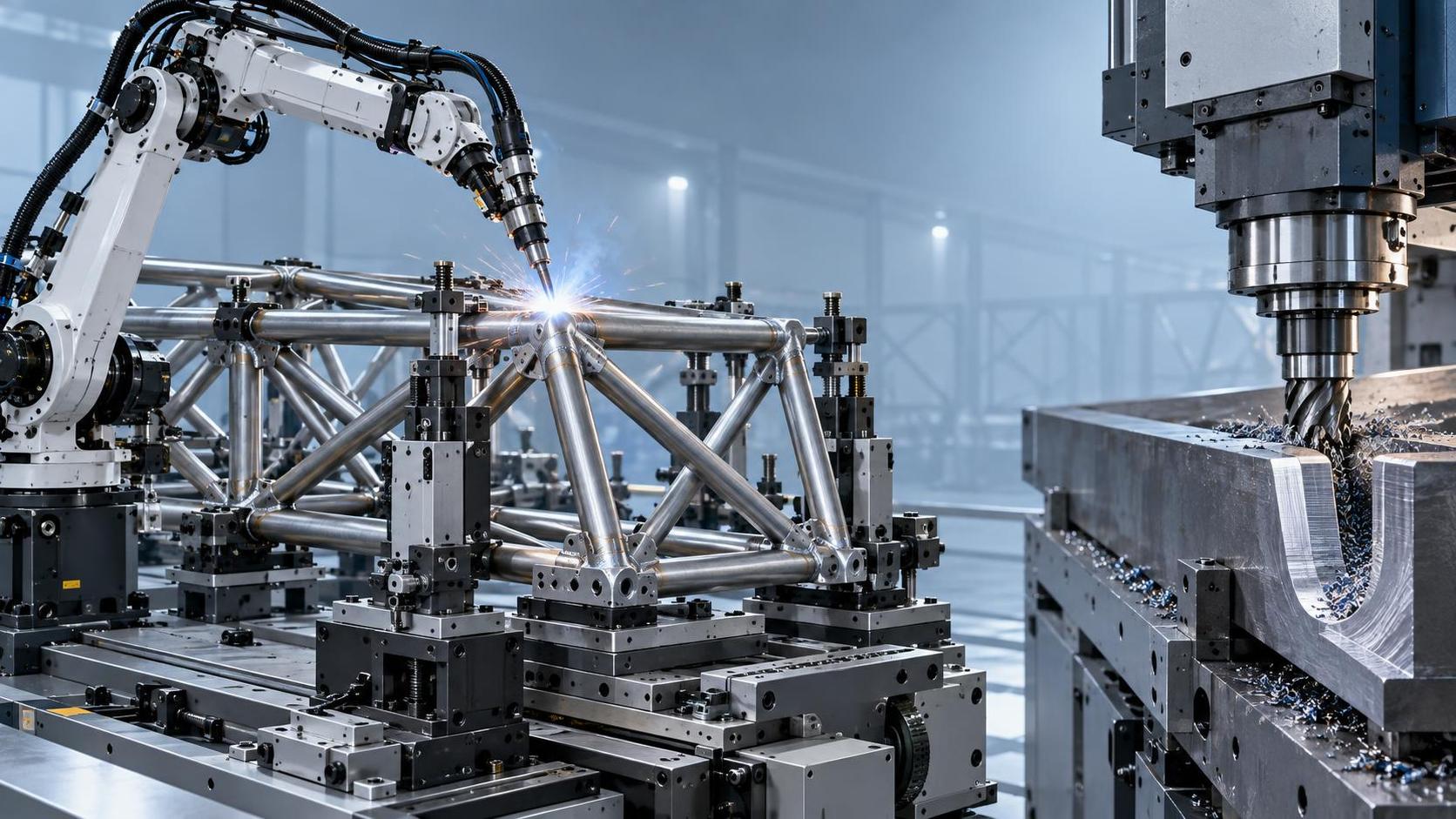
The prefabricated construction industry is rapidly embracing modular automatic space frame welding machine configurations to enhance precision, scalability, and on-site adaptability. As labor costs rise and project timelines tighten, manufacturers like Wuxi Samgins International Trade Co., Ltd.—a ISO9001- and CE-certified supplier of advanced automatic space frame welding machine systems—are meeting demand with flexible, integrated solutions. This shift reflects broader trends toward automation, standardization, and smart factory integration in structural steel fabrication.
Why modularity isn’t just convenient—it’s operationally necessary
Modular configurations for automatic space frame welding machines are gaining traction not because they’re newer or trendier, but because they directly address three persistent operational constraints: site variability, production volume fluctuations, and evolving structural complexity. Prefabricated steel frame assemblies—especially those used in large-span roofs, industrial sheds, and seismic-resistant buildings—require consistent weld quality across diverse geometries and joint types. Fixed-line welding cells struggle when a project shifts from standard dome modules to irregular polyhedral nodes or when transport logistics dictate on-site assembly in constrained urban yards rather than centralized factories. Modular systems solve this by decoupling core functions—positioning, clamping, torch motion, and seam tracking—into interoperable units that can be reconfigured, relocated, or scaled without full system redesign.
This isn’t about swapping out components for novelty’s sake. It’s about maintaining dimensional repeatability while accommodating real-world variables: material thickness tolerances up to ±1.5 mm, thermal distortion during multi-pass welding, and minor misalignments introduced during manual handling prior to welding. A truly modular architecture allows dynamic recalibration of robot path offsets based on real-time seam detection—not pre-programmed assumptions—and enables rapid tooling changeover between node types without mechanical retooling downtime.
Material preparation as the critical upstream bottleneck
Even the most adaptive welding system fails if incoming workpieces lack consistent edge geometry. Bevel quality directly governs penetration depth, fusion zone uniformity, and post-weld distortion. In heavy-frame applications—particularly where carbon steel plates exceed 60 mm thickness—edge inconsistencies compound exponentially: a 2° variation in bevel angle can shift heat input distribution by over 18%, increasing risk of cold cracking in HAZ zones and requiring costly post-weld NDT rework.
Traditional edge planers often fall short here. Their rigid feed mechanisms struggle with plate flatness deviations common in hot-rolled stock, and their fixed cutter heads cannot dynamically adjust for variable plate thickness within a single run. That’s why integrated beveling and milling solutions are increasingly paired with modular welding lines—not as add-ons, but as synchronized process stages. For example, the Beveling & Milling Edge For Heavy Tank handles thickness ranges from 6 mm to 400 mm in a single setup, using motor-driven VFD-controlled feed and detachable, heat-treated guide rails that maintain positional stability under lateral load. Its ability to form U-, V-, and K-shaped bevels in one pass eliminates secondary grinding—reducing cumulative tolerance stack-up before welding even begins.
How structural design choices impact long-term flexibility
Modularity extends beyond software interfaces or quick-connect couplings. It’s embedded in mechanical architecture. Consider guide rail support: conventional suspended rails deflect under dynamic loads from heavy-duty milling heads, introducing micro-vibrations that translate into weld bead waviness. Systems with combined suspension-and-seating support—like those used in high-precision edge milling platforms—dampen resonance across the full frequency spectrum, enabling stable 0.13–1.0 m/min feed speeds regardless of plate thickness or alloy type. This mechanical stability becomes the foundation for reliable CNC path execution downstream in the welding cell.
Similarly, the choice of clamping and positioning hardware dictates how easily a modular line adapts to new frame geometries. Built-in workpiece stop devices with micron-level repeatability allow rapid transition between different node diameters without recalibrating laser trackers. Dedicated bottom support systems for extra-long workpieces prevent sag-induced angular deviation during machining—ensuring that edges presented to the welding torch meet specification before the first arc strike.
Automation depth matters more than headline features
“Automated” doesn’t mean the same thing across vendors. Some systems automate only motion control; others integrate edge detection, feed/return logic, and auto-clamping—but stop short of closed-loop feedback between bevel inspection data and weld parameter adjustment. True operational modularity requires interoperability at the data layer: shared coordinate frames, standardized I/O protocols (e.g., EtherCAT), and vendor-agnostic PLC interfaces. Without these, adding a new module—say, an automated post-weld inspection station—requires custom gateway development, negating the time savings promised by modularity.
Wuxi Samgins’ approach reflects this reality: its equipment is engineered to ISO9001 and CE standards not as compliance checkboxes, but as design constraints that enforce traceable component sourcing, stress-relieved main frames, and indexable cutter inserts with documented wear profiles. These aren’t marketing points—they’re enablers of predictable maintenance intervals, calibrated replacement cycles, and verifiable process capability indices (Cpk) across production batches.
When modularity crosses into over-engineering
Not every application justifies full modularity. Projects with tightly defined, repetitive node families—such as standardized warehouse roof trusses—may achieve higher throughput with optimized fixed-line setups. The tipping point comes when more than two distinct frame geometries enter the production schedule within a six-month window, or when client-specified revisions require frequent reconfiguration of weld sequences. At that stage, the labor hours saved on reprogramming, tooling changes, and trial runs outweigh the initial capital premium of modular architecture.
Also worth noting: modularity introduces new failure modes. Inter-module communication latency, inconsistent firmware versions across subsystems, and calibration drift between independently maintained units can degrade overall system performance faster than a monolithic cell. Successful deployment depends less on hardware specs and more on documented synchronization procedures—like daily master reference checks and version-controlled parameter backups—that treat the entire line as a single, versioned process asset.
For fabricators scaling into complex, low-volume/high-variability projects—especially those involving pressure vessels, heavy storage tanks, or seismic-rated structures—the convergence of precise edge preparation, mechanically stable motion systems, and interoperable automation layers makes modular automatic space frame welding machine configurations not just viable, but operationally indispensable.
search
Products Navigation
Send Us A Message