




Which industries benefit most from deploying an automatic space frame welding machine?
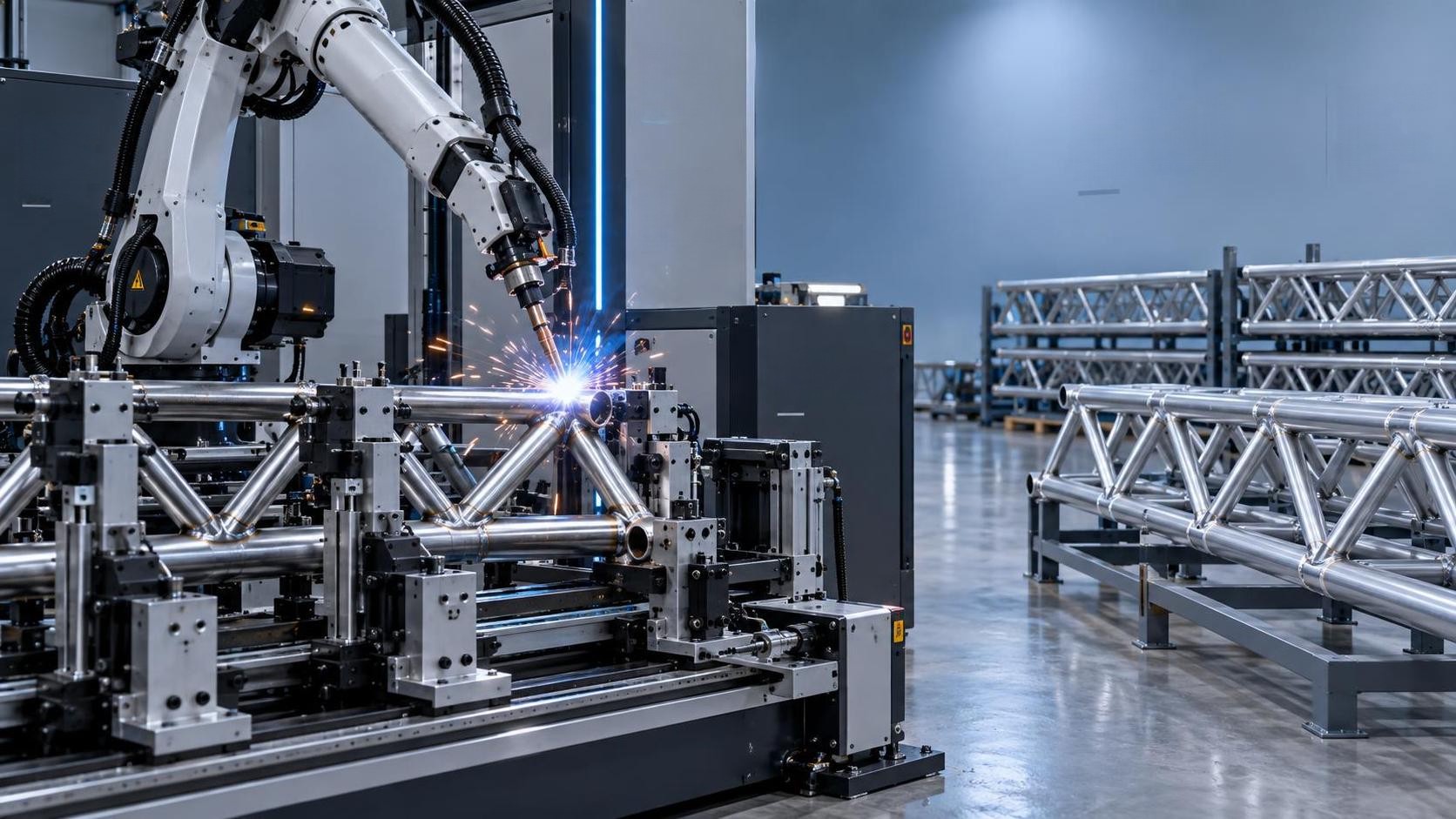
Which industries benefit most from deploying an automatic space frame welding machine?
For manufacturing decision-makers evaluating capital equipment investments, the question isn’t whether automatic space frame welding machines exist—it’s whether they deliver measurable, scalable value in your production environment. Unlike general-purpose welding cells, these systems are engineered for high-precision, repeatable assembly of triangulated tubular structures—where dimensional stability, weld integrity, and geometric repeatability directly determine structural performance, certification compliance, and downstream assembly efficiency. The strongest ROI emerges not in volume alone, but where three conditions converge: recurring part families, strict tolerance requirements, and labor-intensive manual processes that introduce variability or bottleneck throughput.
Automotive & EV chassis manufacturers: Where consistency becomes a compliance requirement
Space frames remain critical in high-performance vehicle architectures—especially in electric platforms where battery pack integration demands absolute rigidity and thermal-path predictability. Manual welding of aluminum or high-strength steel lattice structures introduces heat distortion, inconsistent penetration, and positional drift across dozens of joints per frame. An automatic system eliminates operator-dependent variables while maintaining ±0.3 mm positional accuracy across full assemblies—enough to pass ISO 15614-1 qualification without rework. More importantly, it enables traceability: each weld parameter (voltage, travel speed, wire feed) is logged per joint, satisfying OEM Tier 1 audit requirements for AS9100 or IATF 16949. If your production runs exceed 500 units/month with ≥80% design commonality across variants, automation pays back in under 18 months—not just through labor reduction, but through eliminated scrap, reduced inspection time, and faster launch cycles for new platforms.
Aerospace & defense subcontractors: When “good enough” isn’t certified
Here, the benefit isn’t speed—it’s certifiability. Space frames used in UAV airframes, satellite support structures, or ground-test rigs must meet stringent NDT acceptance criteria (e.g., ASTM E1495 Level 3 UT or radiography). Manual welds on thin-walled titanium or Inconel tubes suffer from inconsistent root fusion and porosity risk—especially at complex node intersections. Automatic systems integrate seam tracking, real-time arc monitoring, and pre-programmed thermal management strategies that maintain consistent interpass temperature and travel speed. Crucially, they allow full digital twin alignment: CAD model → robot path generation → actual weld geometry verification via integrated laser scanning. This closed-loop control is non-negotiable when every weld must be qualified to AWS D17.1 or EN 288-2—and when rework means scrapping $12,000+ raw material. For shops bidding on FAA Part 21 or EASA 21.G contracts, this capability shifts you from “capable supplier” to “certified process owner.”
Prefab modular building & infrastructure fabricators: Scaling precision without scaling headcount
This sector faces a different pressure: rising labor costs amid tightening skilled welder availability. But more critically, field assembly failures—misaligned nodes, out-of-tolerance diagonals—trigger costly rework or structural reinforcement. Automatic space frame welding delivers repeatability across batch sizes as low as 20–30 units, making it viable for regional prefab producers serving commercial or multi-family housing markets. It enables standardized node geometries (e.g., spherical or octahedral hubs) to be welded identically across all frames, ensuring bolt-hole alignment and load-path continuity—even when using variable-thickness wall tubing. The payoff manifests not in cycle time alone, but in predictable delivery windows: no more schedule slips due to welder shortages or quality hold points. One European client reported cutting final inspection time by 65% and reducing field adjustment labor by 40% after integrating automated framing into their 120-unit/year modular school project pipeline.
Energy infrastructure & renewable support structures: Where environment dictates process control
Offshore wind transition pieces, solar tracker frames, and hydrogen storage rack assemblies operate under cyclic loading and corrosive exposure. Weld quality here determines fatigue life—not just initial strength. Manual welding struggles with consistent penetration on thick-section stainless or duplex steel nodes exposed to salt-laden air during fabrication. Automatic systems enforce precise heat input control, minimizing HAZ embrittlement and enabling optimized filler metal selection per joint orientation. They also support hybrid workflows: for example, using a Multipurpose Handing Robot BR20iB-18 to position and rotate large-diameter tubular subassemblies before automated welding—leveraging its ±0.08 mm repeatability and 1911 mm reach to handle parts up to 20 kg without fixturing complexity. This flexibility matters when fabricating custom lattice towers with varying diameters and wall thicknesses across a single job lot.
Where it doesn’t pay—or creates new bottlenecks
Don’t automate if your product mix is truly low-volume, high-variability. A shop producing 5–10 unique architectural space frames per year—with no shared node geometry or tube specifications—will drown in programming time and fixture costs. Likewise, if your current weld quality is already failing basic visual inspection, automation won’t fix root causes like poor fit-up, contaminated base metal, or incorrect shielding gas flow. And crucially: automatic welding only amplifies existing process discipline. Without documented WPS/PQR, calibrated equipment, and trained personnel overseeing parameter validation, you’ll get consistent *bad* welds—not consistent *good* ones. The machine doesn’t replace metallurgical understanding; it demands more rigorous upstream control.
What to assess before committing
Start with your part family analysis—not annual volume, but geometric recurrence. Can 70%+ of your nodes be grouped into ≤5 core configurations? Do tube diameters and wall thicknesses vary within ±15% across models? Then examine your current pain points: what percentage of QA holds are weld-related? How many hours per frame are spent on post-weld correction? Finally, verify your facility’s readiness: stable power supply (±5% voltage), compressed air quality (ISO 8573-1 Class 2), and floor flatness (<0.5 mm/m over 2 m). These aren’t “nice-to-haves”—they’re prerequisites for maintaining the ±0.2 mm repeatability that makes the investment defensible.
Automatic space frame welding isn’t a universal upgrade—it’s a targeted solution for manufacturers where structural integrity, regulatory traceability, and labor scalability intersect. The strongest adopters don’t buy a machine; they invest in a repeatable, auditable, and scalable fabrication capability. That shift changes how you quote, how you schedule, and how you compete—not just on price, but on certainty.
search
Products Navigation
Send Us A Message