




What ISO Certified Hydraulic Shearing Machine Standards Really Mean
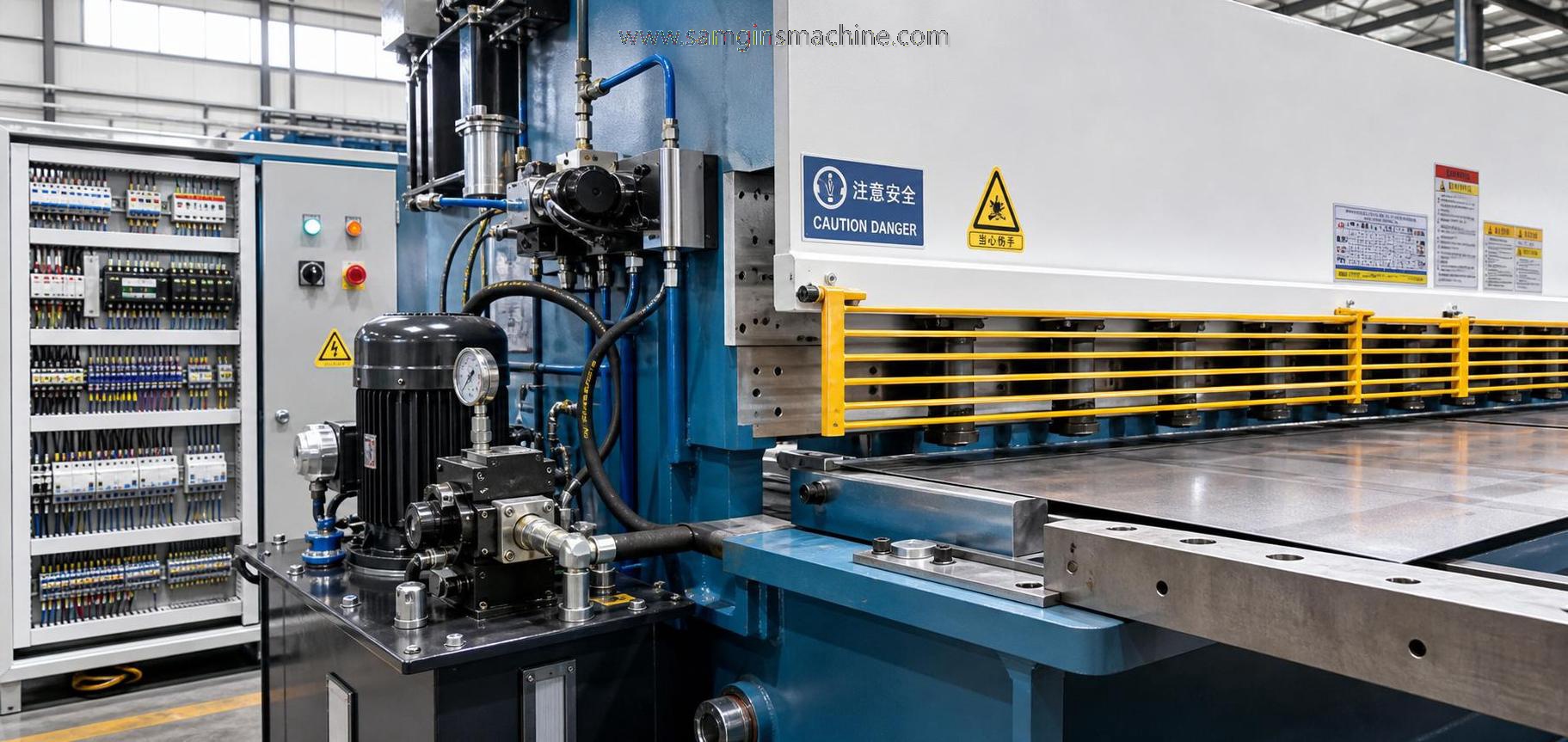
Why does an iso certified hydraulic shearing machine matter beyond the badge?
An iso certified hydraulic shearing machine is rarely important because of branding alone.
What matters is the management system behind it.
In practical terms, certification points to documented production control, inspection discipline, traceability, and repeatable assembly standards.
For metal fabrication lines, that affects cut accuracy, blade stability, hydraulic consistency, and operator protection.
It also changes how equipment stands up during audits.
When a supplier works under ISO9001 and follows CE-oriented design practice, records are usually easier to verify.
That lowers the chance of buying a machine with unclear origin, weak process control, or incomplete safety documentation.
Wuxi Samgins International Trade Co.,Ltd has operated in mechanical equipment since 2012.
Its portfolio covers shearing machines, bending machines, CNC tools, welding equipment, laser systems, and H-beam line equipment.
That broader manufacturing background matters because shearing equipment is rarely evaluated in isolation.
It must fit the overall fabrication workflow, compliance process, and export expectations.
Which ISO standards are people usually referring to?
This is one of the most common points of confusion.
An iso certified hydraulic shearing machine does not mean the machine itself is certified under every possible ISO machinery rule.
More often, it means the manufacturer runs an ISO9001 certified quality management system.
That covers process control, corrective action, supplier management, inspection records, and continuous improvement.
For equipment entering many overseas markets, CE compliance is also highly relevant.
CE is not an ISO certificate, but it is closely tied to machine safety expectations.
A stronger supplier can usually explain both clearly.
The table below helps separate these terms.
So when evaluating an iso certified hydraulic shearing machine, ask exactly what is certified, by whom, and for how long.
How can you tell whether the certification is actually meaningful?
A certificate file by itself proves very little.
The better question is whether the certification appears in daily manufacturing behavior.
That can be checked through records, not slogans.
- Request the certificate number, issuing body, and validity period.
- Check whether inspection reports match the machine model being quoted.
- Review hydraulic, electrical, and blade-related acceptance records.
- Confirm serial number traceability for major assemblies.
- Ask for risk assessment, wiring diagrams, and operating manuals.
- Verify whether spare parts and after-sales procedures are documented.
In actual audits, missing records are often more revealing than missing promises.
If a supplier cannot explain test items such as cutting angle accuracy, backgauge repeatability, or overload protection, the ISO label loses value.
A useful sign is consistency across the product range.
For example, companies handling pipe benders, rolling machines, shearing lines, and CNC equipment under one controlled system usually present cleaner technical files.
That same discipline can be seen in related solutions such as CNC hydraulic pipe bending machine configurations, where PLC data storage, emergency stop functions, and traceable operating logic are built into daily use rather than added later for appearance.
What safety and quality points should be checked on the machine itself?
Certification should lead to visible machine-level controls.
This is where many buyers move from paper review to practical judgment.
On the safety side
Look for emergency stop access, finger protection, rear guarding, and predictable control response.
Electrical cabinets should be organized, labeled, and easy to inspect.
Hydraulic routing should also be tidy, protected, and free from obvious leakage risks.
On the quality side
Check frame rigidity, blade clearance adjustment, backgauge stability, and control repeatability.
An iso certified hydraulic shearing machine should deliver stable performance across repeated cuts, not just during a single demonstration.
Noise, vibration, oil temperature rise, and control alarms also deserve attention.
Short test runs can hide long-cycle problems.
That is why pre-shipment inspection should include sustained operation, not only no-load movement.
Where do buyers usually make the wrong call?
The most common mistake is treating all certificates as equal.
Another is assuming that a compliant machine will automatically suit every production line.
A machine can be properly documented and still be the wrong choice for material thickness, duty cycle, operator habits, or plant layout.
There is also a cost misunderstanding.
A lower-priced machine with weak documentation may create more expense through downtime, corrective work, retraining, and failed compliance checks.
The comparison below is often more useful than a simple price list.
How should you evaluate suppliers if the line includes more than one machine type?
This matters more than it first appears.
Many fabrication plants buy shearing, bending, cutting, and handling equipment together or in phases.
A supplier with broader process experience usually understands interface risk better.
That includes training documents, control logic, maintenance planning, and spare parts coordination.
For example, if a project also involves tube forming, an integrated review may compare a shearing line with a CNC hydraulic pipe bending machine setup.
Features like servo feeding, PLC-stored programs, emergency stop pedals, diagnostic access, and secure parameter control show how a supplier approaches repeatability and safety across categories.
That does not replace machine-specific verification.
It does, however, help reveal whether the supplier has a real system or only a sales document set.
What is the practical next step before approving an iso certified hydraulic shearing machine?
Start with a short approval checklist tied to your own process risk.
Map the machine against required material range, expected cutting accuracy, safety controls, recordkeeping needs, and audit obligations.
Then confirm what the supplier can prove, not just what it can claim.
- Define the production and safety conditions the machine must meet.
- Review ISO9001 and CE-related documents together, not separately.
- Require loaded testing and traceable inspection reports.
- Check whether manuals, spare parts, and after-sales support match the delivered model.
- Document any gaps before shipment, not after installation.
A well-chosen iso certified hydraulic shearing machine should reduce uncertainty in both compliance and production.
If the review stays focused on traceability, machine safety, and repeatable cutting results, the certification starts to mean something concrete.
That is usually the difference between a smooth acceptance process and a costly correction cycle later.
search
Products Navigation
Send Us A Message