




What Is the Delivery Time for Wuxi Samgins Welding Robots?
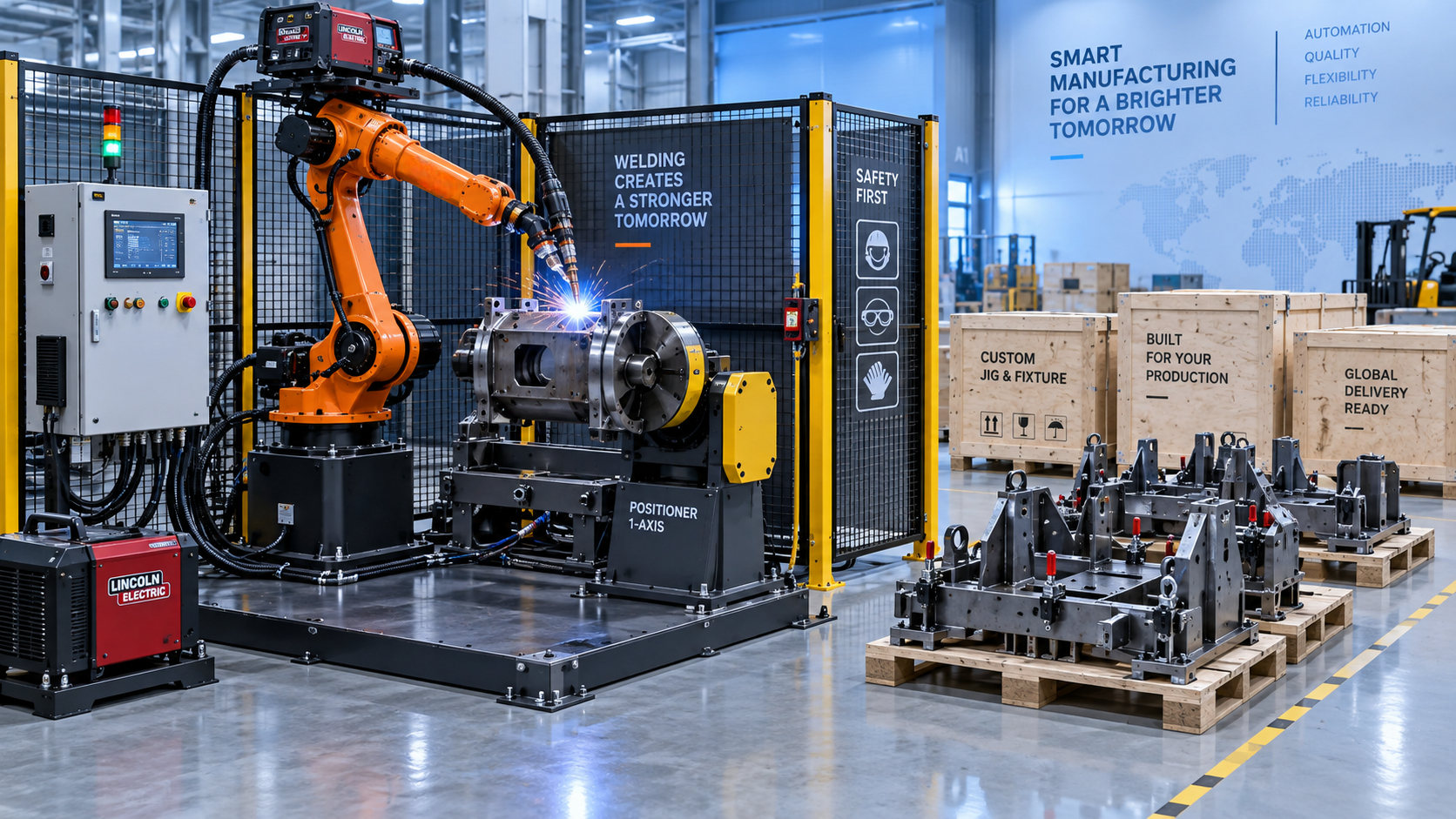
The delivery time for a Wuxi Samgins welding robot cannot be stated as one fixed number before the required cell configuration is confirmed. A standard robot package with a conventional controller, welding power source, and common torch arrangement is usually faster to prepare than a fully integrated workcell. Delivery becomes longer when the order includes custom fixtures, a positioner, safety guarding, offline programming, special welding processes, or export-specific packing and documentation.
The useful date is therefore not simply the date when the robot arm is available. It is the date when the complete equipment scope is ready for dispatch, with the selected welding components matched, the mechanical interfaces checked, and the agreed acceptance requirements addressed. Asking only for the robot delivery date can create a misleading production schedule when the peripheral equipment still requires engineering or fabrication.
What determines the lead time?
A welding robot is normally part of a coordinated system rather than a standalone machine. The robot body, controller, welding power source, wire feeder, torch package, cables, safety equipment, workholding, and material-handling devices all need compatible connections. Lead time follows the slowest critical item and the amount of work needed to assemble and verify the system.
A basic arc-welding package may require limited configuration if the requested robot payload, reach, controller version, welding source, and torch are already defined. Once the application involves coordinated motion, complex access angles, large parts, or multiple stations, the project moves from equipment supply toward cell integration. That transition has a direct effect on delivery planning.
A robot delivery date is different from a production-ready date
Three dates are often confused during early discussions. The first is component availability: when the robot and major purchased items can be allocated. The second is factory dispatch: when the equipment has been assembled, inspected, packed, and released for shipment. The third is production readiness: when the system has arrived, been installed, electrically connected, commissioned, and proven on actual parts.
For a standalone robot package, the distance between dispatch and production readiness may be relatively short if the installation site is prepared and the application is simple. For a complete welding cell, the installation stage can be substantial. A level floor, adequate electrical supply, shielding-gas connection, fume extraction, wire storage, safety clearances, and suitable material flow all affect how quickly commissioning can begin.
Factory acceptance and site acceptance should also be separated. A cell can be checked at the supplier's facility for axis motion, interlocks, basic welding operation, and programmed sequences. Final results at the installation site still depend on the actual part condition, fit-up consistency, consumables, local power quality, and the finished layout. A delivery commitment should identify which milestone it refers to.
Information that should be settled before the schedule is confirmed
Incomplete technical input is a frequent reason for an early lead-time estimate to change later. The highest-value information is not always a long list of options. A few application details can determine whether a standard arrangement is suitable or whether custom work is required.
- Part drawings and weld symbols: Dimensions alone do not show every access issue. Weld size, joint type, intermittent weld locations, root gap requirements, and the permitted weld sequence influence torch orientation and fixture design.
- Material and thickness range: Carbon steel, stainless steel, aluminum, coated material, and mixed material thicknesses can require different welding processes, wire types, gas mixtures, cleaning methods, and parameter windows.
- Part variation: A robot repeats a programmed path accurately, but it cannot correct large changes in joint position without an appropriate sensing or locating method. Variation caused by upstream cutting, bending, tack welding, or manual assembly must be understood before choosing the cell configuration.
- Required output pattern: Cycle time, batch size, changeover frequency, and the number of part variants affect whether a fixed fixture, quick-change tooling, manual loading station, or dual-station layout is appropriate.
- Available site layout: Robot reach alone is not enough. Space is needed for guarding, access doors, cable service loops, part loading, maintenance access, and safe clearance through the full movement envelope.
- Acceptance standard: The agreed test part, weld appearance requirements, dimensional checks, and process demonstration should be defined early. Otherwise, acceptance discussions may begin after the equipment is already built.
Where sample parts are available, they often reveal issues that drawings do not show. Heat distortion can alter a joint after the first welds. Spatter can affect locating surfaces. A clamp that appears clear in a model may block the torch body when the robot approaches at a practical travel angle. These are engineering questions that influence both system design and delivery time.
How custom tooling changes the schedule
Fixtures are commonly underestimated because they are viewed as secondary hardware. In a robotic welding cell, the fixture determines the repeatable position of the joint. A well-designed fixture locates the part from stable reference surfaces, controls distortion as far as practical, leaves room for the torch, and permits loading without disrupting the programmed weld path.
Simple fixtures for rigid, repeatable parts can be produced with a straightforward design cycle. More demanding assemblies may need locating pins, pneumatic clamps, swing clamps, support blocks, poka-yoke features, or interchangeable nests. Each added mechanism requires verification that it holds the part securely and does not enter the robot's collision zone. When multiple part variants share one station, changeover design can become the main engineering task.
Requests to begin fixture fabrication before the final workpiece drawing is released should be handled carefully. A late alteration to a flange position, hole pattern, seam location, or formed edge can require fixture rework and a revised robot program. The resulting delay is often greater than the time saved by starting from an unconfirmed drawing.
Welding process choices also affect preparation
Most robotic arc-welding applications use a familiar power source and wire-feeding arrangement, yet the process selection still matters. Fillet welds on fabricated carbon-steel frames have different requirements from thin stainless-steel assemblies, aluminum structures, or parts with variable root gaps. The torch type, neck angle, contact-tip access, wire diameter, shielding gas, and joint preparation all influence the initial setup.
Pulse welding, synergic programs, tandem arrangements, narrow access torches, or special seam-tracking methods can be appropriate for certain workpieces. They also require enough test time to establish stable parameters. A promised dispatch date should not assume that a demanding weld procedure can be validated using only nominal plate thickness. The actual joint geometry, tack condition, welding position, and desired deposition rate must be considered together.
Part cleanliness is another practical issue. Oil, heavy scale, paint, galvanizing residue, moisture, and inconsistent cut edges can cause porosity, arc instability, or excessive spatter. These conditions do not necessarily prevent automation, but they should be disclosed during project definition because they may require a cleaning stage, modified parameters, or a different process arrangement.
Shipping is a separate part of the timeline
Once equipment is ready to leave the factory, transport introduces another sequence of events. The robot and controller may be packed separately from large steel bases, safety fencing, fixtures, positioners, or external axis components. The packing method must protect precision equipment while allowing practical unloading at the destination.
For international delivery, the transport plan should distinguish factory completion from vessel or air-cargo departure, port arrival, customs clearance, and final delivery to the installation site. Route congestion, port handling, local customs procedures, and the availability of suitable unloading equipment are outside the assembly schedule. Treating these stages as one undivided lead time makes delays difficult to diagnose and manage.
Export documentation should match the actual equipment scope and shipping arrangement. Differences between the packing list, serial-number records, electrical documentation, and delivered packages can slow customs processing or site receiving. It is also useful to establish whether installation tools, lifting equipment, and local electrical connection work are included in the site plan before the shipment arrives.
Common scheduling mistakes
The most common mistake is comparing quotations only by the stated delivery period without comparing the scope behind that period. One offer may refer to a robot arm and controller, while another includes the welding source, torch, safety fence, fixture, programming, and acceptance test. These are not equivalent delivery commitments.
A second mistake is treating the price of a welding robot as the price of a complete automated process. Searches for a Ltd welding robot price often lead to an equipment figure that excludes tooling, positioners, guarding, installation materials, programming time, or freight. The lower initial figure may be appropriate for a simple replacement robot, but it is not a reliable basis for scheduling a turnkey cell.
There is also a tendency to lock a project schedule before the workpiece is stable. When fabrication tolerances, upstream operations, or part revisions remain open, robot programming can only be provisional. The equipment may still be built, but the final cycle time and weld quality demonstration should not be assumed until the production-representative part is available.
How to obtain a meaningful delivery commitment
A meaningful commitment should describe the confirmed configuration, not only a calendar estimate. The scope should identify the robot model class, welding process, power source, torch package, fixture or positioner requirements, safety arrangement, programming extent, factory test basis, packaging method, and delivery term. Any item still awaiting approval should be visible as an assumption rather than hidden inside a general description.
The schedule should also show the approval points that control the next stage: drawing confirmation, fixture layout approval, receipt of sample parts, power-source selection, test-part acceptance, and shipping-release authorization. This makes it easier to identify whether a date changed because of component availability, engineering revision, acceptance testing, or transport.
For projects with strict startup dates, site preparation should progress alongside equipment manufacture. Electrical cabinets cannot be energized without the required site supply. Fume extraction and gas lines should be positioned so that final routing does not interfere with guarding or maintenance access. Material loading space should be checked against the real part envelope, not only the robot's nominal reach.
The practical answer is that delivery time is established after the robot system's scope is frozen and its critical components are confirmed. A clear distinction between equipment dispatch, shipment arrival, installation, and production acceptance prevents a short equipment lead time from being mistaken for an equally short automation launch.
search
Products Navigation
Send Us A Message