




What plate leveling equipment delivers consistent flatness for 6mm–40mm mild steel plates?
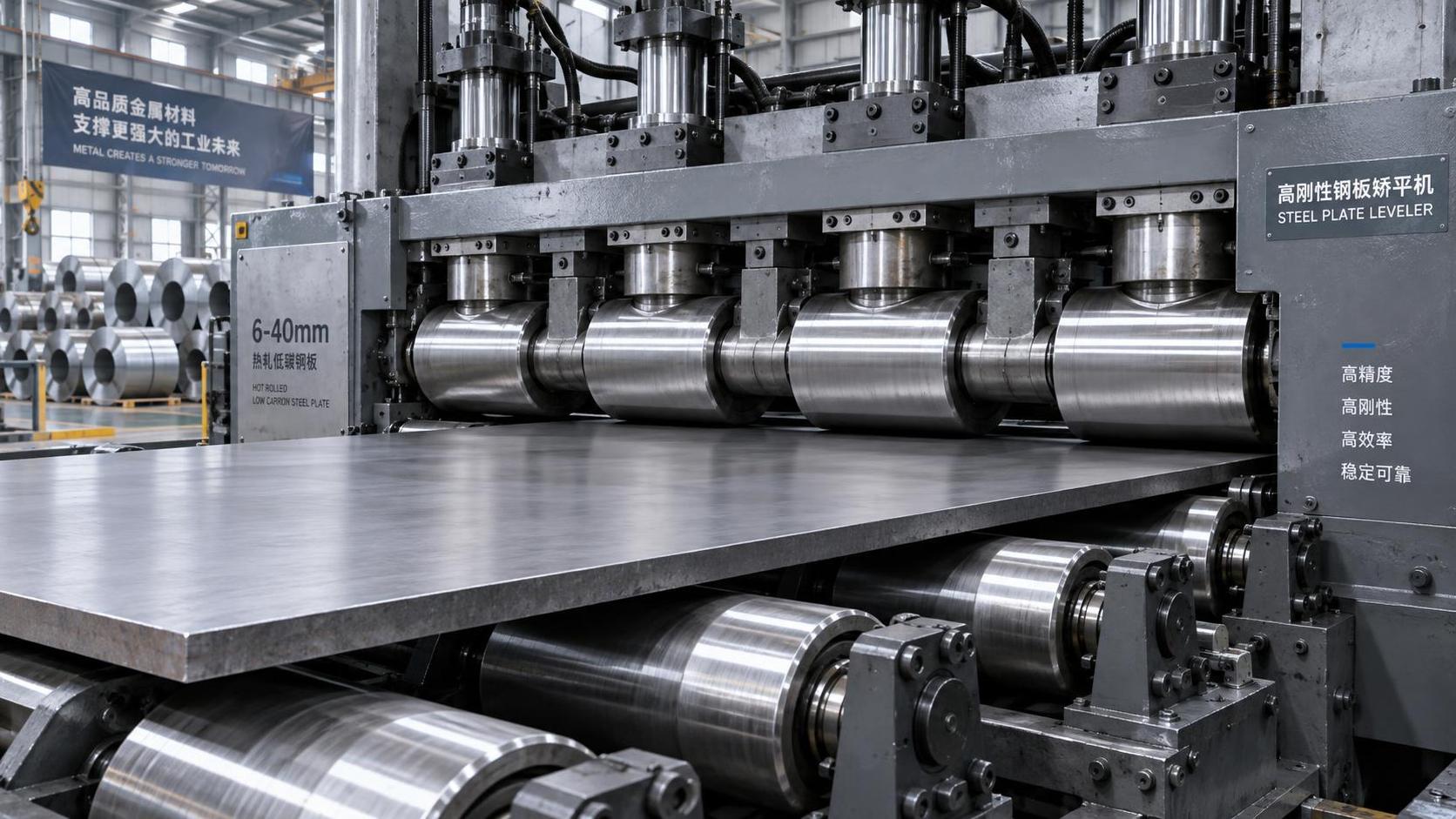
Flatness Isn’t Just a Spec — It’s the First Step in Your Plate Fabrication Workflow
If you’re evaluating plate leveling equipment for mild steel between 6mm and 40mm, you’re likely not just chasing a number on a tolerance sheet. You’re trying to prevent downstream headaches: CNC cut distortion, weld misalignment, fit-up gaps that eat up hours of manual grinding, or worse — scrapped assemblies after final inspection. That 0.3mm/m flatness spec looks clean on paper until your laser-cut part warps during heat input, or your robotic weld seam walks off course because the base plate wasn’t truly planar at loading.
Why “Standard” Levelers Struggle in This Thickness Range
Most entry-level or general-purpose levelers are optimized either for thin sheet (<6mm) or heavy structural plate (>50mm). The 6–40mm band sits in a tricky middle ground: thick enough to resist bending easily, yet thin enough to retain residual stress from hot rolling, cooling, or even handling. A machine built only for high tonnage may over-bend thinner plates (6–12mm), while one designed for light-duty precision often lacks the rigidity to correct bow or edge wave in 30–40mm stock without excessive passes or roller deflection.
We’ve seen shops default to multi-pass setups on older machines — adjusting roller gaps manually between runs, checking with straightedges, then re-running. That works, but it adds cycle time, operator dependency, and inconsistency across shifts. Worse, repeated over-correction can introduce new stresses or surface marking — especially when rollers aren’t hardened or properly aligned.
What Actually Delivers Consistency — Not Just Capacity
Consistent flatness starts with mechanical integrity, not just motor power. For 6–40mm mild steel, three things matter more than headline tonnage:
- Rigidity in the frame and roller support structure — flex under load translates directly to inconsistent pressure distribution across the width;
- Hydraulically pre-bent upper roll adjustment — critical for compensating for natural crown in long plates and avoiding center-high or edge-high profiles;
- Real-time feedback integration — not full inline metrology, but at least repeatable, calibrated roller gap positioning and load monitoring per pass.
At Wuxi Samgins, our industrial-grade leveling machines are engineered around these points — not as add-ons, but as foundational design choices. Built and tested to ISO9001 and CE standards, they’re sized and stiffened specifically for this mid-thickness range, with roller configurations validated across actual production batches — not just lab tests.
Integration Matters More Than Isolation
A leveling machine doesn’t operate in vacuum. It feeds into cutting, welding, or assembly — and those processes expose flaws the leveler missed. If your CNC plasma table is cutting parts that curl slightly after unloading, or your Bolt adjusting welding rotator shows uneven rotation due to minor plate curvature, the root cause often traces back upstream — not to the cutter or rotator, but to insufficient or inconsistent leveling.
That’s why we design our leveling solutions to interface cleanly with common workflow sequences: direct conveyor transfer to CNC tables, compatibility with automated loading arms, and alignment tolerances that match typical fixture repeatability in welding jigs. No point achieving ±0.2mm flatness if your next station introduces ±0.5mm positional variance before clamping.
Where Experience Changes the Evaluation Criteria
Technical evaluators often start with specs: roller diameter, number of rolls, maximum force, speed range. Those matter — but only after answering practical questions first:
- How wide is your most common plate width? A 2500mm-wide leveler isn’t better than a 2000mm one if your material rarely exceeds 1800mm — and the wider frame may compromise rigidity unless significantly over-engineered.
- Do you run mixed thickness batches? If yes, hydraulic pre-bending and quick-change roller sets become non-negotiable — not convenience features.
- Is your shop running two or three shifts? Then maintenance access, lubrication intervals, and operator interface simplicity matter more than peak theoretical throughput.
Our team has supported fabrication shops across Southeast Asia and Europe where uptime and repeatability trump raw speed. In those environments, a machine that delivers the same result shift after shift — with minimal recalibration — consistently outperforms one rated higher on paper but sensitive to ambient temperature drift or operator technique.
Final Note: Don’t Overlook the Human Layer
The best plate leveling equipment won’t compensate for poor material handling. Plates stored flat? Stacked with proper spacing? Loaded without twisting? These seem basic — but we’ve seen flatness gains erased by simply dragging a 30mm plate sideways across a rough floor before loading. Likewise, feeding a plate with significant edge camber into a leveler without pre-straightening can overload front rollers and skew results.
So while you evaluate technical parameters, also ask: what’s the real-world loading practice in your bay? Does your current process include visual pre-checks for obvious warp or twist? Are operators trained to recognize when a plate needs a preliminary pass before final leveling?
That context — not just the machine spec sheet — determines whether your investment delivers consistent flatness, or just another point of variability in the chain.
search
Products Navigation
Send Us A Message