




What safety certifications are required for an industrial handling robot in ISO 10218-compliant facilities?
What safety certifications are required for an industrial handling robot in ISO 10218-compliant facilities?
If you’re a quality control or safety manager overseeing automated welding or fabrication lines, you’ve likely seen this scenario: a new industrial handling robot arrives on-site—fully integrated with conveyors, grippers, and vision systems—and the plant’s safety committee pauses before commissioning it. Not because it doesn’t move precisely, but because no one has yet confirmed whether its safety architecture aligns with what ISO 10218 actually demands—not just as a label, but as a functional, verifiable system.
ISO 10218 isn’t a checklist. It’s a risk-based framework split across two parts: Part 1 covers robot design (mechanical, electrical, control architecture), while Part 2 governs integration—including how the robot interacts with people, other machines, and the environment. Compliance isn’t about ticking boxes on a datasheet. It’s about proving that every hazard—pinch points, unexpected motion, collision zones, energy isolation—has been assessed, mitigated, and validated under real operating conditions.
ISO 10218-1 and -2: Where design meets deployment
For manufacturers supplying robotic systems into EU or ISO-aligned markets, ISO 10218-1 is non-negotiable at the component level. That means the robot arm itself must meet requirements for structural integrity, emergency stop response time (<500 ms is typical), safe torque/speed monitoring, and redundant braking. But here’s where many teams stumble: ISO 10218-2 applies to *your* facility—not the robot vendor’s lab. It requires documented risk assessment (often using ISO 12100 principles), validated safeguarding (light curtains, safety mats, speed/zone monitoring), and verified interlocking between the robot and peripheral equipment—like part feeders, weld fume extractors, or gantry rails.
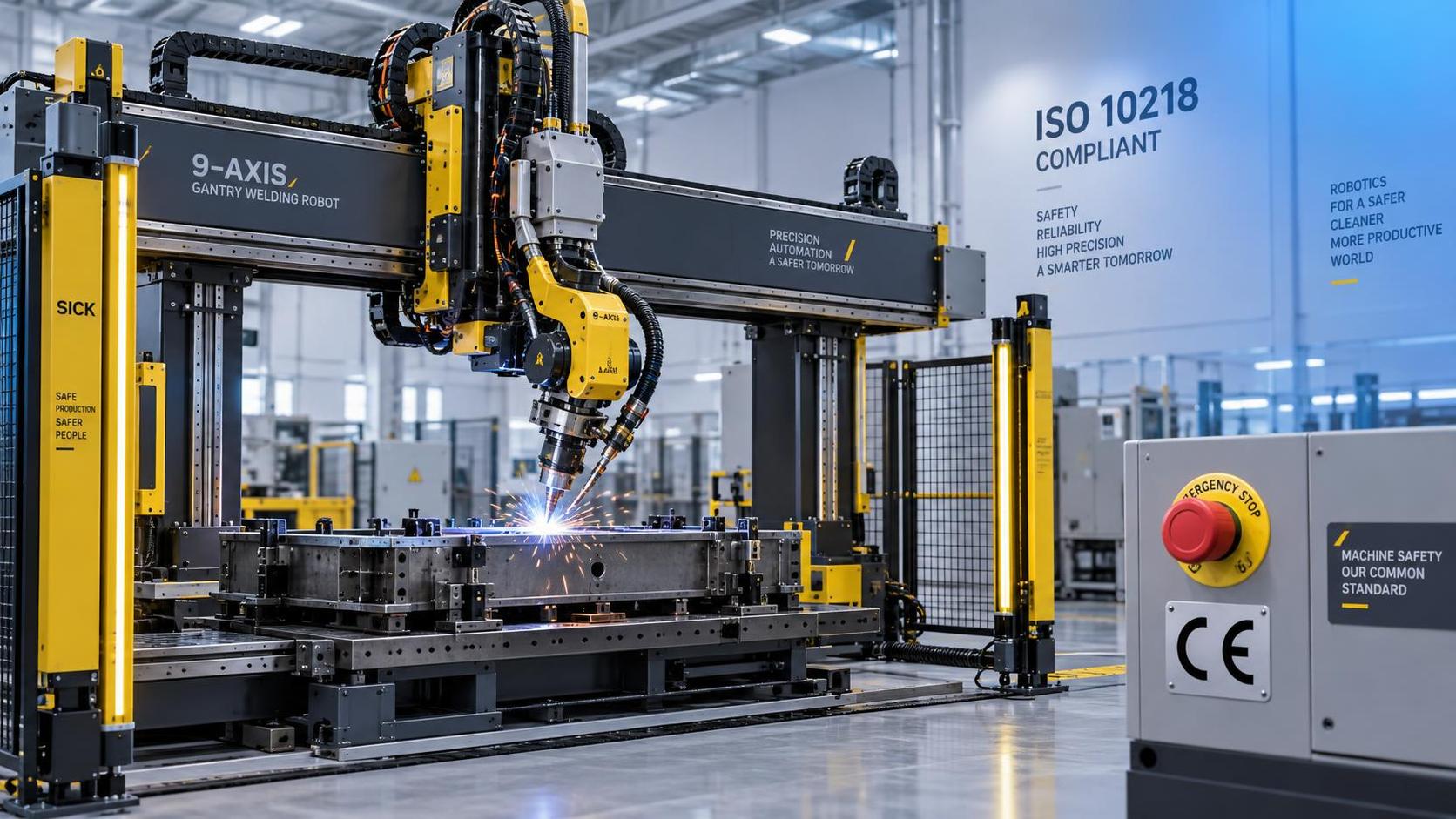
Take a large-scale automatic welding center, for example. When deploying a 9 axis gantry type welding robot, the robot’s 9-axis motion isn’t just about reach—it introduces complex overlapping hazardous zones across rail travel, slide carriage movement, and 6-axis wrist articulation. ISO 10218-2 forces you to map those zones not once, but under all operational modes: manual teach, automatic cycle, maintenance access, and even fault recovery sequences. That’s why simple perimeter fencing rarely suffices—you’ll need zone-specific speed reduction, monitored door interlocks, and often, category 3 or 4 safety-rated controllers.
The certification stack: EN ISO 13849-1 and IEC 62061
ISO 10218 sets the safety philosophy; EN ISO 13849-1 and IEC 62061 define *how* to verify it. These standards govern the performance level (PL) and safety integrity level (SIL) of your control system—especially critical when safety functions rely on programmable logic (e.g., “stop robot if light curtain is breached”). You don’t choose one over the other; they’re complementary. 13849-1 is more common in machinery with electro-mechanical safety components (like dual-channel E-stops or monitored relays), while 62061 leans into software-intensive safety PLCs and drive-integrated safety functions.
Here’s what matters in practice: Your safety-related parts of the control system (SRP/CS) must be designed, validated, and documented to achieve at least PLd (for most collaborative or high-risk handling tasks) or SIL2. That includes calculating MTTFd, DC, and CCF—and confirming those values through manufacturer data *and* field validation. We’ve seen cases where a robot’s base controller met SIL2, but the added vision-guided part positioning module hadn’t undergone separate validation—creating a silent gap in the safety chain.
CE marking: Not a stamp, but a declaration
CE marking is often mistaken for a certification. It’s not. It’s a legal declaration by the *responsible party*—usually the integrator or end-user in machine-building contexts—that the system meets all applicable EU directives, including Machinery Directive 2006/42/EC and Low Voltage Directive 2014/35/EU. For an industrial handling robot, CE marking hinges on full technical documentation: risk assessment report, circuit diagrams, safety validation records, user manuals with safety instructions, and evidence of conformity to harmonized standards like ISO 10218, EN ISO 13849-1, and EN 60204-1.
At Wuxi Samgins, every exported robotic system undergoes internal verification against these requirements before CE documentation is issued. That includes checking grounding continuity (critical for arc-welding environments), verifying emergency stop circuit resistance, and validating that indicator lights—red for fault, yellow for pause, green for run—match actual machine state without lag or ambiguity. Those three status lights on our 9 axis gantry type welding robot aren’t cosmetic—they’re part of the safety interface, tied directly to the SRP/CS and tested during final FAT.
What’s often overlooked—and why it trips up commissioning
Two things routinely delay handover: First, the assumption that “the robot came certified” absolves the site of integration-level validation. It doesn’t. Even if the robot arm carries a valid ISO 10218-1 certificate, integrating it with a servo-driven slide carriage—or linking it to a hoist for workpiece loading—creates new hazards requiring fresh risk assessment and validation.
Second, neglecting human factors in safety validation. ISO 10218-2 explicitly requires evaluating operator interaction: Can someone reach past a light curtain during setup? Does the emergency stop placement match natural reaction paths? Are alarm indicators unambiguous under factory lighting and noise? On large gantry systems, where operators walk alongside moving rails, these details determine whether a safeguard is truly effective—or just present.
Final note: Certification isn’t static
A compliant system today may not stay compliant tomorrow. Software updates, mechanical wear, reconfiguration for new parts, or even changes in production pace can alter risk profiles. ISO 10218-2 expects periodic review—especially after incidents, near misses, or major modifications. Keep your risk assessment living, not archived. And remember: compliance isn’t about avoiding liability. It’s about ensuring that when someone walks into that welding cell to load a 20-meter H-beam, they do so knowing the system’s safety boundaries are both engineered and proven—not assumed.
search
Products Navigation
Send Us A Message