




What to verify before selecting robotic welding integrators
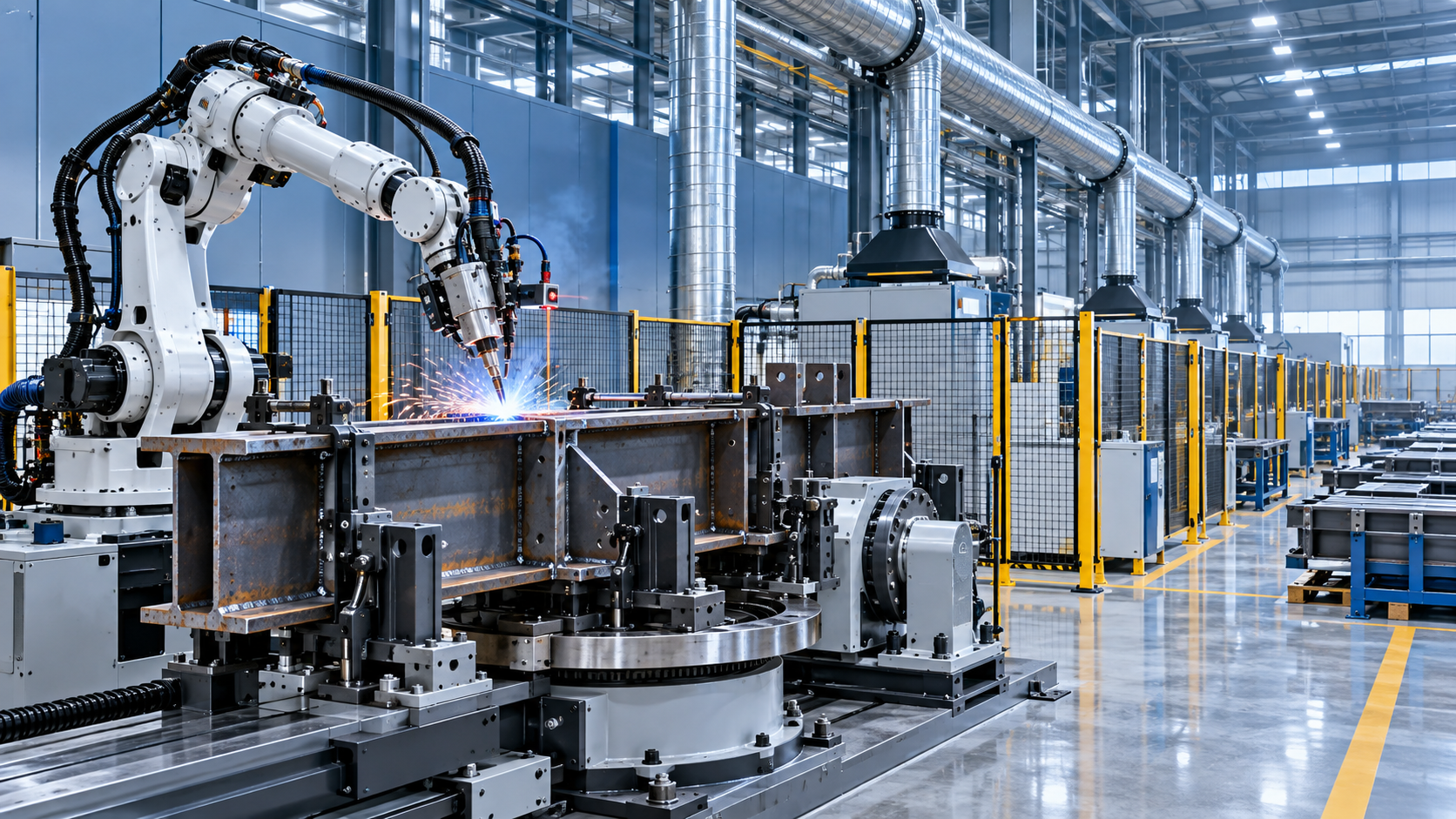
What to Verify Before Selecting Robotic Welding Integrators
Selecting a robotic welding integrator is not the same as buying a robot. The robot brand matters, but it is only one part of a working cell. The integrator decides how the workpiece is located, how weld paths are generated, how parts move through the station, how fumes are controlled, how safety is arranged, and what happens when production changes six months after commissioning.
For a project manager, the risk is rarely that the robot will not move. The risk is that the complete system will not achieve the agreed cycle time, cannot consistently accommodate normal part variation, creates rework downstream, or requires specialist intervention for every adjustment. A polished concept drawing is not proof of a production-ready solution. Before selecting robotic welding integrators, it is worth verifying the details that determine whether automation will be stable on a real shop floor.
Start with comparable application experience, not a general automation portfolio
An integrator may have installed robots for palletizing, handling, painting, or light fabrication and still be poorly suited to a demanding welding project. Welding automation is sensitive to fit-up, heat input, joint access, distortion, weld position, consumables, and the consistency of incoming parts. A cell that works well for thin sheet-metal brackets may not transfer directly to heavy structural components or long assemblies.
Ask for examples that are genuinely comparable in material type, thickness range, joint geometry, production volume, and part handling method. “Similar industry” is not enough. A fabricator producing variable, low-volume machine frames has different needs from a line producing repeated axle housings or H-beam members. The best discussions are specific: What positioning method was used? How were gaps managed? Was seam tracking required? Which weld defects caused the most trouble during trial production?
It is also useful to ask who performed the original commissioning and whether those same technical resources remain available. Some firms are strong at sales engineering but outsource much of the programming and installation work. That arrangement can work, but responsibilities should be visible before the purchase order is signed.
Verify the part assumptions behind cycle-time promises
Cycle time is often presented as a clean number, usually based on welding arc time plus a small allowance for robot movement. Real production includes loading, clamping, tack condition, part identification, torch cleaning, wire changes, inspection, unloading, rework handling, and occasional recovery from a fault. If these are not included in the calculation, the projected output may look attractive but will not be reliable for capacity planning.
Request a cycle-time breakdown rather than a single headline figure. It should separate arc-on time, robot travel, positioner rotation, loading and unloading, clamping, cleaning, and operator interaction. Where multiple part families are involved, request figures for representative easy, typical, and difficult parts. A system designed around the easiest component can become a bottleneck when the real production mix arrives.
Part variation deserves the same scrutiny. In many fabrication shops, drawings may specify dimensions tightly while actual components arrive with mill-scale differences, thermal distortion, inconsistent tack welds, or minor fixture mismatch. Robotic welding integrators should explain whether their process relies on highly controlled incoming parts, mechanical datum references, laser seam finding, touch sensing, vision systems, or manual confirmation. Each approach has cost and limitations; there is no universal “smart” solution that removes the need for sensible fabrication discipline.
Look beyond the robot to fixtures, handling, and accessibility
Fixtures are where many automation projects quietly succeed or fail. A robot repeats its programmed path very accurately, but it cannot correct a part that is poorly referenced or moves during welding. The integrator should be able to show how every critical datum is established, how clamps prevent movement without obstructing the torch, and how operators will load parts safely and consistently.
Accessibility is another practical check. A robotic cell may look compact in a layout but leave little room for torch maintenance, fixture changeover, lifting operations, or manual correction. Check access around the cell with the actual part envelope, not merely the robot reach radius. If the workpiece is long, heavy, or awkwardly balanced, the material flow before and after the cell may deserve more engineering attention than the robot itself.
For structural steel work, integrated process equipment can sometimes be a better fit than trying to make one general-purpose robot cell perform every operation. For example, an 3 in 1 H beam welding machine combines assembly, gantry welding, and straightening in one production unit. For Q235 H-beam production, its PHJ-15, PHJ-18, and PHJ-20 configurations cover web heights from 200 mm up to 2,000 mm, depending on the model. That does not make it the right answer for every factory, but it illustrates an important selection principle: choose the automation architecture around the part family and process route, rather than choosing a robot first and forcing the workflow to fit it.
Confirm welding process ownership and quality validation
A robust integrator should be prepared to discuss more than robot reach and software screens. They should understand welding sequence, torch angles, heat management, consumable selection, fume extraction, anti-spatter practices, and how the selected power source interacts with the planned joint design. If a system includes multi-pass welds or long continuous seams, distortion control and interpass process management need early attention.
Ask what evidence will be used to prove that the cell meets the agreed quality requirement. This may include sample welds, dimensional checks, visual inspection criteria, macro sections, destructive testing, or other inspection methods required by the product and applicable customer specification. The exact acceptance route depends on the project, so it should not be assumed. What matters is that the acceptance criteria are written before fabrication begins.
Be cautious when an integrator says that automation will solve poor fit-up automatically. Sensors can compensate for certain variations, but they do not remove the physics of a badly prepared joint. If parts vary widely, the project may need upstream cutting, forming, or tack-welding improvements as part of the business case. This is sometimes an uncomfortable finding, but discovering it early is much cheaper than discovering it after installation.
Check compatibility across the whole equipment package
A welding cell is a combination of robot, controller, welding power source, wire feeder, torch, safety system, positioner, PLC, extraction equipment, and sometimes marking, cutting, or inspection devices. Compatibility is not simply whether components can be electrically connected. It includes communication protocols, alarm handling, spare-parts availability, local service capability, software licenses, and whether one supplier will accept responsibility when an interface fails.
Project managers should ask for a clear responsibility matrix. Who supplies the main electrical drawings? Who owns PLC programming? Who connects the fume extraction interlock? Who confirms the foundation load for a positioner? Who is responsible for final CE documentation if the cell is delivered into a market where it is required? Vague boundaries between equipment vendors are a common source of delay during commissioning.
For projects involving equipment sourced internationally, documentation quality is especially important. Suppliers such as Wuxi Samgins International Trade Co., Ltd., which has handled automatic welding equipment, CNC machines, laser cutting machines, and H-beam production equipment for export markets, can be useful when a project needs coordinated equipment selection rather than an isolated machine purchase. Still, the buyer should verify the specific configuration, electrical requirements, documentation scope, and destination-market obligations for the actual order.
Treat safety layout as an engineering decision, not a final checklist
Robot safety is more than fencing around a moving arm. The assessment should include loading zones, rotating positioners, overhead lifting, hot workpieces, wire feed hazards, welding arc exposure, sparks, fumes, maintenance access, and recovery after a fault. A cell can be technically guarded yet still be frustrating or unsafe to operate if the operator must reach into an awkward space to clear a minor problem.
Review the operating sequence with the people who will use it. Where does the operator stand while the cell cycles? How are parts loaded when a crane is in use? Can torch cleaning be done without entering a restricted zone? What happens after an emergency stop? A credible integrator will not dismiss these questions as operational details. They shape the uptime of the system.
Audit commissioning, training, and service before discussing the final price
The handover period determines whether the equipment becomes a production asset or an expensive demonstration cell. Confirm the planned sequence for design approval, factory acceptance testing, site installation, commissioning, trial production, and final acceptance. Identify what the buyer must provide at each stage: sample parts, utilities, foundations, lifting equipment, operators, welding wire, shielding gas, and access to plant controls.
Training should distinguish between operators, maintenance technicians, welding supervisors, and programmers. Operators may only need to select a qualified program, load parts, and respond to normal alarms. Maintenance personnel need a deeper understanding of fault recovery and replacement parts. If every minor adjustment requires a remote programmer, production flexibility will be limited.
Ask direct questions about remote support, response times, recommended critical spares, and the availability of consumables such as torches, contact tips, liners, and cleaning stations. Long-term support is particularly relevant for heavy fabrication equipment with a large physical footprint. A typical integrated H-beam layout may occupy roughly 28 metres in length, so relocation or major modification is not a casual decision. Service planning should reflect that reality.
Compare proposals on risk reduction, not only purchase cost
When comparing robotic welding integrators, a lower quotation may omit fixture development, offline programming, commissioning days, sample validation, extraction interfaces, training depth, or spare parts. Conversely, an expensive proposal may include features that add complexity without solving a real production problem. The useful comparison is not “which quote has the lowest number?” but “which scope gives us the clearest path to accepted parts at the required output?”
Before award, convert the proposal into a short verification document: defined parts and materials, target output, agreed cycle-time assumptions, weld acceptance criteria, supplied interfaces, operator roles, safety responsibilities, acceptance tests, training, documentation, and support terms. If an integrator cannot make these points clear before the project begins, clarity is unlikely to improve once the equipment is on site.
The right partner is usually not the one promising the most automation. It is the one that understands where the process is variable, where the operator still adds value, and where the design must remain practical for years of production changes.
search
Products Navigation
Send Us A Message