




Why do machine loading handling robots fail more often at gripper alignment during high-speed part transfer?
Why do machine loading handling robots fail more often at gripper alignment during high-speed part transfer?
Sep 23, 2026
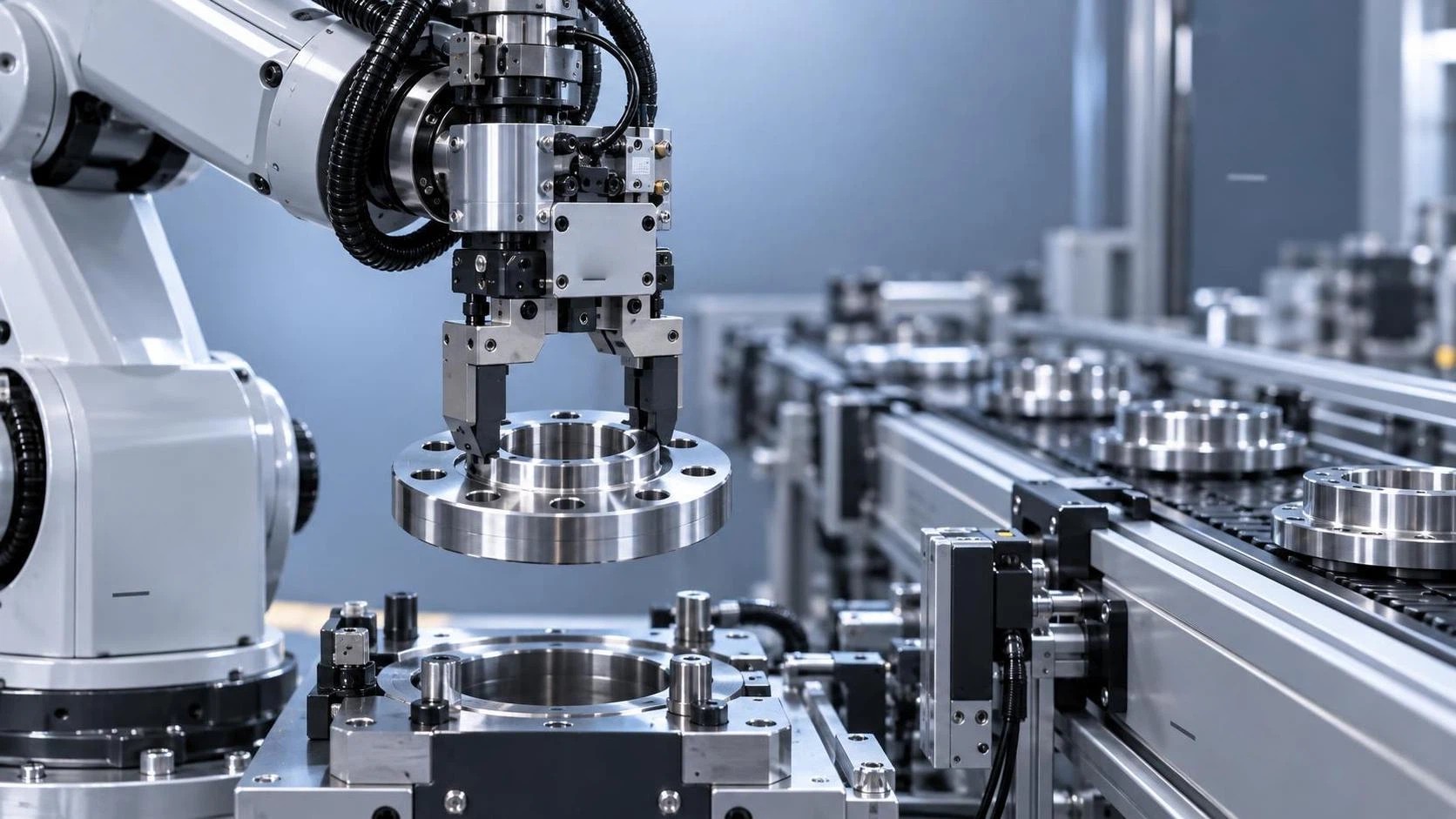
When a machine loading handling robot misses its mark—not by millimeters, but enough to drop a 45-kg flange or skew a precision-machined pipe end—the pause isn’t just operational. It’s diagnostic. For after-sales maintenance technicians walking into a humming fabrication line where cycle time is measured in tenths of a second, that misalignment isn’t noise—it’s a signal. A layered one. And it rarely stems from a single faulty sensor or worn gripper pad. More often, it’s the cumulative effect of physics, timing, and tolerance stacking—amplified precisely when speed increases.
High-speed part transfer demands synchronization across domains: mechanical, pneumatic, electrical, and algorithmic. At low speeds, small delays go unnoticed. A 12-ms encoder update lag? Barely registers. A 0.08° angular drift in joint feedback? Compensated silently by controller gain. But push feed rates beyond 0.6 m/s—and suddenly, those micro-delays compound. Gripper position no longer matches commanded pose. The robot *thinks* it’s aligned; reality says otherwise. And the part slips, jams, or—worse—contacts the fixture with lateral force, triggering emergency stops and recalibration loops that eat into scheduled uptime.
Let’s unpack why alignment fails *more often* at speed—not why it fails *in general*. Because if your team is resetting gripper offsets every shift, you’re not fighting wear. You’re chasing dynamic instability.
First, inertia doesn’t scale linearly. Acceleration profiles matter more than top speed alone. When a robot arm carrying a 30-kg steel bracket accelerates from rest to 1.2 m/s in under 180 ms, torque demand spikes. Servo motors respond—but not instantly. Backlash in harmonic drives, even sub-arcminute levels, becomes perceptible under transient load. That tiny “play” translates directly into positional uncertainty at the wrist. And at high velocity, the controller’s ability to compensate drops—not because the PID gains are wrong, but because the model assumes rigid-body dynamics. Real-world joints flex. Cables stretch. Mounting brackets deflect. These aren’t flaws—they’re physics. And they’re magnified when kinetic energy climbs.
Second, sensor latency isn’t static. Optical encoders, resolver-based feedback, and even vision-assisted alignment systems all introduce variable delay. A camera-based edge detection loop may run at 60 Hz, but image capture, processing, and pose correction add 30–50 ms—enough to misjudge a part’s location by 4–7 mm at 0.8 m/s. Worse, many OEMs calibrate these systems using static targets. No motion. No thermal drift. No vibration. In real operation, motor heat shifts encoder zero points; ambient light flicker interferes with contrast thresholds; even coolant mist on lens surfaces degrades sub-pixel edge detection. These aren’t corner-case failures—they’re daily operating conditions.
Third, pneumatic gripper response isn’t binary. It’s analog, temperature-sensitive, and pressure-dependent. At low speeds, air valves have time to fully open, chambers equalize, and fingers settle before motion begins. At high throughput, the sequence compresses: command → valve actuation → pressure build-up → finger movement → contact → grip confirmation. If supply pressure dips—even momentarily—or filter elements clog slightly (a common issue after 6–8 months of continuous use), the last 15% of stroke slows. Grip force ramps late. Alignment drifts during final approach. Technicians often replace solenoids or re-tune PLC timers—without checking regulator output stability or verifying air dryer performance.
And then there’s synchronization. Not between robot and conveyor—but between *motion planning*, *trajectory execution*, and *gripper logic*. Many legacy systems decouple gripper activation from path interpolation. The robot reaches target XYZ, then triggers grip. But at speed, the part hasn’t fully settled. Vibration from deceleration lingers. Conveyor belts oscillate microscopically. Even weld spatter on a nearby Pipe Cutting & Beveling Machine can induce resonance in adjacent frames—enough to nudge a part 0.12 mm off-center just as the gripper closes.
So what changes when you move from reactive fixes to proactive reliability?
Start with *dynamic calibration*, not static offsetting. Use laser tracker data—not just at standstill, but during actual acceleration/deceleration cycles. Map how joint deflection correlates with payload and velocity. Feed that into custom compensation tables. Don’t rely solely on factory defaults.
Audit air quality—not just pressure. Measure dew point at the valve manifold. Check for oil carryover from compressors. Replace coalescing filters quarterly, not annually. A gripper that closes 8 ms slower due to moisture-laden air isn’t “failing”—it’s starved.
Review encoder mounting integrity. Resolvers bolted directly to motor shafts survive better than those mounted via flexible couplings—especially under repeated high-torque starts. Thermal expansion mismatches between aluminum housings and steel shafts cause subtle zero-point drift over multi-shift operation. Re-torque specs matter. So does material compatibility.
And don’t overlook mechanical grounding. Ground loops between robot controllers, vision systems, and PLCs introduce subtle noise into analog feedback signals. That noise doesn’t trigger alarms—it just blurs position resolution. A 12-bit ADC reading a ±10V signal loses effective resolution when 3 mV of noise rides on the signal. At high speed, that’s the difference between repeatable alignment and consistent miss.
Wuxi Samgins has supported over 230 automated loading cells across shipyards in Busan, boiler plants in Warsaw, and pressure vessel fabricators in São Paulo. What we’ve seen isn’t inconsistency—it’s *contextual sensitivity*. A gripper that aligns flawlessly in a climate-controlled CNC cell may falter in a humid pipe beveling bay where ambient temperature swings 18°C between shifts. The same robot model behaves differently when feeding a heavy-duty non-pressure beam type line versus a standard-profile pipe line—because mass distribution, center-of-gravity shift, and fixture rigidity all change the system’s modal response.
That’s why our field engineers carry not just torque wrenches and multimeters—but portable vibration analyzers and thermal imagers. Because alignment isn’t just about geometry. It’s about energy flow. About how force transmits, dissipates, and rebounds within the entire mechanical chain.
Maintenance isn’t checklist work. It’s pattern recognition. It’s knowing that when gripper misalignment escalates *only* during morning shifts, it’s likely thermal—motor windings cold, lubricant viscous, encoder bias unstable until warmed. When it worsens after weekend shutdowns, check air system condensate traps. When it correlates with specific part geometries—say, thin-walled stainless tubes versus carbon steel flanges—that points to grip-force tuning, not hardware fault.
The goal isn’t perfect alignment. It’s *predictable* alignment. Where deviation falls within statistical control limits—and where deviations trend, not jump. Where technicians anticipate, rather than react.
Because in high-throughput manufacturing, the cost of a single misaligned transfer isn’t just the dropped part. It’s the recalibration time. The QA hold. The delayed shipment. The erosion of operator trust in automation. And that erosion—like backlash or encoder drift—accumulates slowly, invisibly, until one day, the line stops… and no one remembers when the first warning appeared.
You don’t fix high-speed gripper misalignment by tightening bolts or updating firmware. You fix it by listening—to the hum of motors, the hiss of valves, the rhythm of the line. By treating the robot not as an isolated unit, but as one node in a vibrating, breathing, thermally expanding ecosystem. That’s where reliability lives. Not in the manual. But in the margins—where physics meets practice.
search
Products Navigation
Send Us A Message