




Metal Deburring Machine Explained: Essential Methods for Precision Metal Finishing
What Is A Metal Deburring Machine?
A metal deburring machine is industrial finishing equipment designed to remove burrs, sharp edges, slag, micro-joints, and unwanted surface residue from metal parts. Burrs are raised material remnants created when a cutting tool exits a workpiece or when thermal cutting leaves resolidified material along an edge. Although they may appear minor, burrs can compromise assembly fit, coating adhesion, operator safety, sealing performance, and the usable life of a finished component.
The term covers a broad group of machines that use abrasive belts, rotating brushes, flap wheels, discs, barrels, magnetic media, or automated robotic tools. A suitable metal deburring machine does more than make a part feel smooth. It targets a specified edge condition while preserving dimensions, hole geometry, flatness, surface finish, and material properties. The required result may range from simple safe-edge treatment to controlled edge rounding before powder coating or welding.
Typical workpieces include laser-cut sheet metal, punched brackets, machined plates, stainless-steel enclosures, structural components, pipe fittings, aluminum panels, and precision hardware. Carbon steel, stainless steel, aluminum, brass, copper, and galvanized sheet each behave differently during finishing. Material hardness, thickness, protective film, heat-affected zones, and the shape of holes or slots all influence the finishing method and consumable choice.
In procurement specifications, buyers should distinguish between deburring, edge rounding, oxide removal, surface grinding, polishing, and slag removal. These processes can be combined in one production line, but they are not interchangeable. Clear acceptance criteria, such as allowable burr height, minimum edge radius, surface roughness, and treatment of both sides, provide a practical basis for selecting and validating a metal deburring machine.
How Deburring Technologies Work
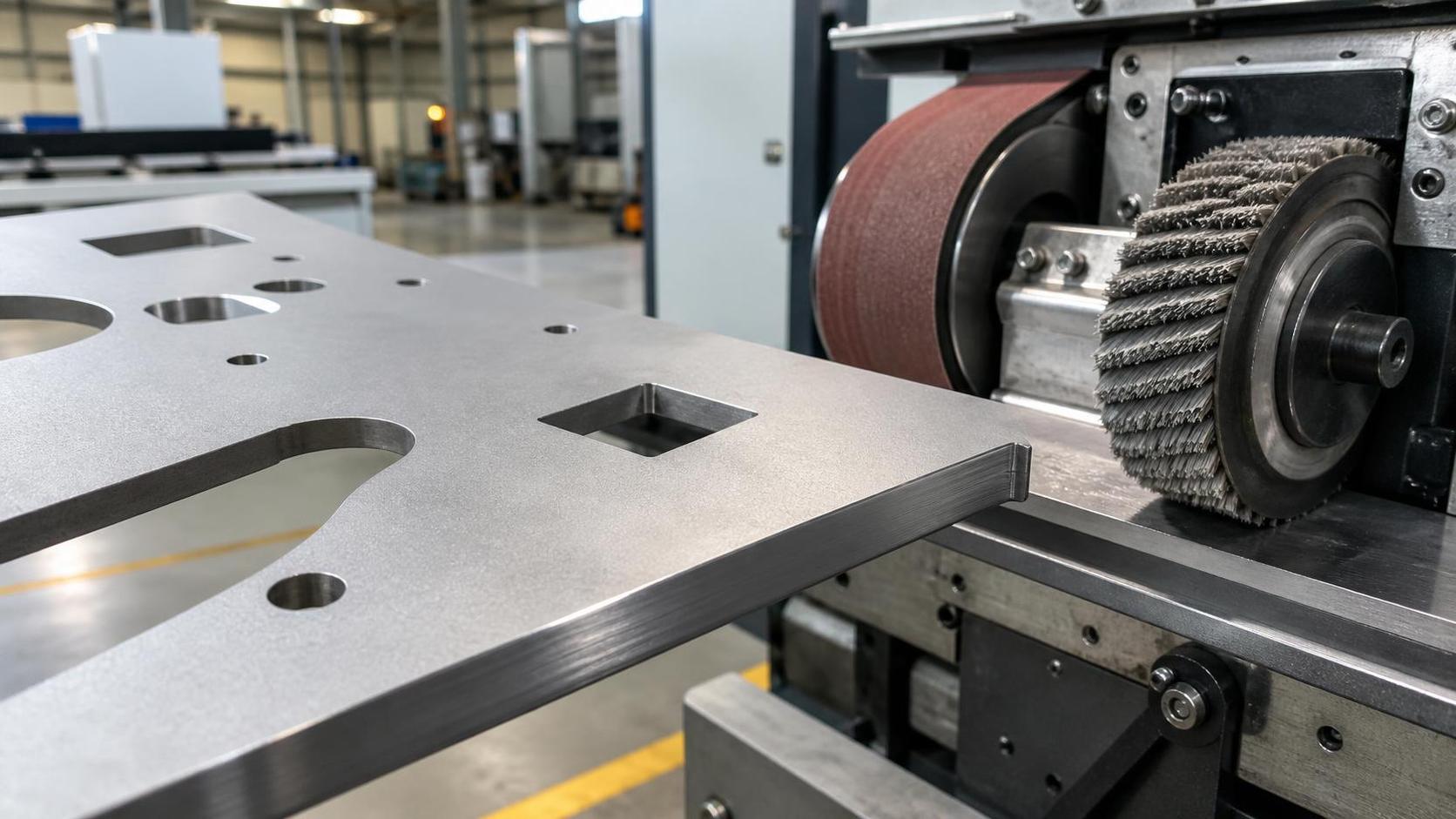
Mechanical deburring removes unwanted material through controlled contact between the part and an abrasive medium. In a wide-belt machine, a conveyor transports sheet parts beneath a grinding belt or brush head. The abrasive cuts burr peaks, while compliant brush filaments can follow external contours and internal holes. Contact pressure, belt speed, feed rate, grit size, and oscillation determine how aggressively material is removed.
Rotary brush systems are widely used where consistent edge rounding is needed on laser-cut, punched, or sheared sheet. Abrasive filaments sweep across part edges from multiple directions, reducing directional bias that can occur with a single belt. For parts with tabs, louvers, narrow slots, or numerous holes, brush stiffness and media geometry must be matched carefully so edges are treated without damaging formed features.
Thermal-cut parts often need oxide or dross removal before coating, bending, or welding. Abrasive belt stages can remove heavy slag, followed by finer belt or brush stages for edge conditioning. For small complex items, vibratory or barrel finishing can process batches through repeated contact with media and compound. Magnetic polishing machines use magnetic fields to move fine abrasive pins around small parts, reaching recesses that conventional tools may miss.
Process stability depends on correct workholding, dust extraction, machine guarding, and consumable management. Excessive pressure can round an edge beyond tolerance, introduce heat marks, or distort thin sheet. Insufficient pressure leaves burrs behind. A repeatable metal deburring machine process therefore begins with representative sample trials, documented parameters, inspection points, and a plan to compensate for normal abrasive wear.
Main Machine Types And Their Applications
Wide-belt deburring machines are common in sheet-metal workshops because they can handle large panels and provide high throughput. Configurations may include one or more abrasive belts, roller brushes, disc brushes, and vacuum workholding. They are appropriate for removing burrs from laser-cut, plasma-cut, punched, or sheared parts, and can be configured for one-side or two-side treatment according to production volume and finish requirements.
Brush deburring machines are especially useful for uniform edge breaking and radius formation. A cross-belt brush layout can address all edge directions in a single pass, which supports predictable coating coverage and safer handling. Machines designed for small parts usually require vacuum or magnetic retention; larger fabrications may need roller conveyors or custom fixtures. Buyers should verify the smallest part size and the ability to process perforated workpieces.
For machined parts, bench units, spindle-based tools, robotic cells, and CNC-integrated deburring systems may be more suitable than conveyor equipment. Robotic deburring is valuable for welded assemblies, castings, curved profiles, and mixed product families, where a programmed tool path can reach irregular edges. It requires dependable part location and appropriate sensing or fixturing to maintain consistency across batches.
Vibratory, centrifugal, and magnetic finishing systems serve different needs. Vibratory finishing handles batches of smaller stamped or machined parts, while centrifugal systems can shorten finishing cycles for selected components. Magnetic polishing is often selected for delicate, intricate pieces needing fine finishing around narrow channels. These systems require attention to media separation, compound control, drying, and the risk of part-to-part contact during batch processing.
Selection Criteria For B2B Buyers
Start selection with the incoming part condition rather than the machine brochure. Record material grade, thickness range, maximum and minimum part dimensions, cut process, burr location, oxide severity, target edge radius, surface-finish requirement, and monthly production volume. A laser-cut stainless-steel enclosure with protective film has different needs from thick plasma-cut carbon-steel brackets or precision aluminum parts with cosmetic surfaces.
Throughput should be evaluated as finished parts per shift, not merely conveyor speed. Loading time, orientation changes, double-sided processing, inspection, rework, and consumable changeovers all affect real output. Ask suppliers to process representative samples with documented settings. The trial should include difficult features such as small holes, narrow slots, sharp external corners, tabs, and parts from normal production rather than only ideal flat coupons.
Integration requirements are equally important. Consider upstream laser, plasma, punching, or shearing equipment; downstream bending, welding, cleaning, and coating operations; available floor space; electrical supply; compressed air; extraction capacity; and material handling. A metal deburring machine should fit the production sequence so parts are not repeatedly stacked, transported, or exposed to contamination after finishing.
Wuxi Samgins can support buyers whose sheet-metal finishing needs connect with broader fabrication workflows, including CNC cutting, press brakes, edge milling, welding equipment, and magnetic polishing machines. Its stated customization capability for fabrication equipment is relevant when conveyors, workholding, automation interfaces, or process sequences need adaptation. Buyers should still define acceptance samples and service responsibilities in the technical agreement before order placement.
Quality Control, Installation, And Safe Operation
An effective installation begins with a stable, level foundation and sufficient access for loading, maintenance, dust collection, and consumable replacement. Before commissioning, confirm utility specifications, extraction connection details, conveyor direction, emergency-stop access, and clearance for the largest intended parts. The installation team should document machine alignment, rotation direction, safety interlocks, and baseline process settings for each commonly produced material family.
Quality control should combine visual, tactile, and dimensional checks. Operators can inspect edge continuity, remaining burrs, oxide residue, scratches, and areas missed near holes or contours. Where a specified edge break or radius is required, use suitable gauges or measurement methods on defined sample locations. Verify that thin parts remain flat and that hole size, bend reference surfaces, and critical dimensions remain within the drawing tolerance after finishing.
Consumables are process tools, not incidental spare parts. Belt grit, brush type, filament condition, and media cleanliness directly determine finish quality. Establish replacement criteria based on output quality and operating hours, then record actual service life by material and application. This avoids the common error of extending abrasive use until defects become visible, which can create inconsistent edge conditions and unplanned rework.
Dust and fire risk require disciplined controls, especially when processing combustible metal dust. Follow the machine documentation, local workplace rules, and applicable dust-collection requirements. Operators need training on loading limits, personal protective equipment, emergency stops, lockout procedures, and inspection of guards. Wuxi Samgins states that its machines comply with its ISO9001 quality system and EU CE Machinery and LVD directives; buyers should request the machine-specific compliance documentation applicable to their destination market.
Applications, Global Requirements, And Project Experience
Metal deburring is used across contract sheet-metal fabrication, electrical cabinets, agricultural equipment, transport equipment, machinery guards, steel structures, pressure-related fabrication, food-processing equipment, and general industrial assemblies. The process is particularly valuable before powder coating, painting, galvanizing, welding, adhesive bonding, and manual assembly. Cleaner, consistently rounded edges help downstream teams handle parts safely and reduce variation caused by manual filing.
Export-oriented fabricators should align finishing requirements with the destination contract, drawing notes, customer quality plan, and local safety expectations. For projects involving tanks, pipelines, or structural fabrication, the wider production chain may also need to account for applicable codes such as ASME or API where contractually relevant. These codes do not replace a deburring specification, but they reinforce the need for traceability, controlled workmanship, and inspection records.
Wuxi Samgins lists international customers including URALSTANKOIMPORT, MD Calbah Industries Pty Ltd, Ersay International Transport, Zein Steel Industries Co. LLC, BatysMunaiGazZhabdyktary LLP, Estructuras Metalicas Girders Chile Limitada, and Lincoln Electric-MENA. These names demonstrate experience serving varied international industrial markets, but a buyer should discuss the specific material, part geometry, output target, and local installation conditions for their own project.
For laser-cut components, an early technical review is useful because cut quality sets the workload for the metal deburring machine. The related selection topic, Choosing a sheet metal deburring machine for laser-cut parts, is a practical starting point: compare laser edge condition, oxide formation, micro-joint removal, part retention, and required edge rounding. Choosing the cutting and finishing stages together often produces a more stable line than optimizing either process independently.
Total Cost Of Ownership And Future Trends
The purchase price is only one element of total cost of ownership. Buyers should include freight, installation, extraction equipment, electrical work, operator training, spare parts, abrasive consumption, energy use, cleaning compounds, maintenance labor, downtime exposure, and quality losses. Automation can add capital cost but may reduce manual handling, variation, safety exposure, and queue time. The appropriate investment depends on annual volume, product mix, labor availability, and downstream quality risk.
A practical ROI model compares current manual deburring hours, rework, rejected coatings, injury risk controls, and delivery delays with the projected finished-part capacity of the proposed system. Use conservative assumptions for consumable life and utilization. Calculate different cases for typical volume, lower demand, and peak demand. A machine with excess capability may be justified for growth, but only when its operating complexity and maintenance requirements are manageable for the plant.
Industry development is moving toward integrated fabrication cells, programmable recipes, automatic thickness compensation, condition monitoring, robotic handling, and better traceability of finishing parameters. Demand is also growing for repeatable edge rounding because coatings, automated assembly, and safety expectations expose variations that manual finishing can hide. Environmental controls, dust management, and lower-waste consumable practices are becoming more prominent selection factors.
For long-term value, specify a metal deburring machine around measurable output: accepted part condition, throughput, supported materials, consumable availability, service response, and integration interfaces. Wuxi Samgins offers a broad fabrication-machinery portfolio and states that it provides support from design and manufacturing through sales, after-sales service, and technical support. A detailed sample test and written scope remain the most reliable path to a system that performs consistently in the buyer's actual production environment.
search
Recommended Products
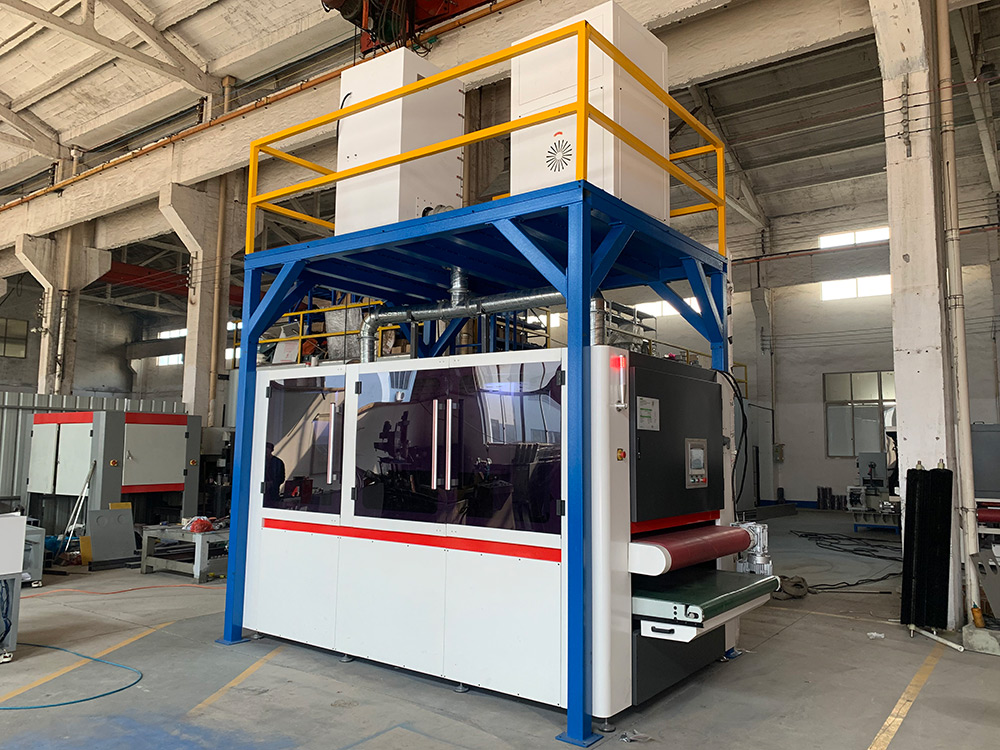
 RNS1300 Sheet metal deburring machineThis equipment features a dry sanding belt combined with four sets of universal sanding roller brushes. It is primarily designed for edge processing, hole deburring, and surface finishing of metal sheets, including drawing, descaling, and polishing. It can effectively remove burrs generated by stamping, shearing, laser cutting, plasma cutting, and flame cutting in a single pass, from all directions. As a result, all edges and holes of the workpiece achieve a smooth small R-arc finish. The entire processing procedure is safe and reliable, ensuring superior workpiece quality.
![星星1]()
- RNS1000 Sheet metal deburring machineThis equipment combines a dry sanding belt with four sets of universal sanding roller brushes. It is primarily designed for edge processing, hole deburring, and surface finishing of metal sheets, including drawing, descaling, and polishing. It effectively removes burrs generated by stamping, shearing, laser cutting, plasma cutting, and flame cutting in a single pass from all directions, delivering a smooth small R-arc finish on all edges and holes. The process is safe, reliable, and ensures superior workpiece quality.
![星星1]()
- RNS 800 Sheet metal deburring machineThis equipment combines a dry sanding belt with four sets of universal sanding roller brushes. It is primarily designed for edge processing, hole deburring, and surface finishing of metal sheets, including drawing, descaling, and polishing. It effectively removes burrs generated by stamping, shearing, laser cutting, plasma cutting, and flame cutting in a single pass from all directions, delivering a smooth small R-arc finish on all edges and holes. The process is safe, reliable, and ensures superior workpiece quality.
![星星1]()

Send Us A Message
Send us a Message
A dedicated person will follow up on your needs one-on-one and provide personalized customized solutions according
to your needs.
Get In Touch
We look forward to hearing from you for in-depth communication on how to fulfill your mixing requirements.