




cnc shear control upgrades Explained: Backgauge Accuracy and Cutting Automation
What CNC Shear Control Upgrades Actually Change
CNC shear control upgrades replace or extend the electronic systems that position a shear’s backgauge and coordinate supported cutting functions. Depending on the existing machine, the project may include a controller, operator interface, servo drive, motor, encoder, wiring, and control software. The objective is to produce repeatable cut lengths with less manual adjustment. A successful retrofit starts by separating control limitations from mechanical wear, because a new screen cannot correct loose guides, damaged screws, or an unstable machine frame.
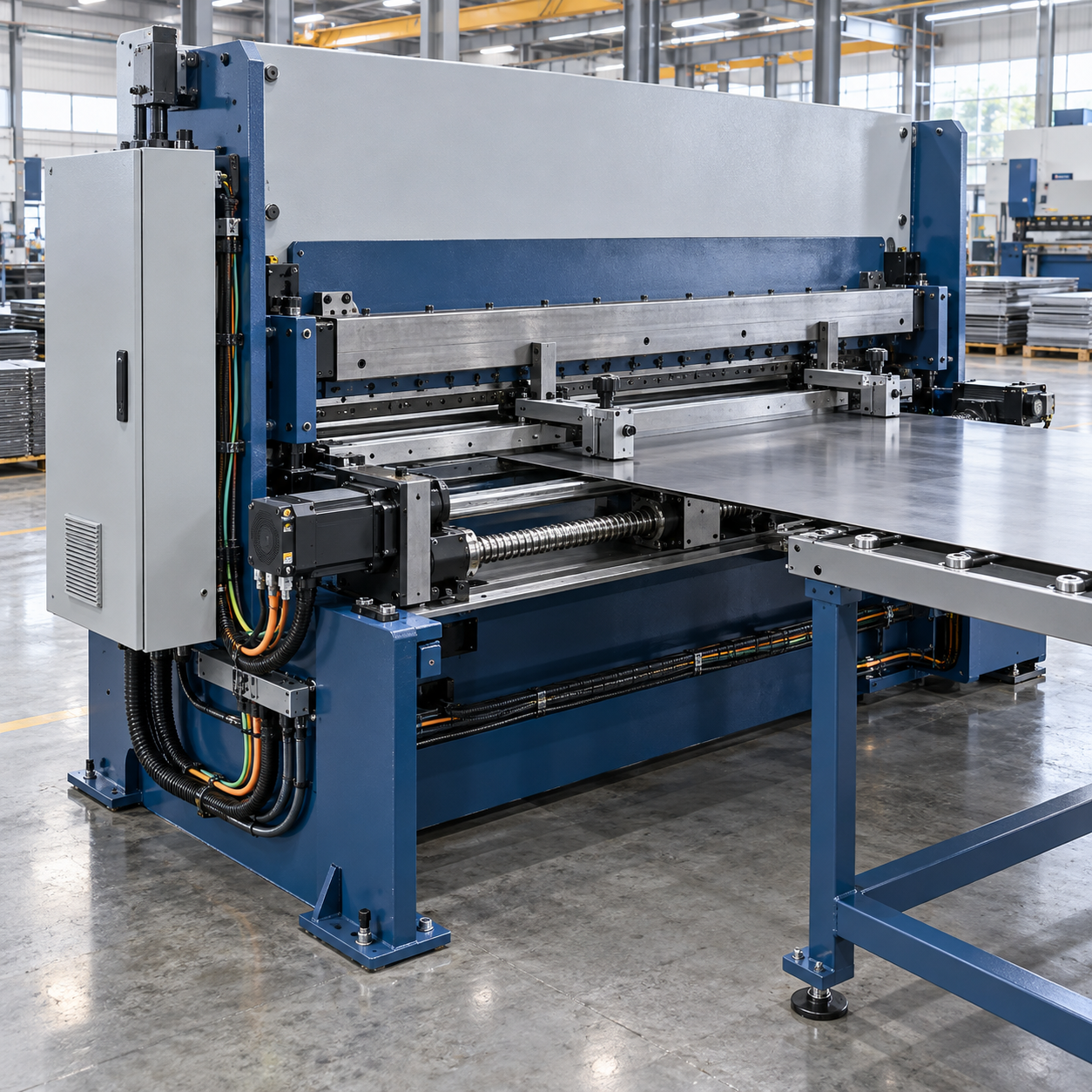
On a plate or sheet metal shear, the backgauge establishes the distance between the sheet reference position and the cutting line. Programmable positioning allows operators to store dimensions, quantities, and successive gauge movements. More capable installations can coordinate backgauge retraction, stroke settings, and other adjustable functions. These capabilities depend on installed actuators and machine design; adding a controller does not automatically make blade clearance, rake angle, or sheet support electronically adjustable.
The main upgrade categories are controller replacement, backgauge motion modernization, and broader automation integration. Controller replacement addresses obsolete interfaces or limited programming while retaining compatible drives. Motion modernization adds or replaces feedback devices, drives, and sometimes mechanical transmission components. Broader integration can connect material handling, production data, or powered adjustments. Buyers should define the required outcome before selecting the category, since unnecessary automation adds integration work without necessarily improving finished part quality.
Typical users include sheet metal subcontractors, electrical enclosure manufacturers, steel service centers, and fabrication shops preparing blanks for bending or welding. High product variety often creates a stronger case for programmable sequences than repetitive production at one fixed dimension. However, cutting capacity remains governed by the original machine’s engineering limits, material strength, blade condition, and approved operating parameters. A control retrofit must never be presented as an automatic increase in permissible material thickness or cutting force.
How Backgauge Accuracy And Cutting Automation Work
A typical positioning system converts a programmed cut length into a motion command for the backgauge. The drive moves the motor, and feedback reports motor rotation or actual linear movement. The controller compares commanded and measured position, then adjusts motion according to its control architecture. Motor encoder feedback primarily describes the motor’s position; it may not directly detect backlash or deflection downstream. A linear measuring device can observe a different part of the mechanical chain, but still requires correct installation and calibration.
Resolution, positioning accuracy, repeatability, and finished cut tolerance describe different things. Resolution is the smallest displayed or commanded increment. Positioning accuracy describes closeness to a reference position, while repeatability describes the spread of repeated moves under defined conditions. Finished cut dimensions also reflect sheet seating, squareness, hold-down behavior, material deformation, and blade geometry. Buyers should therefore reject comparisons based only on decimal places displayed on the controller and request measurements tied to representative cutting conditions.
Backlash compensation and consistent approach direction can improve positioning behavior where residual mechanical clearance exists. They cannot restore severely worn components or eliminate variable deflection under load. Backgauge beam alignment, finger condition, screw support, coupling security, and guide lubrication all influence results. Thin sheets may sag before reaching the gauge, while long or heavy plates may require suitable support. The specification should identify material sizes and handling conditions so the supplier can distinguish positioning problems from workpiece presentation problems.
Cutting automation adds repeatable operating sequences around the positioning task. A stored program may move the gauge through several dimensions, count completed cuts, and prompt the operator when a batch finishes. Where the machine supports it, gauge retraction can help accommodate sheet movement during shearing. Every sequence must respect the machine’s safety logic and operating instructions. Reduced setup time is a practical benefit, but actual throughput still depends on feeding, unloading, operator access, and material flow.
How To Select A Compatible Upgrade Package
Begin with a machine survey covering manufacturer, model, year, cutting capacity, backgauge travel, electrical supply, available drawings, and existing control components. Record the present fault symptoms and maintenance history. Photographs of the electrical cabinet and component nameplates help identify integration constraints, but an onsite inspection may still be necessary. Establish whether the mechanical assembly moves freely and holds alignment before specifying new electronics. This prevents a control quotation from becoming an incomplete solution to a mechanical problem.
Next, define requirements using actual jobs: material grades, thickness range, blank dimensions, batch sizes, dimensional tolerances, and changeover frequency. Specify how acceptance will distinguish positioning performance from cut quality. For example, a shop producing narrow strips from thin sheet has different support and handling needs from a fabricator cutting heavy plate. A practical specification also states gauge travel, required positioning speed, program storage needs, operator language, and whether existing production records must be transferred.
Electrical compatibility requires more than matching voltage. The integrator should review motor and drive characteristics, encoder signals, input and output requirements, reference sensors, travel limits, electromagnetic compatibility, and cabinet conditions. Existing hydraulic valves or powered adjustments may require additional interfaces. Establish which components remain, which are replaced, and who supplies the revised drawings. If a proposed controller relies on unsupported legacy hardware, ask how future faults will be diagnosed and which replacement components will remain obtainable.
Compare suppliers on the complete integration scope, including mechanical corrections, software configuration, safety assessment, installation, training, documentation, and support. Request a clear responsibility matrix when several contractors are involved. Define warranty coverage and exclusions in the quotation rather than relying on general promises. For cnc shear control upgrades, the most useful proposal explains how the supplier will achieve the agreed operating result on the identified machine and demonstrates a credible path for maintaining it afterward.
Industry Standards And Practical Application Planning
A shear retrofit changes part of a hazardous machine and requires a competent review of the affected functions. Common reference frameworks include ISO 12100 for risk assessment and IEC 60204-1 for machine electrical equipment. ISO 13849-1 may be relevant where safety-related control functions are designed or modified. Applicable requirements depend on jurisdiction, machine configuration, and modification scope. The responsible integrator should identify the current, applicable editions and any machine-specific requirements before work begins.
Ordinary positioning controls must not be assumed to provide safety functions. Emergency stops, guards, interlocks, restart prevention, and any protective devices require suitable architecture and validation for their intended use. A new controller or component bearing a conformity mark does not establish conformity of the complete modified machine. Buyers should obtain the required technical documentation and clarify who is responsible for assessing the modified assembly, particularly when equipment crosses borders or the retrofit substantially changes its operation.
Wuxi Samgins supplies shearing machines alongside press brakes, plate leveling machines, sheet metal deburring machines, and CNC cutting equipment. This range can support discussions about the entire blank preparation process: leveling before shearing, dimensional consistency before bending, and edge finishing afterward. The company reports using internationally recognized hydraulic, servo, and CNC component brands. Buyers should request the proposed component list and application-specific performance commitments, since the available background does not establish a universal retrofit package for every existing shear.
Wuxi Samgins also reports more than ten years of export experience, ISO 9001 quality management compliance, and machinery conformity credentials for its equipment. Procurement teams should verify the certificates, declarations, and scope relevant to the exact machine or supplied work. Its broad fabrication equipment portfolio may help evaluate whether upgrading an existing shear or purchasing a replacement better suits production needs. Named customer references should be checked for comparable work; a customer listing alone does not demonstrate a completed shear control retrofit.
Installation, Commissioning, And Quality Verification
Installation planning should establish the machine’s baseline condition before dismantling begins. Record representative cut dimensions, positioning behavior, existing faults, and relevant settings. Back up available programs and parameters, label wiring, and preserve drawings. Qualified personnel should isolate electrical and stored hydraulic or mechanical energy using the site’s established procedures. Agree on access, lifting needs, production downtime, and spare parts before installation so that missing hardware or incomplete information does not prolong the shutdown.
Mechanical preparation typically includes checking gauge beam alignment, guide condition, transmission clearance, couplings, reference switches, and travel limits. Electrical work should follow the approved design, with suitable cable routing, grounding, protection, and identification. The installer then establishes motion direction, reference position, travel boundaries, and conservative initial motion settings. Parameter changes should be documented. Tuning must suit the actual moving mass and transmission rather than copying settings from a different machine with superficially similar dimensions.
Acceptance testing should cover several gauge positions across the working travel, repeated approaches, and representative cutting tasks. Use calibrated measuring equipment appropriate to the agreed tolerances, and document material, thickness, measurement method, and test conditions. Check dimensional consistency and squareness as separate characteristics where relevant. Comparing gauge position with finished cuts helps identify whether variation originates in motion control, sheet handling, or the cutting process. Acceptance limits should be agreed before purchase, with measurement uncertainty considered where it affects the decision.
Functional verification should also include program sequencing, quantity counting, power recovery behavior, alarms, and the validated response of affected safety functions. Train operators on referencing, selecting programs, correcting dimensions, and recognizing abnormal behavior. Maintenance personnel need updated schematics, parameter backups, component identification, and recovery instructions. Final handover should record unresolved issues and responsibilities. Production release belongs after the agreed checks are completed, with a clear process for reporting faults during the initial operating period.
Total Ownership Cost And Investment Evaluation
The purchase price of a controller represents only part of the investment. Total installed cost can include drives, motors, measuring devices, mechanical repairs, cabinet changes, engineering, freight, installation, safety work, training, and acceptance testing. Production disruption may be significant if the shear serves several downstream operations. Ask suppliers to identify assumptions and exclusions explicitly, especially for concealed mechanical wear, missing drawings, travel expenses, and additional work discovered after dismantling.
Operating value usually comes from shorter setups, fewer dimensional corrections, reduced scrap, and improved equipment availability. Establish the current baseline using production records rather than optimistic estimates. Measure how frequently operators change dimensions, how much time each change takes, and which rejects genuinely result from positioning errors. An upgrade cannot claim savings from defects caused by unrelated material or tooling problems. Any increase in output also needs downstream capacity and customer demand to create realizable financial value.
A basic simple payback calculation divides the total installed investment by estimated annual net savings. Calculate net savings after added maintenance, software fees, support charges, and other recurring costs. Where labor time is released but staffing remains unchanged, assess whether that time can support additional useful production rather than treating every saved minute as a cash reduction. Use conservative, expected, and favorable scenarios to show how utilization, downtime, and product mix affect the investment case.
Compare cnc shear control upgrades with replacement when the existing machine has substantial hydraulic deterioration, structural concerns, inadequate guarding, or insufficient production capacity. A retrofit can be attractive when the machine remains mechanically sound and control obsolescence is the main constraint. Replacement may offer a clearer route when several major systems need rebuilding. Request comparable quotations with consistent assumptions about capacity, installed scope, documentation, warranty, and expected downtime so the decision reflects the complete production requirement.
Maintenance, Future Trends, And The Next Procurement Step
Maintenance intervals should follow the machine and component manufacturers’ instructions, adjusted for operating hours, dust, temperature, and production intensity. Routine attention commonly includes lubrication, cabinet cooling, cable condition, sensor mounting, and mechanical fasteners. Monitor dimensional drift and recurring positioning alarms instead of waiting for a complete failure. Recheck relevant accuracy after collisions, transmission repairs, encoder replacement, or parameter changes. Keep dated parameter backups and retain a controlled record of approved modifications.
Upgrade planning becomes timely when spare parts are difficult to obtain, failures interrupt production, manual setup dominates working time, or customer tolerances exceed demonstrated process capability. These triggers should lead to diagnosis before purchasing. Repeated size errors may arise from worn gauge fingers or poor sheet support, while intermittent faults may originate in wiring or electrical noise. Correctly identifying the failure mechanism helps determine whether a limited repair, focused motion upgrade, or complete control replacement is justified.
Future development is moving toward clearer operator interfaces, easier program management, production data connectivity, and better diagnostic access. Integration with planning systems or material handling can reduce repeated data entry where compatible interfaces exist. Connected controls also create practical responsibilities for access permissions, backups, software support, and network security. Buyers should prioritize supported functions that solve current production problems and ask how data can be exported or recovered if the original controller becomes unavailable.
To discuss a project with Wuxi Samgins, prepare the shear nameplate details, electrical drawings, cabinet photographs, current fault history, material range, and representative part requirements. Include target tolerances, batch patterns, available downtime, and destination market. Request an initial compatibility assessment covering retrofit feasibility, mechanical prerequisites, integration scope, acceptance testing, and documentation. This gives both parties a concrete basis for comparing an upgrade with a replacement shearing machine and selecting an investment suited to the production process.
search
Recommended Products
Send Us A Message
Send us a Message
A dedicated person will follow up on your needs one-on-one and provide personalized customized solutions according
to your needs.
Get In Touch
We look forward to hearing from you for in-depth communication on how to fulfill your mixing requirements.