




3-Roll and 4-Roll Bending Equipment: Which Is Better for Thick Plate Jobs?
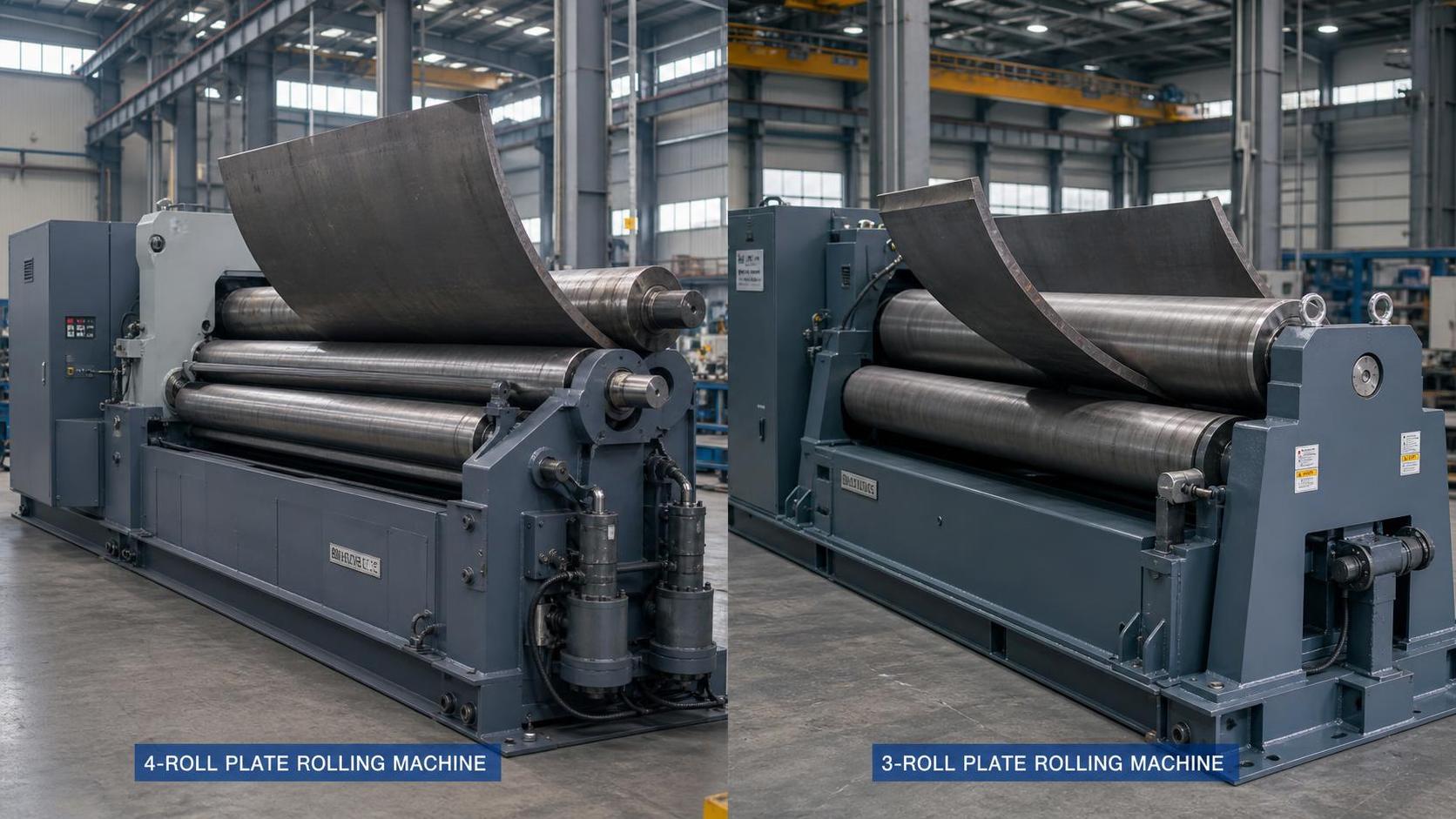
If you are comparing 3-roll and 4-roll bending equipment for thick plate work, the short answer is this: 4-roll machines are usually the better choice when you need repeatability, faster setup, and tighter control of plate positioning; 3-roll machines still make sense when your jobs are heavier on flexibility, operator experience is strong, and budget pressure is real. The right answer is rarely about “which machine is more advanced.” It is about which one fits your plate thickness range, batch pattern, edge quality requirement, and shop workflow.
That is where many evaluations go off track. People often compare bending force or machine price first, but thick plate jobs are decided just as much by pre-bending quality, plate feeding stability, rework rate, and how often the machine will be asked to switch diameters and materials.
What really changes with 3-roll and 4-roll bending equipment on thick plate jobs
On paper, both machine types can roll thick plate into cylinders or cones. In practice, they behave differently in production.
A 3-roll plate rolling machine typically uses a simpler structure. Depending on the design, you may see pyramid type or variable geometry type. For thick plates, variable geometry 3-roll systems are often the more serious option because they can generate high forming force and adapt well to demanding diameters. Shops that handle custom one-off parts or mixed geometry sometimes still prefer them for that reason.
A 4-roll machine adds a lower roll that pinches the plate while side rolls perform the bending. That extra control point matters more than many buyers expect. It keeps the plate located, reduces the chance of feeding error, and makes pre-bending more predictable. For thick material, especially when the plate is expensive and hard to rework, that control is not a small advantage.
In plain terms: a good 3-roll machine can absolutely handle thick plate, but a 4-roll machine usually makes thick plate work easier to manage.
Here is the practical decision rule many technical teams end up using: if the job mix includes repeated shell production, tighter dimensional tolerance, or less dependence on operator correction, lean toward 4-roll. If the work is more varied, the team is experienced, and you need strong forming capability without paying for every convenience feature, 3-roll may still be the better fit.
Where 4-roll equipment usually wins
The biggest advantage is not just automation. It is process stability.
With thick plate, plate handling errors become expensive quickly. A few millimeters of misalignment at feeding can turn into poor roundness, extra crane handling, or wasted time trying to correct the shell after tack welding. A 4-roll machine grips the plate more securely during the rolling cycle, so the operator spends less effort “managing” the plate and more effort controlling the result.
This matters in pressure vessel work, wind tower sections, boiler fabrication, shipbuilding components, and other heavy fabrication jobs where consistency across multiple shells is more important than getting one part done with an expert operator.
Another point evaluators often overlook: pre-bending on both ends is generally more convenient on a 4-roll machine. Residual flat ends can still exist depending on machine quality, tooling, and setup, but they are usually easier to control. If your downstream welding fit-up is sensitive, that can save more money than the purchase price difference suggests.
There is also a manpower angle. When production relies on a few highly skilled operators, the process can look efficient until those people are unavailable. A 4-roll machine tends to reduce that dependence because plate positioning and sequence control are more forgiving.
Where a 3-roll machine still makes sense
It is a mistake to treat 3-roll equipment as the weaker choice in every case. That is not how real shops operate.
For some thick plate applications, especially with large diameters, lower annual output, and experienced operators, a robust 3-roll machine is still a practical and economical solution. Many fabricators value its mechanical simplicity, easier maintenance access, and lower initial investment. If the production schedule is not dominated by frequent changeovers, some of the speed advantage of a 4-roll machine matters less.
There is also a misunderstanding in the market that “thicker plate always means 4-roll.” Not necessarily. The real question is whether the machine structure, roll diameter, drive configuration, and frame rigidity are suitable for the material and required shell geometry. A properly specified 3-roll machine can outperform an undersized or poorly configured 4-roll machine.
That is why technical evaluation should start from actual workpieces, not from machine category alone.
The thick plate details that should drive your decision
When evaluating 3-roll and 4-roll bending equipment, these are the questions that usually separate a sound purchase from a future headache.
- What is the real plate range? Not the occasional maximum thickness, but the thickness you run most often. A machine chosen around rare peak thickness may be oversized and inefficient for daily work.
- What material are you forming? Carbon steel, stainless steel, and aluminum do not behave the same way. Yield strength, springback, and surface marking sensitivity all affect the machine choice.
- How important is pre-bending quality? If your shells must minimize straight ends before fit-up, a 4-roll machine often has the advantage.
- How many diameter changes happen in a week? Frequent changeover favors easier setup and repeatability.
- How dependent is production on operator skill? If the process must be stable across shifts, the machine should absorb more of the variability.
- What happens after rolling? Welding, edge preparation, and assembly requirements should influence the decision early.
That last point deserves more attention than it usually gets. Thick plate rolling is not an isolated step. If shell edges need accurate bevels for welding, the bending decision should be considered together with edge preparation capability. In pressure vessel, boiler, chemical, and shipbuilding work, shops often need straight flanges, V grooves, K grooves, or other bevel forms before welding. In those cases, equipment such as the Non-standard Edge Milling Machine Without Pressure Beam can be a useful reference point in the process chain, especially for carbon steel, stainless steel, and aluminum plates in the 8-100 mm range where edge finish and preparation consistency affect fit-up quality. It is not a substitute for plate rolling, of course, but it shows why bending equipment should be judged as part of the whole fabrication route, not as a standalone machine.
Common buying mistakes
One of the most common mistakes is focusing on nominal capacity without checking the conditions behind it. Plate rolling machine capacity charts often depend on material strength, minimum rolling diameter, and acceptable residual straight edge. If you compare two machines only by “max thickness,” you may be comparing numbers that were reached under different assumptions.
Another mistake is underestimating handling and support. Thick plate jobs do not fail only at the roll set. Feeding tables, side supports, overhead handling, and discharge control have a direct effect on safety and accuracy. A capable rolling machine can still produce poor results if the plate enters the rolls under unstable conditions.
Then there is the software issue. On CNC-equipped machines, buyers sometimes assume the control system will compensate for weak mechanics or poor setup. It will not. CNC helps with repeatability and sequence control, but base frame rigidity, roll quality, and hydraulic stability still decide whether the machine behaves well under load.
And finally, some teams buy for the sales demo instead of the production mix. A smooth demonstration on a medium plate test piece tells you very little about how the machine will perform on your thickest plate, longest shell, or smallest required diameter.
How I would judge the machine if the job is truly heavy-duty
For serious thick plate applications, I would put the evaluation in this order:
First, confirm the machine can form your real materials and diameters with a safety margin, not just hit a maximum figure once.
Second, look closely at frame rigidity, roll structure, hydraulic response, and synchronization. Thick plate exposes weakness fast.
Third, examine pre-bending performance and roundness control on plates similar to your production work.
Fourth, check how the machine fits your labor model. If stable output depends on reducing manual correction, 4-roll usually earns its keep.
Fifth, review after-sales support and engineering communication. This matters more than many buyers want to admit. Wuxi Samgins International Trade Co.,Ltd, established in 2012 in Wuxi and supplying bending, cutting, milling, welding, and related fabrication equipment to overseas markets, is the kind of supplier profile many buyers look for when they want broader process understanding rather than a single-machine conversation. ISO9001-based production management and CE-oriented design are also worth confirming when the project involves export or stricter compliance expectations, though final technical verification should always be based on the exact model and official documentation.
If your production is repetitive, tolerance-sensitive, and scheduled tightly, I would generally favor 4-roll. If your production is varied, your team is experienced, and capital efficiency matters more than setup convenience, I would keep 3-roll in the running.
A practical answer for most technical evaluations
Many technical evaluators are really asking one question: which machine will create fewer downstream problems?
For thick plate jobs, that answer often points to 4-roll equipment because it reduces feeding uncertainty, improves pre-bending control, and supports more repeatable operation. That does not make it automatically “better.” It makes it better for shops where consistency, throughput, and lower operator dependence matter more than a lower purchase price.
3-roll machines still belong in the conversation, especially for custom fabrication, lower-volume heavy work, or buyers who know exactly how their operators and job mix behave. In the wrong hands, a cheaper machine becomes expensive very quickly. In the right application, a well-built 3-roll system can remain the smarter investment.
So when you compare 3-roll and 4-roll bending equipment, do not stop at machine type. Match the machine to your thick plate range, shell geometry, edge quality target, operator structure, and downstream welding requirements. That is usually where the correct decision becomes clear.
FAQ
Is 4-roll always more accurate than 3-roll for thick plate?
Not automatically. A well-built machine with proper setup and support can outperform a poorly specified alternative. But in normal production, 4-roll machines usually give more stable positioning and easier repeatability.
Does thick plate automatically require CNC?
No. CNC helps when you need repeat jobs, stored programs, and reduced operator variation. For lower-volume work with skilled operators, manual or simpler control systems may still be practical.
What matters more for thick plate: maximum capacity or minimum diameter?
Both matter, but many buyers overlook minimum achievable diameter under real material conditions. A machine that handles the thickness but cannot meet the diameter target is the wrong machine.
Should edge preparation be considered during bending machine selection?
Yes. If welding quality depends on controlled bevel geometry and fit-up, edge milling and rolling should be evaluated together, especially in vessel, boiler, and heavy fabrication work.
Internal Link Anchor Text Suggestions
- plate rolling machine selection guide: guide or category page
- how to choose edge milling equipment for thick plates: blog article or solution page
- pressure vessel fabrication equipment lineup: industry application page
- CNC plate bending machine vs conventional machine: comparison article
- heavy plate welding preparation solutions: technical resource page
Suggested External Source Directions
- brand official technical documentation for plate rolling machine capacity and configuration notes
- industry association materials on pressure vessel or heavy fabrication best practices
- academic or technical institute research on plate forming mechanics, springback, and rolling accuracy
search
Products Navigation
Send Us A Message