




Automated Welding Cell vs. Manual Welding: Which Delivers Better ROI for High-Mix Automotive Frame Production?
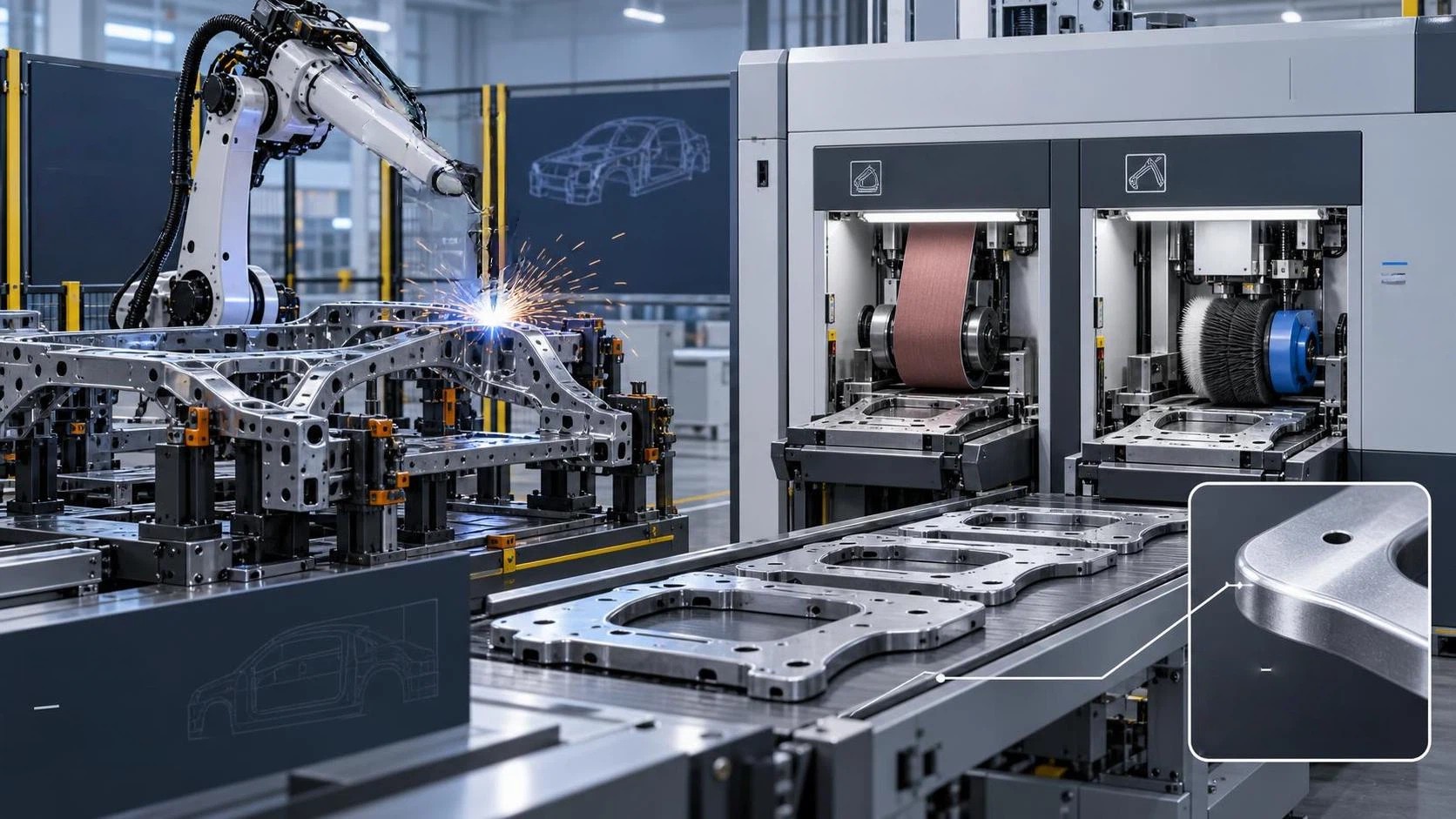
For high-mix automotive frame manufacturers, ROI isn’t determined solely by equipment acquisition cost—it’s governed by how quickly and consistently a system adapts to part variation while maintaining dimensional integrity, weld quality, and process traceability. Manual welding may appear lower in upfront investment, but its hidden costs compound across three critical dimensions: labor variability, rework latency, and changeover friction. An automated welding cell doesn’t eliminate human input; it relocates it from execution to supervision, programming, and validation—shifting labor from repetitive motion to higher-value tasks like fixture design, path optimization, and thermal distortion analysis.
Consider a typical frame family with 12 variants per model year—each differing in bracket location, tube diameter, joint geometry, and material grade (e.g., DP780 vs. HSLA450). Manual welders must interpret drawings, adjust amperage/voltage per joint, compensate for heat sink differences between thin-gauge flanges and thick-section cross-members, and visually verify penetration on each pass. That interpretation introduces variance: one operator may hold a 1.2 mm wire at 15° travel angle for a fillet on a stamped bracket; another may use 18° on the same joint due to perceived fit-up gap—resulting in inconsistent throat thickness, undercut risk, and post-weld grinding requirements. These micro-variations accumulate into measurable yield loss: industry benchmarks show manual processes average 3.2–4.7% scrap/rework in high-mix frame lines, primarily from mismatched weld profiles, porosity in multi-pass root passes, and misaligned tacks that propagate error downstream.
An automated welding cell addresses this not by replacing skill—but by codifying it. Pre-validated weld schedules, calibrated arc sensors, and real-time seam tracking (via laser vision or through-arc monitoring) ensure identical energy delivery regardless of operator shift, fatigue level, or experience tier. More critically, it decouples setup time from production volume. A manual line requires 45–60 minutes to reconfigure for a new variant: repositioning clamps, recalibrating torch angles, adjusting shielding gas flow for different joint geometries. In contrast, an integrated cell with modular fixturing and offline programming can switch between variants in under 8 minutes—retaining weld parameter history, torque logs, and thermal cycle data for each part number. This agility directly impacts throughput economics: where manual lines idle during changeovers, automated cells maintain ≥82% uptime across mixed batches.
Yet automation’s ROI hinges on upstream process stability. A welding cell cannot compensate for inconsistent part flatness, uncontrolled burr geometry, or variable edge condition. Laser-cut frame components often carry micro-burrs along cut edges—especially at corners and hole perimeters—that interfere with torch positioning, cause arc instability, and trap shielding gas. Manual deburring is subjective: operators may over-grind thin flanges, inducing dimensional drift, or skip internal holes entirely. This leads to weld spatter adhesion, incomplete fusion at critical stress points, and increased post-weld inspection time. Here, precision pre-weld surface conditioning becomes non-negotiable—not as an isolated step, but as a synchronized subsystem. The RNS 800 Sheet metal deburring machine exemplifies this integration: its dual-station architecture—abrasive belt for slag removal and macro-burr elimination, followed by counter-rotating sand roller brushes for 360° edge and hole finishing—delivers consistent R0.2–R0.5 radii across all cut edges, regardless of whether the part was processed via laser, plasma, or flame cutting. Its vacuum adsorption holds 0.5–40 mm sheets without distortion, preserving dimensional accuracy required for robotic torch path fidelity. Crucially, both stations operate independently: the belt station handles descaling and surface drawing prior to welding prep; the brush station performs final edge conditioning immediately before loading into the welding cell—ensuring no recontamination occurs.
Material behavior further narrows the decision boundary. High-strength steels used in modern frames exhibit narrow thermal windows: excessive heat input causes softening in the heat-affected zone (HAZ); insufficient input risks lack of fusion. Manual welders rely on visual cues—spark color, puddle fluidity—which vary under ambient lighting, helmet shade, and even lens cleanliness. Automated systems integrate temperature modeling with real-time current/voltage feedback, dynamically adjusting travel speed and wire feed rate to maintain peak interpass temperature within ±15°C of target. This consistency translates directly to mechanical test results: tensile strength deviation drops from ±8% (manual) to ±2.3% (automated), and fatigue life at welded joints improves by 17–22% in validated test cycles.
Maintenance economics also diverge meaningfully. Manual welding gear has low capital cost but high consumable volatility: electrode waste, shielding gas leakage, and nozzle replacement rates fluctuate with operator technique. Automated cells standardize consumable usage—wire feed precision reduces spatter by 35–40%, extending nozzle life 3× and cutting gas consumption by 12–18%. More importantly, predictive maintenance becomes actionable: vibration signatures from servo motors, arc stability metrics, and coolant flow telemetry feed into centralized diagnostics—flagging potential issues before weld quality degrades. Manual lines lack this visibility: a worn contact tip may go unnoticed until porosity appears on 3rd-shift production, triggering full batch quarantine.
The break-even point isn’t fixed—it’s conditional. For shops producing fewer than 800 frames/month with extreme variant diversity (<20 units per variant), manual welding retains flexibility advantages—if supported by rigorous operator certification, standardized work instructions, and real-time SPC tracking. But above that threshold—or when delivery windows tighten below 72 hours—the automated cell’s repeatability, reduced rework, and scalable capacity without proportional headcount growth tilt ROI decisively. It’s not about choosing automation over craft; it’s about aligning process control with the physics of high-mix frame fabrication—where every millimeter of tolerance, every joule of heat, and every second of changeover time compounds into measurable financial outcome.
search
Products Navigation
Send Us A Message