




Choosing deburring machines for sheet metal with heavy punching burrs
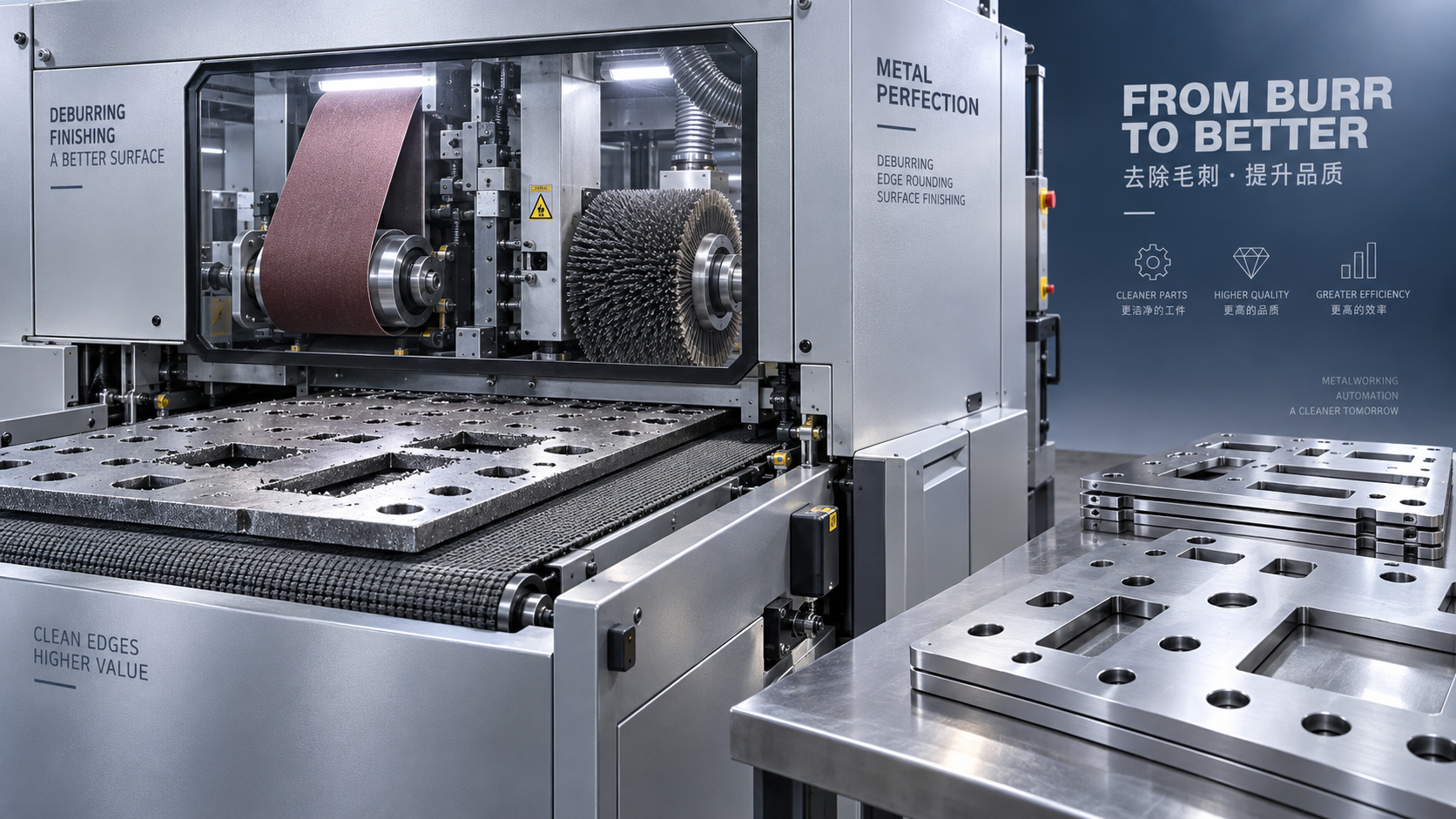
Heavy punching burrs can stop a sheet-metal job from moving smoothly into assembly: parts snag during handling, sharp projections interfere with fit-up, and manual grinding becomes a production bottleneck. When choosing deburring machines for sheet metal, prioritize verified stock-removal capacity and secure workpiece holding—not simply working width or the number of abrasive heads. A machine that rounds clean laser-cut edges may not have enough cutting action to remove thick, firmly attached punching burrs.
The practical starting point is a trial on representative punched parts. For substantial burrs, evaluate a stock-removal stage, often an abrasive belt, followed by a separate edge-finishing stage where required. Confirm that this sequence removes the burr without excessive thinning, distortion, or damage to holes and narrow features. Exceptionally large or folded burrs may require correction at the punching operation or preliminary removal before automatic finishing becomes economical.
Define the burr before comparing machines
“Heavy burr” is not a sufficient purchase specification. A tall, thin projection can behave differently from a short burr with a broad root. The thin projection may bend over instead of being removed, while the broad-rooted burr demands more grinding and can generate greater heat. Record burr height, root condition, location, and variation across the parts you actually produce.
Inspect both faces, outside edges, internal holes, slots, and areas close to formed features. Punching burrs commonly occur on the die-exit side, but part orientation and mixed operations can complicate presentation to the machine. Determine whether one-sided processing is sufficient or whether parts must be flipped or processed on both faces.
- Material and condition: Specify the alloy, thickness range, surface coating or protective film, and whether the stock is oily.
- Part geometry: Include the smallest components, narrowest webs, largest sheets, and any upward or downward formed features.
- Burr severity: Supply typical parts and the worst acceptable production condition, not only samples made with newly serviced tooling.
- Finished requirements: Define allowable residual burr, edge condition, thickness loss, flatness, and cosmetic appearance.
Tool wear, punch-to-die clearance, and alignment should also be reviewed. Deburring equipment can handle a defined incoming condition; it should not be expected to compensate indefinitely for deteriorating punching quality. Set an incoming burr limit and identify when tooling maintenance must take priority over more aggressive grinding.
Separate stock removal from edge rounding
The first operation must remove the attached burr material. The second, if required, modifies the remaining edge into a safer or more suitable profile. Treating these as separate acceptance requirements prevents a common purchasing error: accepting a rounded-looking edge that still carries folded or partially attached material.
Belt grit, abrasive type, contact arrangement, belt speed, feed speed, and grinding pressure all influence the result. A coarser abrasive may cut more aggressively but leave deeper scratches; greater pressure may increase removal while also increasing heat and dimensional risk. Ask suppliers to demonstrate a workable process window rather than one successful result obtained at an impractically slow feed rate.
Head count alone is a poor comparison measure. Several finishing brushes do not necessarily replace a capable stock-removal head. Equally, an aggressive grinding stage without suitable downstream finishing may leave an edge that is burr-free but still too sharp for handling or assembly.
Workpiece holding can determine the usable capacity
A machine may have enough abrasive power yet fail on small or irregular parts because it cannot restrain them. Heavy burr removal introduces forces that can rotate, lift, or displace a component. Thin sheets can also flex under contact pressure, producing uneven removal or leaving areas insufficiently processed.
Magnetic holding is relevant to suitable ferromagnetic materials, but it does not cover aluminum or many stainless-steel grades. Vacuum systems offer another approach, although effectiveness depends on the conveyor arrangement, available contact area, openings, leakage, and part geometry. Neither method should be accepted solely from a brochure description.
Request the minimum supported part dimensions for the proposed configuration and test the actual smallest components. Perforated sheets, narrow strips, and parts with large cutouts deserve separate trials. Where carriers or fixtures are necessary, include their loading time, maintenance, and possible interference with edge access in the quotation.
Thickness capacity also needs careful interpretation. The nominal machine opening does not establish that every part within that range can be processed successfully. Burr height, thickness variation, flatness, and formed features affect clearance and contact. Parts that rock on the conveyor or present uneven surfaces may need a different processing sequence.
Set acceptance criteria around the next operation
“Smooth to the touch” is too subjective for equipment acceptance and should not replace controlled inspection. Identify which edges need treatment and how the finished part will be checked. Relevant criteria may include residual burr height, a specified edge break or radius, permitted surface scratches, minimum remaining thickness, and hole dimensions.
Downstream needs can conflict. A coating process may benefit from softened edges, while a locating feature may require tight dimensional control. Cosmetic stainless-steel faces may not tolerate broad grinding marks. Separate functional edges from appearance-critical surfaces so the supplier can assess whether selective protection or a different process route is needed.
Do not treat deburring as a substitute for forming capability. Where later production involves bending suitable profiles or circular flanges, a Profile bender serves a separate purpose, with pre-bending, coiling, and rounding functions and horizontal or vertical operation. Its digital displacement readout supports forming control; it does not remove punching burrs. Validate deburred blanks against the requirements of the actual downstream forming equipment.
Run a trial that exposes production limitations
A supplier demonstration should reproduce the intended process, including loading, orientation, abrasive condition, and inspection. Fresh abrasives and hand-selected flat parts can make a marginal process look convincing. Ask how results change as abrasives wear and what adjustments operators must make to maintain quality.
- Prepare a representative sample set. Include different materials and thicknesses, the smallest parts, perforated geometries, and parts near the agreed incoming burr limit.
- Record the starting condition. Measure burrs and critical dimensions, identify the burr side, and document existing marks or distortion.
- Run the proposed production sequence. Record abrasive specification, feed speed, head settings, pass count, flipping, and any manual preparation.
- Inspect beyond the outside edge. Check holes, slots, corners, thickness, flatness, and cosmetic surfaces. Look for folded remnants and secondary sharp edges.
- Assess repeatability and handling. Process a sequence of parts, including material or thickness changes where relevant, and record interruptions and adjustment time.
Retain accepted samples and the associated machine settings as a reference. For important features, agree on the measuring method and inspection locations before the trial. Otherwise, buyer and supplier may reach different conclusions about the same finished part.
A useful rejection signal is removal that succeeds only after repeated passes with substantial manual intervention. That approach may suit occasional work, but it should not be quoted as straightforward continuous production. Another warning is a process that meets the burr requirement while consuming the available thickness or hole-size tolerance.
Compare cost per accepted part, not conveyor speed
Rated feed speed is only one element of throughput. Actual output includes spacing between parts, loading and unloading, turning parts over, repeat passes, abrasive changes, cleaning, inspection, and changeovers. Wide sheets may occupy the full conveyor, while small parts may require careful placement or fixtures that limit loading density.
Ask each supplier to quote against the same sample mix and quality requirements. Compare abrasive consumption, electricity, extraction or fluid-management costs, labor, and maintenance alongside purchase price. A lower-priced machine can become expensive if the heaviest burrs still require manual grinding before or after processing.
Consumables should be identified precisely enough to evaluate availability and replacement cost. Check belt sizes, brush replacement arrangements, expected adjustment procedures, and whether routine consumables are proprietary. Treat abrasive-life estimates as conditional: material, burr severity, contact pressure, and required finish all affect wear.
Resolve dry or wet processing and support before ordering
Dry processing avoids process-fluid handling but requires an extraction arrangement suited to the material and dust generated. Wet processing may help control heat and airborne dust, yet introduces filtration, fluid maintenance, drying, and material-compatibility considerations. Neither option is automatically correct for every shop.
Aluminum and other combustible metal dusts require particular care. Mixed-material processing can also create hazards that are not solved by attaching a general-purpose dust collector. Have the machine and collection-system suppliers confirm the proposed arrangement for the actual materials, including cleaning and changeover procedures. Wet systems likewise need material-specific review rather than being assumed inherently safe.
Before issuing the purchase order, confirm installation utilities, extraction or filtration scope, guarding, operator training, maintenance access, and spare-parts support. Clarify who is responsible for commissioning the complete process, especially when the machine and dust-control equipment come from different suppliers.
The final purchase specification should state the accepted incoming burr range, representative part families, finished-edge requirements, permitted dimensional change, and demonstrated production rate. Include the abrasive configuration and handling method used to achieve those results. If a proposed machine cannot meet those conditions on representative punched parts, reduce the incoming burr severity or change the process route before committing to equipment.
search
Products Navigation
Send Us A Message