




Is a Cheap 9-Axis Welding Robot Worth It? Costs, Support, and Risk Checks
The low purchase price is not the investment cost
A cheap 9-axis welding robot is worth considering only when the quoted price represents a complete, supportable production cell rather than a partially specified machine package. For capital approval, the relevant comparison is not robot price versus robot price. It is the expected lifecycle cost of producing acceptable welded parts, including integration, safety, programming, consumables, maintenance, downtime exposure, and the cost of recovering when the system fails to meet the promised cycle time.
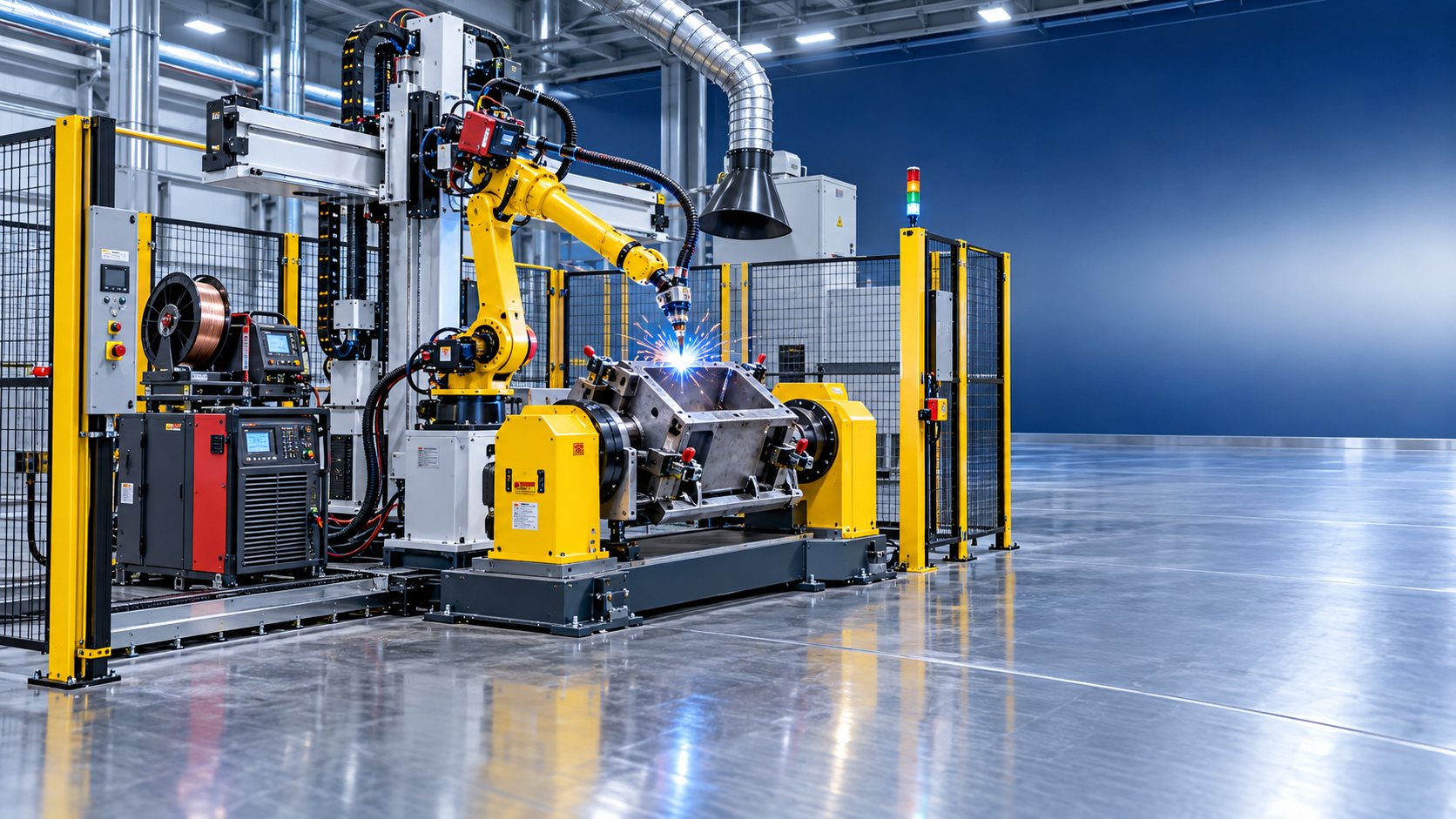
The “9-axis” description deserves particular scrutiny. In many quotations, it does not mean a nine-axis articulated robot. It often means a conventional six-axis welding robot combined with a two-axis or three-axis positioner. That configuration can be highly useful: the positioner presents more weld seams to the torch while allowing the robot to maintain favorable welding angles. But it also introduces additional drives, fixtures, safety interlocks, cabling, synchronization requirements, and fault points. A low price may reflect a simpler positioner, lighter-duty rotary axes, limited payload capacity, incomplete guarding, or an integration scope that excludes the work needed to make the cell productive.
The approval question is therefore not “Is this robot cheap?” It is “What output, risk, and support are actually included at this price?”
Separate the robot package from the operating cell
Many budget proposals appear attractive because they list the visible equipment while leaving the operating environment outside the quotation. A welding robot cannot be evaluated as an isolated capital asset. It functions within a cell containing workholding, welding power source, wire feeder, torch-cleaning equipment, fume extraction, guarding, controls, and part-handling logic. If any of these elements are weak or omitted, the purchase price understates the required capital expenditure.
A finance review should require a line-by-line scope definition covering at least:
- Robot make, model, controller version, payload, reach, and repeatability specification.
- Number and type of external axes, including positioner payload, center-of-gravity limits, rotation range, and synchronization with the robot controller.
- Welding power source brand, rated process capability, duty cycle, wire-feed configuration, and availability of local consumables.
- Fixtures, clamps, datum strategy, changeover method, and responsibility for part distortion caused by welding heat.
- Safety enclosure, access doors, interlocks, emergency stops, safety PLC or relay architecture, and installation responsibility.
- Fume extraction, electrical supply requirements, compressed-air requirements, foundations, and site modifications.
- Programming scope, sample-part trials, operator training, acceptance criteria, and commissioning support.
Without this separation, a cheap quotation can become an expensive project through “necessary extras” identified after a purchase order is issued. The cost is not only financial. Delays in fixture design, power installation, or safety validation can defer the period in which the asset begins generating useful output.
Cycle-time claims need a financial definition
A robot demonstration can show rapid movement, but robot motion time is only one component of part cycle time. The financial value of automation depends on the completed production cycle: loading, clamping, positioner rotation, arc start, welding, cleaning, inspection, unloading, and changeover. A quoted cycle time that excludes handling or manual touch-up does not provide a reliable basis for savings calculations.
For a meaningful approval model, calculate annual capacity using the expected productive hours rather than scheduled hours. Productive hours should reflect planned breaks, shift patterns, expected changeovers, maintenance, wire replacement, torch cleaning, fixture adjustments, programming refinement, and reasonable downtime allowances. The objective is not to make a conservative model look pessimistic; it is to prevent the investment case from depending on uninterrupted operation.
Part quality also belongs in the calculation. A robotic cell may reduce direct welding labor yet increase cost if poor fit-up causes frequent arc faults, inconsistent penetration, porosity, spatter, or rework. Automation repeats a stable process well; it does not correct unstable incoming parts by itself. If cut, formed, or tack-welded components vary materially, the project may require better upstream controls before the robot can deliver its intended return.
This is particularly important for fabricated assemblies where edge condition affects fit-up and weld preparation. A separate finishing process can be commercially justified when it stabilizes downstream welding rather than merely improving appearance. For example, an RNS 800 Sheet metal deburring machine is designed for deburring and edge finishing of sheet metal parts up to 800 mm wide. Its relevance to a robotic welding budget is not that every welding line needs a deburring machine; it is that burrs, slag, and uneven edges can create preventable variation in assembly, clamping, and joint presentation. Upstream preparation should be treated as part of the process-risk review when the parts require it.
The main saving may be labor stability, not labor elimination
Labor savings are often the largest number in a robot business case and the least carefully defined. The correct comparison is not necessarily one robot replacing a fixed number of welders. A robotic cell still requires people to load parts, inspect welds, replenish wire and gas, manage changes, and respond to faults. In a high-mix environment, skilled labor may shift from continuous manual welding to setup, fit-up correction, programming, and quality control.
The economic benefit can still be substantial where the cell converts scarce skilled welding time into more predictable throughput or protects delivery performance. Yet the payroll effect depends on whether labor hours can actually be redeployed, reduced, or used to remove a production bottleneck. If staffing remains unchanged and manual work continues alongside the cell, treating all theoretical welding minutes as cash savings will overstate payback.
A more defensible model distinguishes between:
- Cash-releasing savings: overtime avoided, temporary labor reduced, outsourced welding brought in-house, scrap reduced, or additional output sold with no equivalent labor increase.
- Capacity value: skilled welders reassigned to tasks that constrain output or quality, without an immediate payroll reduction.
- Risk reduction: reduced dependence on a small number of difficult-to-replace operators, provided the organization retains programming and maintenance capability.
These categories should not be blended into one optimistic hourly rate. A capital project can be strategically sound with modest direct labor savings, but its approval case should state where value is expected to appear.
Support capacity determines whether a low-cost system remains low-cost
The most material hidden exposure in lower-priced imported automation is often not mechanical failure. It is the time required to diagnose and recover from a fault when documentation, spare parts, software access, or competent support are unavailable. A cell stopped for several days during a production peak can erase a meaningful portion of the apparent purchase-price advantage.
Support should be assessed as an operating capability, not as a vague warranty statement. A supplier should be able to identify who provides remote diagnosis, which language is used for technical communication, what response arrangement applies, whether controller backups are supplied, and how software licenses are transferred or maintained. The contract should distinguish between warranty coverage for defective equipment and paid technical support for process changes, collision recovery, programming modifications, and operator errors.
Spare-parts risk needs similar specificity. Request a recommended critical-spares list with part numbers, estimated lead times, and unit prices. Typical exposure points include torch necks, liners, contact tips, wire feeders, cables, drive components, safety devices, controller electronics, and positioner components. Some items are inexpensive but production-critical; others have high value and long lead times. The appropriate inventory policy depends on the cost of an outage, not simply on the price of a spare.
There is also a difference between a robot based on globally supported components and a cell assembled around proprietary interfaces. A lower initial price may be reasonable if the control system, welding source, and motion components can be serviced in the destination market. It is considerably harder to justify if restoring operation depends on one overseas supplier and undocumented settings.
Compliance cannot be treated as a paperwork add-on
Welding cells combine moving machinery, arc radiation, hot workpieces, electrical energy, welding fumes, and pinch points created by positioners and fixtures. Safety engineering affects both installation cost and the ability to operate legally and reliably in the destination location.
Where equipment is placed on the EU market, CE marking is relevant only when the applicable conformity requirements have been met. It should not be accepted as a generic quality claim. A CE label alone does not establish that the delivered cell is correctly documented, risk assessed, wired, guarded, and configured for its final installation. The approval file should request the Declaration of Conformity where applicable, technical documentation, electrical diagrams, safety-circuit information, manuals, and clear identification of the entity responsible for final cell compliance.
Risk assessment principles associated with ISO 12100 and industrial robot safety requirements associated with ISO 10218 can provide useful reference points. Functional safety design may also require consideration of standards such as ISO 13849, depending on the installation and applicable legal framework. Local regulations, insurance requirements, and customer audit conditions can impose additional obligations. The decisive issue is not collecting standard numbers in a quotation; it is confirming that the delivered safeguards match the actual hazards of loading, positioner movement, maintenance, and fault recovery.
A low-cost system that later requires new fencing, upgraded interlocks, electrical rework, or external safety validation is no longer a low-cost system. These items should be budgeted before approval, not classified as unforeseen commissioning costs.
Acceptance criteria should protect the investment before shipment
Factory acceptance testing is one of the strongest controls available to a buyer, particularly when the supplier and installation site are separated by national borders. The test should use representative parts, material thicknesses, joint types, and tolerances rather than a simple demonstration coupon. If production parts cannot be sent to the supplier, the limits of the substitute test should be stated explicitly.
Commercially useful acceptance criteria may include the agreed weld sequence, target cycle time with defined inclusions and exclusions, dimensional condition after welding, visual weld-quality requirements, repeatability across multiple cycles, positioner function, safety-device operation, controller backup delivery, and confirmation that documentation matches the supplied equipment. Destructive testing or non-destructive examination should be specified only where the product and applicable quality requirements justify it.
Payment milestones should align with evidence of performance. Paying nearly all value before factory acceptance and shipment transfers excessive execution risk to the buyer. Retaining a defined portion through site acceptance gives both parties a practical reason to resolve installation and performance issues promptly. The contract should also establish who bears the cost of rework when delivered performance differs from agreed specifications.
When the cheap option can be rational
A lower-priced 9-axis cell can be a rational purchase where the parts are repetitive, fixture requirements are understood, the welding procedure is stable, output demand is sufficient, and the supplier can demonstrate technical support and spare-parts access. It can also be appropriate where the buyer has in-house automation competence and can manage programming, diagnostics, and process improvement without depending heavily on the equipment vendor.
The risk rises sharply when the project combines high product variation, uncertain part fit-up, demanding quality requirements, no local technical support, and an aggressive payback assumption. In that situation, the lowest bid may be less a cost advantage than a transfer of integration risk from the supplier to the purchaser.
The most credible approval case shows the full installed cost, models output using realistic productive time, separates cash savings from capacity benefits, assigns a value to downtime exposure, and documents how support and compliance will be secured. If the lower-priced supplier remains competitive after those checks, the decision is based on value rather than on an incomplete headline price.
search
Products Navigation
Send Us A Message