




Key Specifications to Review Before Buying a Swing Beam CNC Hydraulic Shearing Machine
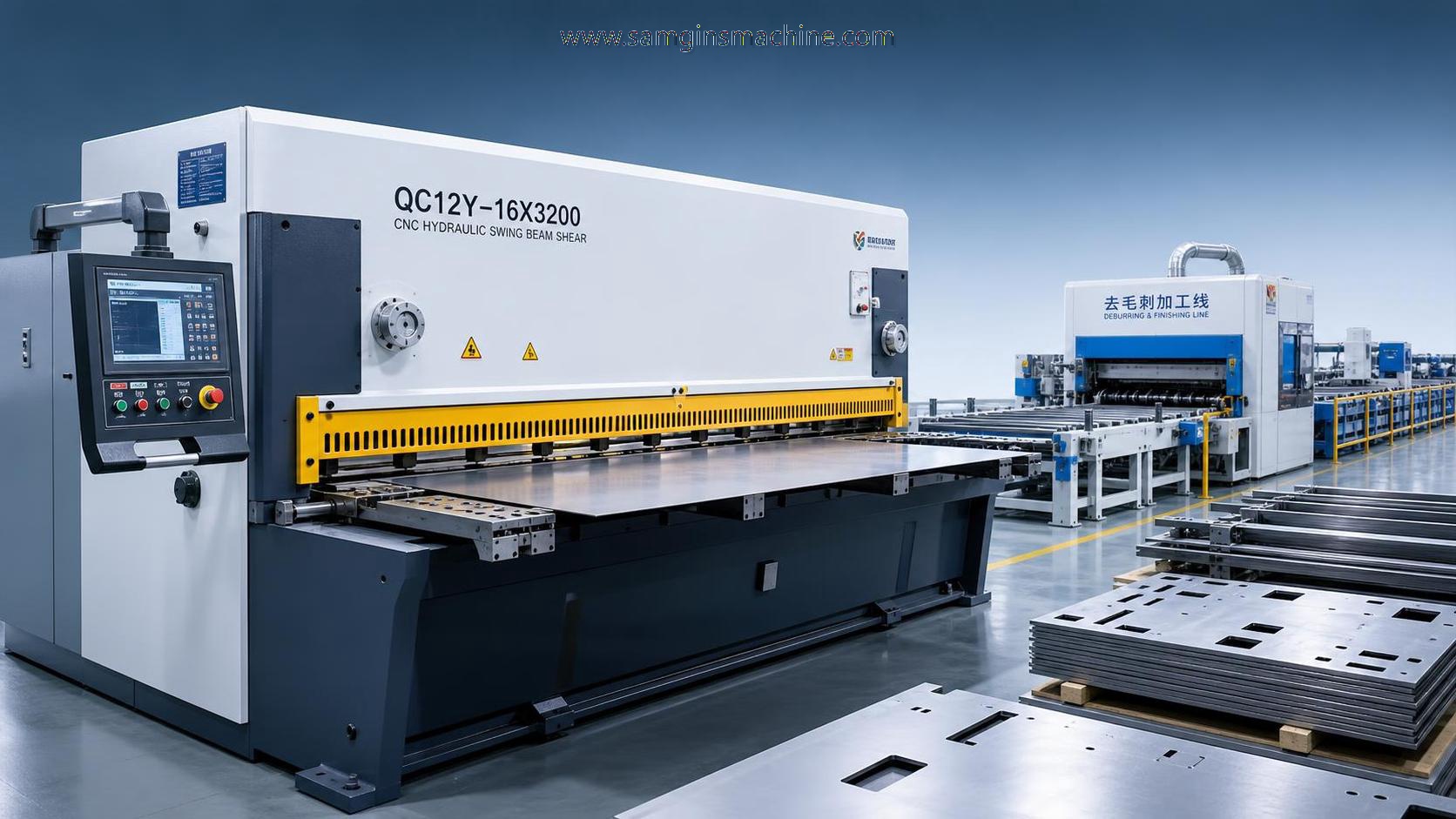
What should be checked first in a swing beam CNC hydraulic shearing machine?
A swing beam CNC hydraulic shearing machine is often judged by price first. In practice, that is rarely the safest starting point.
The better question is whether the machine matches the real cutting workload. Capacity, control stability, blade life, and service access will shape cost far more than the initial quotation.
For sheet metal processing, even small specification gaps can lead to edge deformation, poor repeatability, or excessive downtime. Those problems become expensive once production starts.
A reliable purchase review usually begins with four basics: material range, cutting length, backgauge performance, and hydraulic system quality. Everything else should be measured against those points.
This matters even more when production lines must work with downstream equipment. Wuxi Samgins International Trade Co.,Ltd has supplied shearing, bending, cutting, and finishing equipment to multiple overseas markets, so line compatibility is not a minor issue but a practical buying condition.
How do you know if the cutting capacity is really suitable?
Rated capacity on a brochure can look impressive, but it only helps when it reflects the actual material being processed every day.
Start with sheet type, thickness range, tensile strength, and maximum width. Mild steel, stainless steel, and aluminum do not place the same load on a swing beam CNC hydraulic shearing machine.
A machine rated for 6 mm mild steel may not deliver the same performance on stainless steel at similar thickness. That is where buyers often underestimate the difference.
It is also worth checking whether most jobs run near the machine limit. If they do, blade wear and hydraulic stress will rise faster than expected.
- Confirm maximum cutting thickness by material grade, not by one general number.
- Review effective cutting length against the largest sheet format in regular use.
- Ask whether the quoted performance is continuous-duty or occasional-duty.
- Check if overload protection and pressure stability are included.
In real workshops, a moderate reserve is usually better than running at the upper limit. That gives cleaner cuts and more predictable maintenance intervals.
Which control and accuracy specifications deserve the closest attention?
Many buyers focus on tonnage and frame size, but day-to-day performance often depends more on control details.
The CNC system should allow simple programming, repeatable backgauge positioning, and quick adjustment for different batch sizes. If setup is slow, the machine becomes less productive even when cutting speed is acceptable.
Backgauge travel and positioning accuracy matter a great deal. When small parts or repeat jobs are common, inconsistent gauge movement will create scrap faster than most teams expect.
Blade clearance adjustment is another point that deserves attention. Manual adjustment may be acceptable for stable, repetitive production. Frequent material changes usually benefit from easier, more precise adjustment.
Look carefully at these items when comparing one swing beam CNC hydraulic shearing machine with another:
If the machine will feed a bending or welding line, repeatability matters more than peak speed. Stable dimensions help the entire production flow.
Is cut quality only about the shear itself?
Not really. The shear determines the cut, but the finished part quality depends on what happens before and after the blade passes.
A swing beam CNC hydraulic shearing machine with solid frame rigidity and good blade geometry can reduce twist, burrs, and edge defects. Still, some materials and thicknesses will need post-processing.
That is why line planning matters. In many sheet metal operations, deburring is not an optional extra. It protects downstream bending accuracy, coating quality, and handling safety.
For example, after shearing, some producers pair the process with RNS 800 Sheet metal deburring machine when edges, holes, and surface finish require cleaner consistency.
Its pass-through design supports deburring from shearing, laser, plasma, and flame cutting, while preserving workpiece dimensions. That makes sense where the shear is only one step in a tighter production chain.
So when evaluating a machine, ask not only, “Can it cut?” but also, “What part quality will the next process receive?”
What are the common buying mistakes that raise operating cost later?
The most common mistake is buying to the maximum advertised specification instead of the actual production mix.
An oversized swing beam CNC hydraulic shearing machine can mean higher power use, more floor space, and unnecessary capital cost. An undersized one creates even bigger losses through scrap and maintenance stress.
Another mistake is ignoring serviceability. Blade replacement, hydraulic seal access, lubrication points, and spare part availability all affect uptime.
Imported components can be an advantage, but only when replacement lead time is realistic. A premium brand part is not helpful if production stops for weeks.
There is also a hidden cost in poor dust and edge control across the line. If burr removal becomes manual, labor and quality variation rise quickly. In those cases, equipment such as the RNS 800 can reduce rework, especially for metal sheets from 0.5 mm to 40 mm with mixed edge-finishing needs.
- Do not compare only machine price. Compare blade cost, energy use, and maintenance hours.
- Do not assume all CNC controls are equal. Ease of setup affects every batch change.
- Do not skip trial-cut evidence, especially for stainless steel or high-mix production.
- Do not treat safety devices as optional details. They directly affect stable operation.
How should cost, delivery, and compliance be judged together?
A low quotation can lose its advantage once installation, tooling, training, and spare parts are added. Total ownership cost is the more useful comparison.
Delivery time should also be checked carefully. Standard models may ship faster, but optional controllers, custom throat depth, or special voltage can extend the schedule.
Compliance matters when the machine is entering regulated markets or audited production sites. ISO9001-managed production and EU CE-oriented design are practical indicators because they affect documentation, traceability, and acceptance.
Suppliers with broader metalworking equipment experience can also be easier to work with. When the same source understands shearing, bending, deburring, and cutting processes together, specification discussions tend to be more accurate.
What is a practical way to make the final decision?
The most practical method is to compare machines against real production data, not against catalog language.
Prepare a short requirement sheet with material types, thickness distribution, largest sheet size, monthly output, accuracy expectations, and downstream finishing needs.
Then ask each supplier to respond to the same list. That makes differences in the swing beam CNC hydraulic shearing machine offer much easier to see.
A good final review usually includes these checks:
- Trial-cut results on your typical material.
- Backgauge and controller demonstration.
- Maintenance access review.
- Lead time for wear parts and hydraulic components.
- Assessment of whether post-shear deburring is needed.
In short, the right machine is not the one with the longest parameter list. It is the one that fits the material, the workflow, and the real cost target over time.
When reviewing a swing beam CNC hydraulic shearing machine, focus on capacity truth, control accuracy, service practicality, and line integration. That is usually enough to separate a usable investment from an expensive mismatch.
search
Products Navigation
Send Us A Message