




What Can a Robotic Handling Arm Automate in High-Mix Manufacturing Lines?
What Can a Robotic Handling Arm Automate in High-Mix Manufacturing Lines?
In high-mix manufacturing, automation is rarely a simple matter of replacing one operator with one machine. Product sizes change, routings change, fixture positions change, and batch quantities may range from a single urgent part to a repeat order that runs for several days. For project leaders, the real question is not whether a robotic handling arm can move a part. It is whether it can keep moving the right part, to the right process, with enough flexibility to avoid becoming another production bottleneck.
A well-designed robotic handling system can automate loading, unloading, orientation, sorting, buffering, transfer between stations, and machine tending. It can also support inspection handoffs and pallet movement when those tasks are repeatable enough to define. In machining, welding, cutting, and sheet metal fabrication, the greatest return often comes from removing the waiting time around the core process rather than trying to automate every human decision on the shop floor.
That distinction matters. A robotic handling arm works best when it is designed around material flow, part variation, and recovery from normal production interruptions. It works poorly when it is expected to compensate for unstable upstream quality, unclear work instructions, or fixtures that change without being documented.
Where Handling Automation Usually Starts
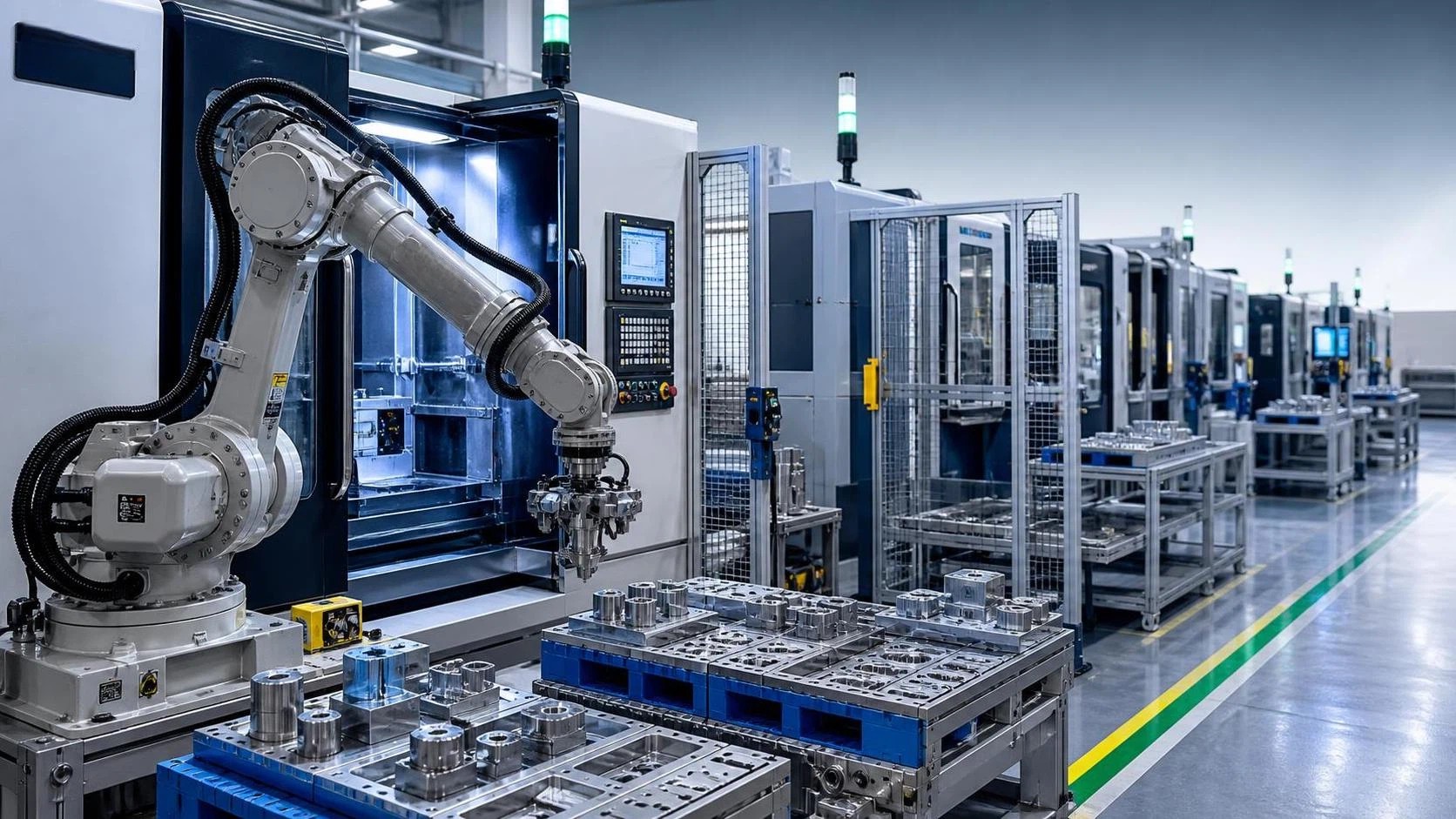
The first automation target is often manual machine tending. CNC lathes, machining centers, face milling machines, laser cutting cells, and welding stations commonly require operators to stand nearby for repetitive loading and unloading. The machining cycle may be automated, but the spindle stops whenever no one is available to exchange the workpiece. A robot can take over that repetitive handoff while operators focus on setup, first-piece checks, tool management, exception handling, and process improvement.
In a high-mix setting, machine tending does not necessarily mean fully unattended production. A practical goal may be to maintain stable operation through breaks, cover shifts with limited staffing, or reduce the number of manual touches between operations. Even a cell that requires an operator at changeover can be worthwhile if it removes repeated lifting, awkward reaching, and the risk of loading the wrong face or the wrong part orientation.
Common handling tasks include:
- Picking blanks from a rack, pallet, conveyor, or gravity-fed magazine;
- Opening and closing a machine door where required by the cell design;
- Loading parts into a chuck, fixture, welding positioner, or workholding nest;
- Removing completed parts and placing them in a finished-goods rack;
- Separating acceptable parts from pieces awaiting inspection or rework;
- Transferring semi-finished workpieces between cutting, milling, welding, deburring, and marking operations;
- Turning or reorienting parts so the next operation can be performed on the correct surface.
The automation boundary should be chosen carefully. For example, if parts arrive in random orientations with inconsistent surface condition, a robot may need vision guidance, locating features, or a standard presentation tray. If those additions are more complicated than the task itself, it may be better to automate only the machine-side transfer and retain manual preparation upstream.
Automation Opportunities Across Fabrication and Machining
Different process families create different handling challenges. Sheet metal parts may be thin, sharp-edged, oily, or prone to sticking together. Machined components may be heavy and require accurate placement in a fixture. Structural steel members create another set of issues: long dimensions, variable straightness, weld spatter, and the need to support the part safely throughout transfer.
For CNC machining cells, a robotic handling arm can load raw stock and unload finished components, then place them into separate trays based on program, part family, or inspection status. If multiple jobs share a machine, the cell should use identifiable pallets, controlled fixture locations, and clear program-to-part logic. The robot itself does not solve job traceability; it must receive reliable signals from the machine control, barcode system, operator interface, or production management process.
In robotic welding lines, handling automation can stage components, present them to a positioner, remove welded assemblies, and transfer them to cooling, grinding, or inspection. The benefit is especially clear when manual loading exposes workers to heat, sharp edges, or repetitive lifting. Yet welding distortion must be considered early. A gripper designed around nominal dimensions may fail when heat input changes part geometry beyond the allowable pickup range.
Laser cutting and deburring lines often benefit from automated sheet or part transfer, but the highest-value application may be downstream sorting. Cut parts that look similar can be routed to different bending, welding, or assembly operations. A robot can separate them according to nesting data or identification rules, provided the material presentation and part separation method are dependable.
For beam and column fabrication, handling may involve loading components for end processing, moving workpieces between stations, or supporting material flow around long-cycle equipment. A face milling application illustrates why the process machine and the handling concept should be considered together. Equipment such as a CNC Face milling machine can process H-beams, box columns, cross beams, flanges, molds, and related workpieces, with some configurations offering a maximum processing range of 2500 mm × 2000 mm. Its stored parameter sets can support quicker job changeover, but material handling still needs to accommodate the actual beam profile, weight, reference surfaces, and downstream routing.
Flexibility Is Built Into the Cell, Not Added Later
High-mix automation depends less on robot reach alone than on the surrounding cell. A robot with sufficient payload may still be unsuitable if gripper changeovers are slow, parts have no consistent pickup points, or every new job requires mechanical repositioning. The project team should map the entire cycle: how parts enter, how they are identified, where they are located, how they are clamped, what confirms completion, and where they go when the next operation is unavailable.
A useful design principle is to standardize what can be standardized without forcing every part into one shape. This can mean common pallet footprints, repeatable locating holes, modular gripper fingers, coded fixture plates, or a limited number of material presentation methods. It may also mean defining part families according to handling characteristics rather than product names. Two unrelated components can often share a robot program if their gripping surfaces, mass range, and fixture interfaces are similar.
Quick-change end effectors are valuable where one gripper cannot safely handle all products. Vacuum tooling may suit flat sheet or plate, while mechanical grippers are often preferable for porous, rough, oily, or irregular components. Magnetic gripping can be effective for ferrous material under appropriate conditions, but it requires careful review of surface condition, residual magnetism, part geometry, and safe holding behavior during power loss or an emergency stop. There is no universally correct tool; the correct choice follows the part and the failure mode that must be controlled.
The Parameters That Should Be Confirmed Before Layout Approval
Projects often stall because the robot is selected before the handling requirements are properly measured. Payload should include the heaviest workpiece, gripper, adapters, cables or hoses carried by the wrist, and an appropriate margin for dynamic movement. Reach must cover pickup, machine loading position, finished-part placement, and any safe clearance path. Cycle-time assumptions need the same discipline: machine cycle, robot travel, gripper actuation, door movement, clamping, verification, and possible queue time all affect actual output.
Part cleanliness also deserves attention. Chips, coolant, scale, welding spatter, and burrs can interfere with location sensors and gripping surfaces. Where a process produces heavy contamination, the cell may need air blow-off, chip management, protective covers, or a gripper designed to tolerate buildup. Ignoring this issue can turn a successful factory acceptance test into unreliable daily production.
Avoid Automating a Problematic Process
A robot repeats what it is given. If raw material varies beyond the fixture tolerance, if operators use undocumented setup adjustments, or if machine programs are changed informally, automation can make the disruption more visible rather than less frequent. Before committing to a robotic handling arm, teams should identify the causes of manual intervention during a normal production week. Some will be valid exceptions; others point to process instability that should be corrected first.
Another common mistake is designing for theoretical maximum throughput while providing little buffer space. In high-mix work, machines stop for inspection, tool changes, material replenishment, and first-off approval. A small infeed and outfeed buffer can allow the robot and machine to operate independently for short periods. The purpose is not to hide problems indefinitely. It is to prevent one routine interruption from stopping every connected process immediately.
Safety planning belongs at the concept stage. Risk assessment, guarding, access points, safe zones, part retention, emergency-stop behavior, and maintenance access need to reflect the actual operating environment and applicable local requirements. For heavy beams, sharp sheet metal, or hot welded assemblies, the safe recovery method after a fault may be more important than the nominal cycle time. Requirements for CE-marked equipment or other market-specific obligations should be confirmed for the destination and final integrated cell, rather than assumed from an individual machine alone.
A More Practical Way to Scope the Project
The strongest automation projects typically begin with a representative part range, not only the easiest part in the catalog. Select several parts that reflect normal variation: a small component, a heavy component, an awkward geometry, a frequent repeat job, and a part that causes handling difficulty. Then define which tasks must be automatic, which can remain operator-assisted, and what level of changeover time is acceptable.
Machine capability should be reviewed in parallel. For metal structure face milling, a rigid CNC platform with controlled tool path and feed rate supports consistent geometry, but the handling design must preserve the same datum strategy from loading through machining and unloading. Machines built with high-strength cast iron structures and configured for milling, drilling, boring, tapping, chamfering, or other optional operations may broaden the process scope. That flexibility is useful only when the robotic cell can recognize the job recipe and deliver the workpiece in the required position.
Wuxi Samgins International Trade Co., Ltd., established in 2012 in Wuxi, Jiangsu Province, works across equipment categories that are often connected in these projects: CNC machine tools and lathes, automatic welding equipment, welding robots, laser cutting systems, milling equipment, H-beam production lines, bending and shearing machines, plate rolling, leveling, deburring, pipe bending, thread rolling, and edge-processing equipment. This broader equipment perspective is useful when a handling decision affects more than one machine. The company organizes production and design in line with ISO9001 quality-system practices and EU CE standards, while export requirements and final compliance should still be checked against the specific project scope and destination market.
Choose the First Cell for Control, Not for Show
The best first application is usually a process with repetitive handling, stable workholding, measurable interruptions, and a part family that does not require a new mechanical concept every day. It does not need to be the highest-volume product. In a high-mix factory, a controlled cell that can be changed over predictably is often more useful than a highly optimized installation that runs only one ideal part.
Before finalizing a solution, confirm the real part list, weights, dimensions, pickup surfaces, takt expectations, machine interfaces, buffer requirements, safety obligations, and the method for handling exceptions. Those details determine whether the robotic handling arm becomes a dependable extension of the production line or an isolated piece of equipment waiting for manual rescue.
search
Products Navigation
Send Us A Message