




Which welding robot for metal fabrication offers the shortest ROI when replacing dual-station MIG lines?
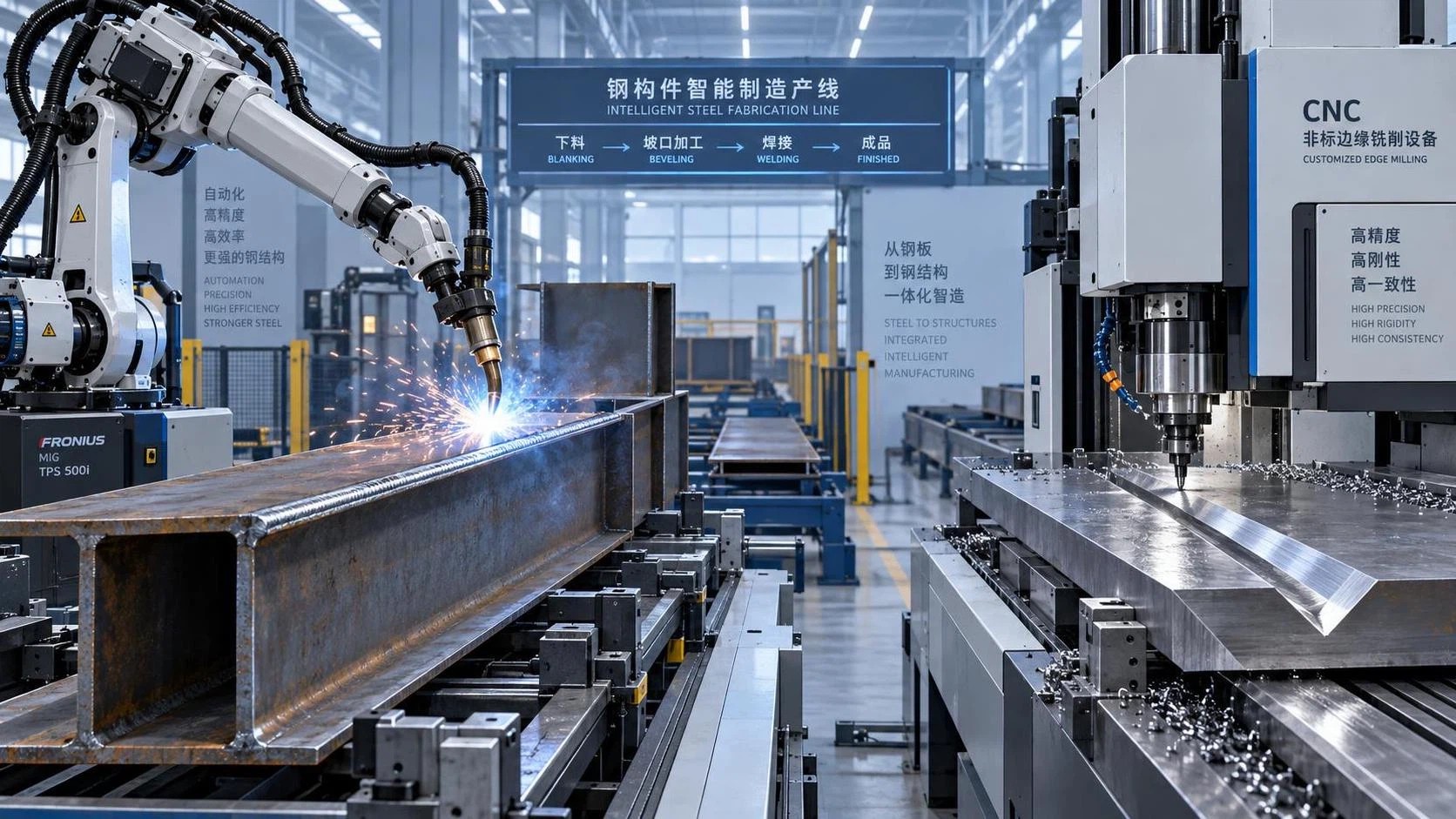
Which welding robot for metal fabrication offers the shortest ROI when replacing dual-station MIG lines?
If you’re running a dual-station MIG line in structural steel, pressure vessel, or heavy equipment fabrication—and you’ve started calculating payback on automation—you’re not asking whether to automate. You’re asking: which robot delivers cash back fastest, without derailing throughput or quality? That’s a procurement question rooted in real production economics—not theoretical specs.
The short answer: there is no universal “fastest-ROI” welding robot. But there is a narrow, high-leverage configuration that consistently cuts payback to 12–18 months in shops upgrading from manual or semi-automated dual-MIG stations—provided three conditions hold: (1) part geometry permits consistent torch access, (2) joint preparation meets tight bevel consistency thresholds, and (3) upstream edge-milling isn’t bottlenecking cycle time. Miss any one, and even the most advanced robot stalls ROI at 24+ months.
Why dual-station MIG lines are ripe—but risky—for robot replacement
Dual-station MIG setups deliver decent flexibility for medium-batch, multi-part work. But their hidden cost isn’t labor—it’s variability. Operators adjust wire feed, voltage, travel speed, and torch angle per pass, per joint, per shift. That variability compounds in post-weld rework: 12–18% of welds require grinding, spatter removal, or correction in typical fabrication shops running these lines. And every minute spent correcting welds is a minute lost on value-added output.
Automation eliminates that variability—but only if the input is predictable. A robot won’t compensate for inconsistent bevel angles, mismatched plate thicknesses, or poor fit-up. In fact, it amplifies those inconsistencies. So ROI starts before the robot arm powers up: it starts with how cleanly and repeatably your edges are prepared.
The ROI bottleneck most buyers overlook: edge prep, not welding speed
Welding robots are often sold on arc-on time reduction—“50% faster than manual!”—but arc-on time rarely exceeds 35% of total cycle time in dual-station MIG workflows. The rest is loading, positioning, tack welding, cleaning, and inspection. Where the real drag lives is in edge preparation.
Traditional flame-cut or planed edges introduce taper, oxidation, and inconsistent bevel geometry. That forces robots to either slow down (reducing throughput), add complex seam tracking (increasing programming time and maintenance), or accept higher rework rates. All three erode ROI.
This is where high-precision edge milling shifts the equation. Unlike planers or plasma-cut bevels, modern CNC edge mills deliver repeatable, clean, oxide-free bevels—Ra3.2–12.5 surface finish, ±0.5° angular tolerance, and full-length consistency across plates up to 18,000 mm long. When paired with a welding robot, that means less seam tracking overhead, fewer stops for manual touch-up, and immediate gains in first-pass yield.
For example, a shipyard in Guangdong replaced its dual-MIG line with a six-axis welding robot—and saw ROI stretch to 30 months until they retrofitted upstream edge prep with a Non-standard Edge Milling Machine Without Pressure Beam. Within three months, weld rework dropped from 16% to 3.2%, and average cycle time per structural assembly fell by 22%. Payback compressed to 14 months.
What “shortest ROI” actually means in practice
Shortest ROI isn’t about lowest robot price. It’s about minimizing the sum of: (1) capital outlay, (2) integration downtime, (3) operator retraining time, and (4) ongoing process instability costs (rework, scrap, unplanned stops). A $120k robot with plug-and-play teach pendant and pre-loaded MIG parameter sets for carbon steel, stainless, and aluminum may outperform a $95k unit requiring custom PLC interfacing and daily calibration—if it gets operators productive in two days instead of three weeks.
Based on deployments across Europe, Southeast Asia, and North America since 2018, the highest-ROI configurations share three traits:
- Modular mounting: Robots designed for direct bolt-on to existing MIG station frames—no new foundations or floor reinforcement—cut installation from 3 weeks to 5 days.
- Integrated seam tracking with adaptive voltage control: Not just laser vision, but closed-loop adjustment of wire feed and voltage based on real-time gap detection. Critical for handling minor fit-up variation without sacrificing speed.
- Pre-certified CE/ISO9001 compliance: Not just “meets standards,” but documentation traceable to third-party test reports—avoiding 4–6 weeks of factory audits or delayed commissioning.
These aren’t marketing checkboxes. They’re hard constraints affecting calendar time to first profitable weld.
When “shortest ROI” doesn’t apply—and what to do instead
Shortest ROI assumes stable part families: repeated weld joints on similar geometries (e.g., H-beam flange-to-web, boiler drum circumferentials, or structural column splices). If your dual-station line handles high-mix, low-volume work—say, 50+ unique part numbers per week—robot ROI extends dramatically. Programming time alone can exceed 8 hours per new joint. In those cases, ROI accelerates only after adding offline programming software and standardized joint templates—pushing breakeven past 24 months unless volume scales.
Also, don’t assume robotic welding eliminates skilled labor. It shifts skill requirements: from torch manipulation to path validation, parameter tuning, and preventive maintenance. Shops that skip cross-training see 30% higher unplanned downtime in Year 1—even with top-tier hardware.
Next steps: build your ROI filter, not your spec sheet
Before requesting quotes, run this three-point filter:
- Map your top 5 recurring weld joints: List actual part numbers, material thicknesses, bevel types (V, U, K), and current cycle time per joint—including load/unload, tack, weld, and cleanup.
- Measure edge prep consistency: Take 10 random plates from last month’s production. Measure bevel angle at 3 points per plate. If standard deviation >±1.5°, prioritize edge-milling upgrade before robot selection.
- Calculate true labor cost per weld hour: Include not just wage, but burden (payroll tax, benefits, training), overtime premiums, and estimated rework labor. Most shops underestimate this by 40–60%.
If your data shows >10% rework rate, >2° bevel inconsistency, or true labor cost >$65/hour, then ROI compression is achievable—and likely within 12–18 months. If not, invest first in upstream precision, not downstream automation.
Because the shortest ROI isn’t found in the robot catalog. It’s found where edge prep meets weld execution—and where procurement decisions start with measured reality, not brochure claims.
search
Products Navigation
Send Us A Message