




Are welding robot for pressure vessels compatible with ASME Section VIII Div. 1 weld procedure specifications?
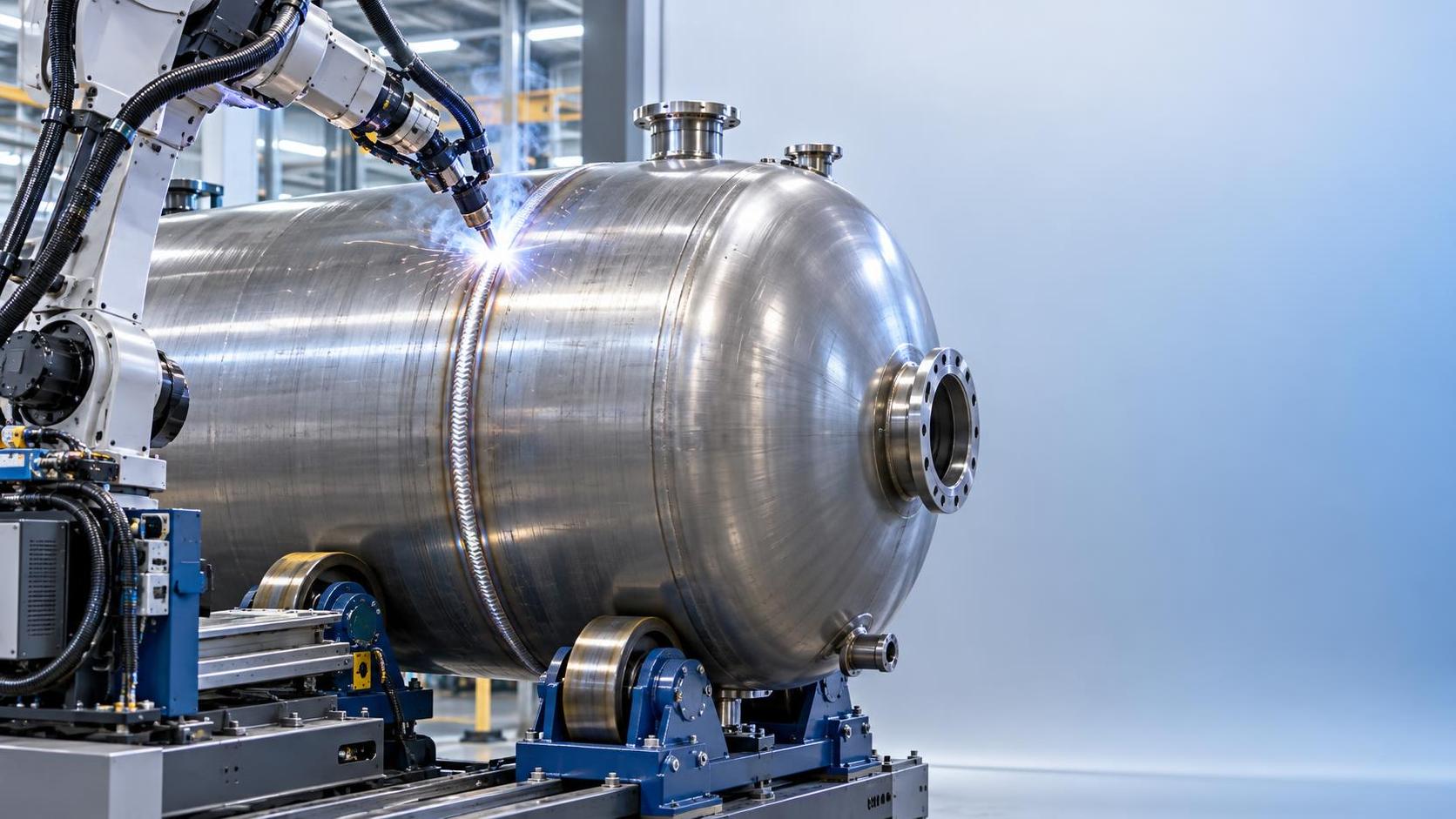
Yes—But Not Automatically
A welding robot for pressure vessels isn’t “ASME Section VIII Div. 1–compliant” by default. Compatibility isn’t baked into the hardware—it’s built, validated, and documented. For technical evaluators reviewing robotic solutions, the question isn’t whether a system *can* weld pressure vessel joints—it’s whether its entire operational framework aligns with the procedural rigor demanded by ASME BPVC. That means qualification of procedures, personnel, equipment, and traceability—not just weld appearance or speed.
Where Code Compliance Begins—and Ends
ASME Section VIII Div. 1 doesn’t regulate robots. It regulates *welding procedures*, welder performance, and production control. So compatibility hinges on how well a robotic system integrates into that regulatory ecosystem. Key touchpoints include:
- Weld Procedure Specification (WPS) qualification: The robot must operate within prequalified or qualified WPS boundaries—including voltage, amperage, travel speed, shielding gas composition, and interpass temperature. Deviations require requalification—even if the robot is more precise than manual welding.
- Welder Performance Qualification (WPQ): Though robots don’t hold certifications, the operator programming and supervising the system must be qualified under ASME QW-300 series. Their scope covers parameter setting, joint preparation verification, and post-weld inspection oversight.
- Equipment validation: The robot’s repeatability, arc stability, and torch positioning accuracy must be verified against the WPS parameters—not just once, but as part of routine maintenance and after any mechanical or software update.
- Traceability: Every weld pass must be linkable to its WPS, WPQ, material lot, heat treatment record, and NDE result. This isn’t optional logging—it’s required documentation for third-party inspectors and Authorized Inspectors (AIs).
How Wuxi Samgins Aligns—Without Overpromising
Based in Wuxi—30 minutes from Shanghai by high-speed rail—Wuxi Samgins International Trade Co., Ltd. has supported fabrication shops across Southeast Asia, Europe, and the Americas since 2012. Our approach to ASME compliance reflects field experience, not just certification badges. We design and validate our welding robots for pressure vessels with ISO 9001–certified process controls and CE-compliant safety architecture—but we treat those as foundations, not finish lines.
For example, our systems support parameter locking and real-time monitoring, enabling operators to enforce WPS limits at the machine level. We supply full documentation packages—including procedure qualification records (PQRs), weld maps, and calibration logs—structured to match ASME BPVC Annex B requirements. But we also advise clients early: final acceptance depends on their specific WPS scope, material grade (e.g., SA-516 Gr. 70 vs. SA-387 Gr. 22), and jurisdictional interpretation—especially where local AIs require additional witness testing or data retention protocols.
When Structural Fabrication Demands More Than Welding Alone
Pressure vessel work often overlaps with structural steel fabrication—especially in skid-mounted units, modular reactors, or integrated piping supports. That’s where integration capability matters. A robot designed solely for circumferential seam welding may lack the flexibility needed for complex H-beam assemblies used in vessel support frames or containment structures.
Our 3 in 1 H beam welding machine exemplifies this cross-domain thinking. Built for Q235 and other structural steels, it merges assembly, dual-sided龙门 welding, and thermal correction into one synchronized unit. Its independent welding gun mounts allow fine-tuned angle and height adjustment—critical when matching groove geometry to ASME-approved joint designs. And because it operates with VFD-controlled speeds (200–1200 mm/min) and closed-loop slag recycling, weld consistency stays within tight thermal input windows—reducing distortion risk without sacrificing throughput.
What Technical Evaluators Should Verify—Before Committing
Don’t assume compliance from a spec sheet. Ask for evidence—not claims:
- Can the robot execute your exact WPS—including preheat maintenance, interpass cooling, and post-weld heat treatment (PWHT) coordination—or does it require external controllers?
- Does the manufacturer provide WPS templates validated for common pressure vessel materials (e.g., SA-516, SA-387, SA-240), or do you need to qualify everything in-house?
- How are weld parameter deviations flagged? Is there real-time override prevention, or just an alert log?
- What’s included in the documentation package? Are PQRs, weld maps, and equipment calibration records delivered in ASME-compatible formats—or left to the fabricator to generate?
Also consider scalability. A robot validated for 12 mm thick SA-516 may not cover 40 mm SA-387 without additional procedure testing—even with identical power sources and wire feeders. Wuxi Samgins works with clients to map coverage gaps early, using actual project parameters—not generic ranges.
Final Note: Standards Don’t Change—But Application Does
ASME Section VIII Div. 1 hasn’t changed its core WPS requirements in decades. What’s evolved is how fabricators apply them—especially with automation. Today’s challenge isn’t meeting the code; it’s ensuring every layer of your robotic workflow—from offline programming to post-weld NDE reporting—holds up under audit scrutiny.
If you’re evaluating a welding robot for pressure vessels, start with your current WPS library, your AI’s expectations, and your internal QA/QC capacity—not the robot’s brochure. Then assess how cleanly a supplier bridges that gap. Wuxi Samgins’ strength lies in that bridge: ISO 9001 processes, CE-compliant hardware, and field-tested integration—not just theoretical alignment.
search
Products Navigation
Send Us A Message